What These Terms Actually Mean
When you look at an internet plan or run a speed test, you're handed a handful of numbers — Mbps, ping, upload, download. Most providers throw these out without explaining what they measure or why each one matters differently depending on how you use the internet.
| Unit for bandwidth | Mbps (megabits per second) or Gbps |
| Unit for latency | Milliseconds (ms) |
| Good latency for gaming | Under 50ms |
| Typical plan asymmetry | Download far exceeds upload on most home plans |
| Minimum for HD streaming | ~25 Mbps download (FCC broadband definition guidance) |
| What speed tests measure | Throughput (actual) + latency (ping) |
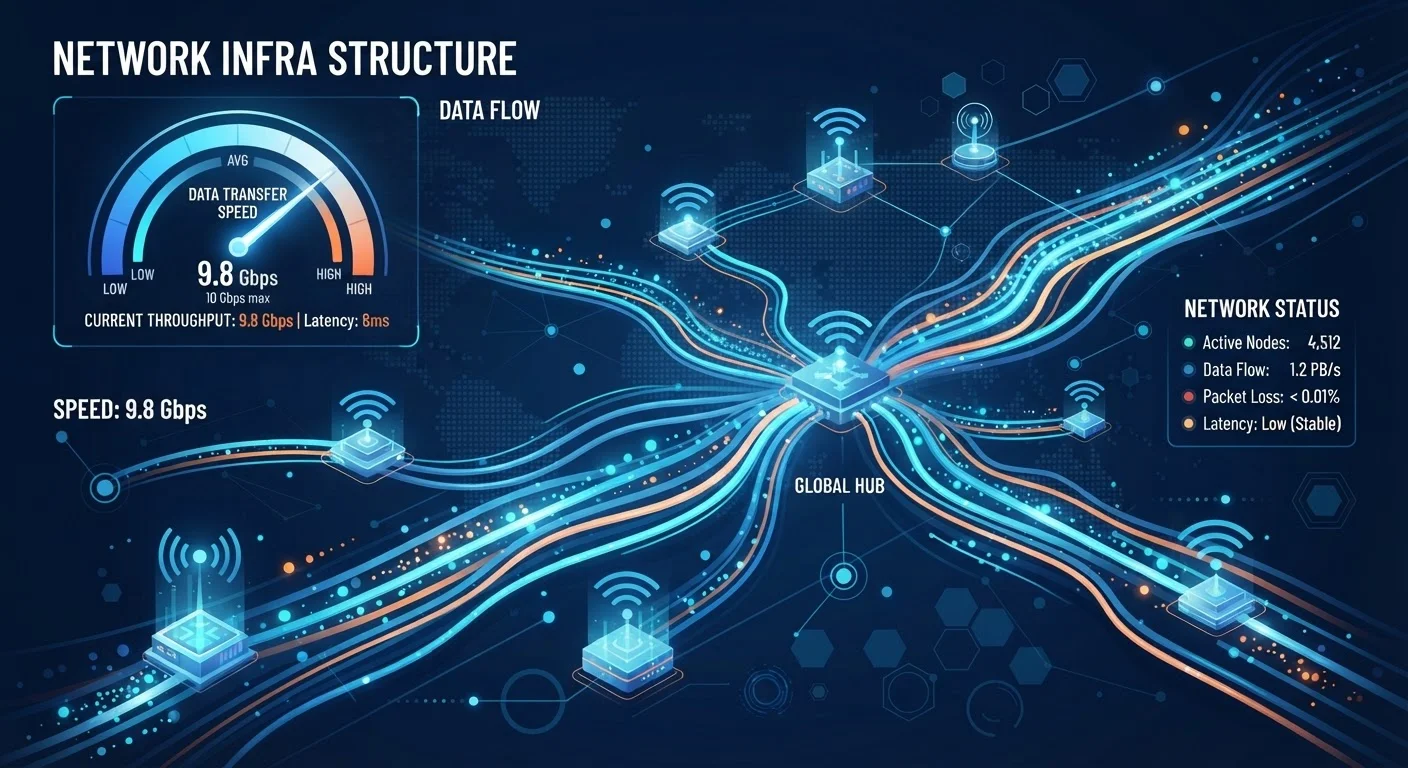
Think of your internet connection like a highway. Bandwidth is how many lanes the highway has — more lanes means more cars (data) can travel at once. Speed, more accurately called throughput, is how fast those cars actually move under real-world conditions. And latency is the delay between a car entering the highway and reaching its destination — even on a wide, fast highway, a long distance still takes time.
These three concepts are related but measure completely different things. A connection can have high bandwidth and still feel sluggish if latency is high. Understanding which metric causes which problem helps you diagnose what's actually going wrong — and what isn't worth worrying about. For a broader look at how your whole home setup fits together, see Your Home Network in Plain English.
Bandwidth and Download vs. Upload
Bandwidth is measured in Mbps (megabits per second) or Gbps (gigabits per second). It describes the maximum capacity of your connection — not a guaranteed speed, but a ceiling. Your plan's advertised number is almost always a bandwidth figure.
That bandwidth is split into two directions:
- Download — data coming to your device. Streaming video, loading web pages, and receiving emails all use download bandwidth.
- Upload — data going from your device. Video calls, sending large files, and live streaming all rely on upload bandwidth.
Most home internet plans are asymmetric, meaning download bandwidth is much higher than upload. A plan advertised as "200 Mbps" commonly delivers around 10–20 Mbps upload. This matters if you frequently video-call or work from home. If you notice choppy outgoing audio on calls, upload bandwidth is often the culprit — not download.
Advertised Speed vs. Real-World Speed
The Mbps number on your internet plan is a bandwidth ceiling, not a guarantee. Actual speeds depend on network congestion, your router's age and placement, the number of devices connected, and the wiring inside your home. Running a speed test at different times of day gives you a more realistic picture of what your connection actually delivers.
For context on how data actually travels between your device and the wider internet, What Actually Happens When You Type a Web Address Into Your Browser walks through the full journey in plain language.
Latency: The Metric That Matters Most for Real-Time Use
Latency is the time it takes for a small packet of data to travel from your device to a server and back. It's measured in milliseconds (ms) and commonly called ping on speed test tools.
<20ms
Ping range considered excellent for gaming
Generally accepted benchmark among network performance guides for real-time online gaming responsiveness.
600ms+
Typical latency on satellite internet connections
Traditional geostationary satellite internet introduces significant round-trip delays due to the distance data must travel to orbit and back.
Low latency matters enormously for anything interactive:
- Online gaming — a 20ms ping feels instant; 150ms feels sluggish and can cause missed inputs.
- Video calls — high latency creates the awkward "talking over each other" effect, because audio takes too long to arrive.
- Web browsing — even a fast connection with high latency loads pages slowly, because each file request must wait for a round-trip before the next one begins.
Latency is largely determined by physical distance to the server, the type of connection (fiber typically has lower latency than cable, which is lower than satellite), and how congested the network is at any given moment. You can check your current latency using any reputable speed test tool — look for the "ping" or "latency" reading alongside your Mbps numbers.
Curious how Wi-Fi and mobile data compare on latency? Wi-Fi vs. Mobile Data: Understanding the Differences Beyond Price covers that directly. And to learn what quietly degrades these numbers over time, see Things That Silently Slow Down Your Internet Connection.
Which Number Should You Care About?
The honest answer: it depends on what you do online.
| Activity | Most Important Metric |
|---|---|
| Streaming HD video | Download bandwidth (25+ Mbps recommended) |
| Video calls | Upload bandwidth + low latency |
| Online gaming | Latency (aim for under 50ms) |
| Large file downloads | Download bandwidth |
| General browsing | Latency matters more than raw speed |
Many people pay for higher bandwidth plans when their real problem is high latency — an issue that more Mbps won't fix. If pages feel slow to start loading but then load quickly, latency is usually the cause. If videos buffer mid-stream, download bandwidth is the likely constraint.
For a glossary of the broader vocabulary around internet connections, Key Internet Terms Every Beginner Should Know is a useful reference. You can also learn how your device is identified on the network in IP Addresses, Explained Without the Jargon.
Bandwidth
The maximum capacity of your internet connection, measured in Mbps or Gbps. It represents how much data can travel through the connection at once — like the number of lanes on a highway.
Latency (Ping)
The time, measured in milliseconds, for data to travel from your device to a server and back. Lower latency means a more responsive connection, which is critical for gaming and video calls.
Download Speed
The rate at which data arrives at your device from the internet. Streaming, browsing, and receiving files all consume download bandwidth.
Upload Speed
The rate at which data leaves your device and travels to the internet. Video calls, live streaming, and sending large files depend on upload speed.
Mbps
Megabits per second — the standard unit for measuring internet connection speed and bandwidth. One megabit equals one million bits of data.
Throughput
The actual amount of data successfully transferred per second under real conditions, as opposed to the theoretical maximum bandwidth. It's what a speed test actually measures.