Why Bother with a Budget?
A budget is not a punishment. It is a straightforward plan that tells your money where to go instead of wondering where it went. Without one, most people have only a rough sense of whether they are spending more than they earn — and that uncertainty is stressful.
Making a budget for the first time gives you two things: a clear picture of your current finances and a framework for making decisions going forward. You do not need to overhaul your lifestyle on day one. The goal is simply to see the full picture. If you want a broader foundation before diving in, our complete personal budgeting resource covers everything from first steps to long-term habits.
Net income
The money you actually receive after taxes and other deductions have been taken out of your paycheck. This is the number you use when building a budget.
Fixed expense
A cost that stays the same every month, like rent or a loan payment. You can count on it being the same amount each time.
Variable expense
A cost that changes from month to month, like groceries or dining out. These are usually the easiest to adjust when you need to cut back.
Budget surplus
When your income is higher than your total spending, leaving money left over. A surplus should be directed to a specific goal like savings.
Budget shortfall
When your total spending is higher than your income. A shortfall means you need to reduce expenses, increase income, or both.
Discretionary spending
Money spent on wants rather than needs — things like entertainment, eating out, or hobbies. These are typically the first place to look when trimming a budget.
Step 1 — Know Your Take-Home Income
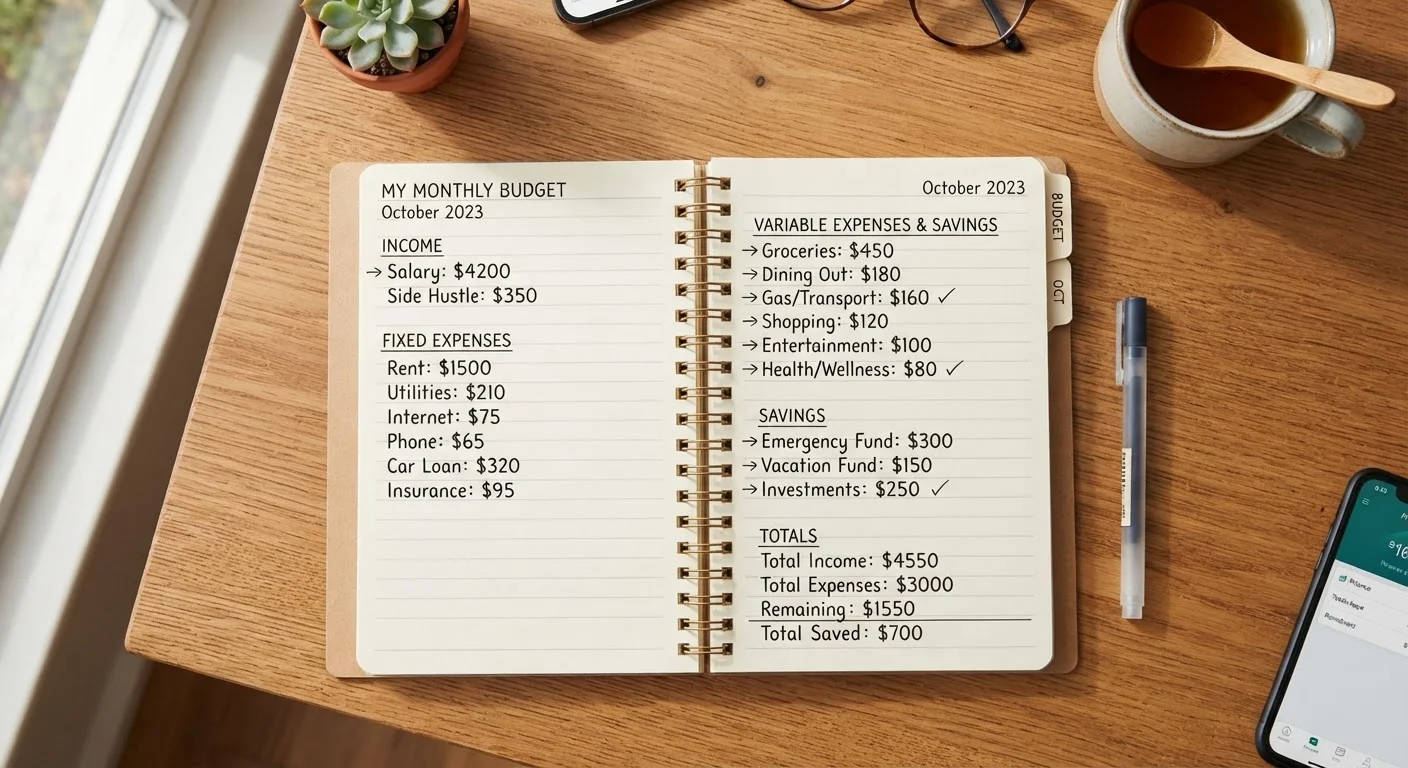
Before you can plan your spending, you need to know exactly how much money comes in each month. Use your net income — the amount deposited in your bank after taxes, health insurance premiums, and any other deductions have been removed. Your gross salary (the number on your offer letter) is higher, but you cannot spend money that never reaches your account.
If your income varies month to month — for example, if you are freelance or work hourly — use a conservative estimate, such as your lowest recent month. It is safer to plan with a little less and end up with a surplus than to plan with a little more and come up short.
Add up every source: your main job, any side income, regular government benefits, or consistent support payments. Write that total down. That single number is the ceiling your entire budget must stay under.
Use last month's pay stub, not estimates
The most accurate starting point is your actual recent pay stub or bank deposit records. Estimating from memory often leads people to overstate their income slightly, which can throw off the entire budget. A few minutes looking at real numbers saves a lot of reworking later.
Step 2 — List Every Expense
Now list everything you spend money on in a typical month. It helps to split expenses into two categories:
- Fixed expenses — costs that are the same every month, such as rent, a car payment, or a subscription you pay annually divided by 12.
- Variable expenses — costs that change, such as groceries, gas, dining out, clothing, or entertainment.
Pull up two or three months of bank and credit card statements to catch expenses you might forget — streaming services, annual fees, quarterly insurance premiums. Irregular costs are easy to overlook but they still count. Divide annual bills by 12 so they show up as a monthly line item rather than a surprise.
Do not judge what you find. This step is about accuracy, not guilt. If you want clear definitions for any terms you encounter along the way, the budgeting glossary for beginners is a quick reference worth bookmarking.
Step 3 — Set Spending Limits and Balance the Budget
Subtract your total expenses from your total income. There are three possible outcomes:
- Income exceeds expenses — you have a surplus. Decide intentionally where that extra goes: an emergency fund, savings, or paying down debt.
- They are equal — every dollar is already assigned. That is fine as long as savings is one of the line items.
- Expenses exceed income — you have a shortfall. Look first at variable expenses, since those are the easiest to reduce. Fixed costs take longer to change but are worth reviewing over time.
A useful rule of thumb when setting limits is the 50/30/20 approach: roughly 50% of take-home pay toward needs, 30% toward wants, and 20% toward savings and debt repayment. It is not a law — it is a starting point. Our comparison of zero-based budgeting and the 50/30/20 rule walks through how these two popular frameworks differ if you want to explore further.
Don't forget irregular and annual expenses
One of the most common first-budget mistakes is only accounting for monthly bills and forgetting costs that hit once or twice a year — car registration, annual insurance premiums, holiday gifts, or back-to-school spending. Divide these by 12 and add them as monthly line items so they don't blow up your budget when they arrive.
Step 4 — Track, Review, and Adjust
Writing a budget is step one. The habit that makes it work is checking in throughout the month to see whether your actual spending matches your plan. This does not need to be daily — even a weekly ten-minute check is enough for most beginners.
At the end of the month, do a simple review: compare what you planned to what you actually spent in each category. Some categories will be over, some under. That information tells you whether your limits were realistic or whether your behavior needs to shift. For a structured end-of-month process, the monthly budget review checklist walks you through every step.
Adjust next month's budget based on what you learned. A budget that gets refined over a few months is far more useful than a perfect-looking plan that sits in a drawer.
What Comes Next
Once you have a working budget and a review habit, you are ready to go deeper. Two natural next steps are understanding different budgeting methods — some people prefer a more structured approach than others — and beginning to build credit responsibly alongside your savings plan.
For a side-by-side look at the most widely used frameworks, see popular budgeting methods compared. If credit is new to you, understanding credit for the first time is a good companion read. And if you want a more detailed month-by-month walkthrough beyond this introduction, building a monthly budget step by step picks up where this guide leaves off.
This article provides general financial information for educational purposes only and is not personalized financial advice. Consider consulting a qualified financial professional for guidance specific to your situation.