Why Gardeners Think About Plant Neighbors
When you look at a well-planned garden, plants are rarely placed at random. Experienced growers think carefully about which crops sit next to each other — not just for aesthetics, but because plant neighbors genuinely affect each other. Companion planting formalizes that thinking into a practical strategy.
The concept draws on three core ideas: some plants repel or confuse pests, some attract the insects that pollinate crops or hunt harmful bugs, and some improve the growing environment for nearby plants. Understanding which mechanism applies to a given pairing helps you decide whether it's worth trying.
If you're new to gardening, companion planting fits naturally into the broader picture. Our complete introduction to gardening covers the foundational principles that make strategies like this one easier to apply.
3+
Distinct mechanisms behind companion planting benefits
Pest deterrence, beneficial insect attraction, and soil improvement each represent a separate way that plant neighbors can support each other.
~3,000 years
Estimated age of the Three Sisters planting system
The corn-beans-squash combination is one of the oldest documented companion planting strategies, developed by Indigenous agricultural communities in North America.
1 season
Minimum observation period recommended for fair testing
Because garden conditions vary widely, horticultural educators generally recommend tracking a companion planting trial across at least one full growing season before drawing conclusions.
The Three Main Mechanisms
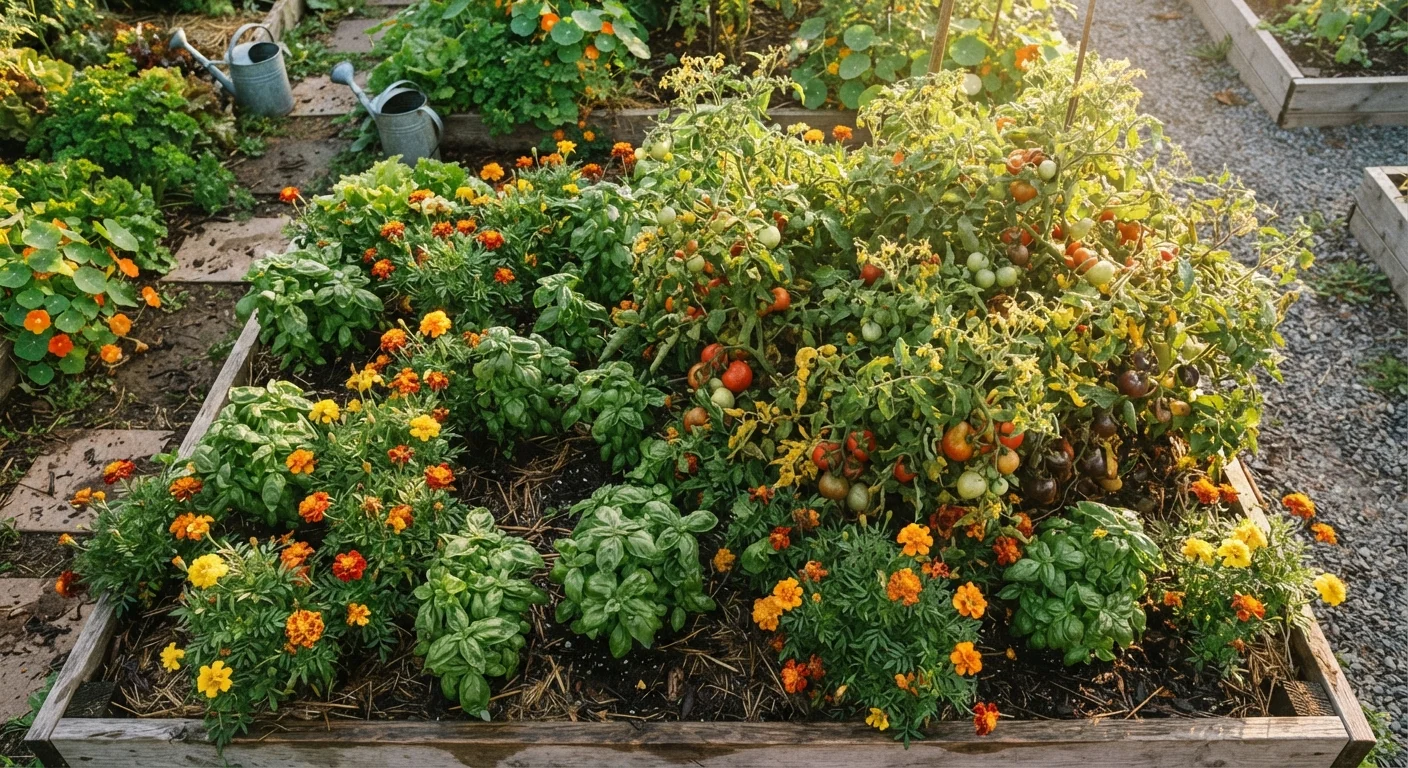
Pest deterrence is the mechanism most people associate with companion planting. Certain plants release compounds — through their roots, foliage, or scent — that repel specific insects or disrupt their ability to locate a host crop. Marigolds (Tagetes species) are a well-studied example: they produce a substance called alpha-terthienyl in their roots that suppresses soil nematodes (microscopic worms that damage roots). Their strong scent is also thought to confuse insects searching for target crops.
Beneficial insect attraction works differently. Flowering companion plants — herbs like dill, fennel (grown carefully away from other vegetables), and cilantro allowed to bolt — draw in parasitic wasps and predatory insects that feed on common garden pests. Planting these near pest-prone crops can build a natural buffer over time.
Soil and structural benefits form the third category. Legumes (beans, peas, clover) host bacteria in their roots that fix atmospheric nitrogen into a form other plants can use. Growing a legume beside a nitrogen-hungry crop like corn is the oldest documented application of this principle. Height variation also matters: tall plants can shade low-growing crops that prefer cooler conditions, reducing water stress.
Start With One Proven Pairing
Rather than redesigning your whole garden around companion planting, pick one well-documented combination — such as marigolds alongside vegetables — and observe the results over a full season. This gives you real data from your own conditions before scaling up. Keep a simple notebook with planting dates, pest observations, and harvest notes.
Classic Pairings and What the Evidence Says
The most famous companion planting combination is the Three Sisters — corn, beans, and squash — developed by Indigenous agricultural communities across North America. Corn provides a climbing structure for beans, beans fix nitrogen for corn, and squash spreads across the ground to shade out weeds and retain moisture. This is a well-documented, multi-function pairing that holds up under scrutiny.
Tomatoes and basil is another popular combination. The evidence here is more mixed: some studies suggest basil may reduce certain aphid populations near tomatoes, while others find no significant effect. Many gardeners report positive results, and since basil and tomatoes share the same growing conditions (warmth, sun, well-drained soil), they're practical neighbors regardless.
Marigolds and most vegetables is one of the better-supported general-purpose pairings. French marigolds in particular have shown measurable nematode suppression in research settings. They also attract pollinators, making them a useful all-around addition to a vegetable bed.
For a closer look at which crops work well for new growers, see our guide to easy crops that reward first-time growers.
“Companion planting is best understood not as a magic formula but as a framework for observation. The gardener who pays attention to what grows well together — and what doesn't — will learn more from one season than from any book.”
— Extension Horticulture Specialists, University cooperative extension programs across the U.S.
Pairings to Avoid and How to Experiment Safely
Not every plant combination is neutral. Some species produce allelopathic chemicals — compounds that inhibit neighboring plants' germination or growth. Fennel is the most widely cited example and is generally best grown in its own container or a separate bed away from vegetables.
Onions and garlic planted too close to beans or peas can reduce their yields. Brassicas (cabbage, broccoli, kale) and tomatoes are often listed as poor companions, though the evidence is largely observational.
The safest way for beginners to approach companion planting is to start with one well-documented pairing in a small section of your garden, keep notes on what you observe, and compare results over a full growing season. Gardening under real conditions involves many variables — soil, climate, local pest populations — that no general guide can fully anticipate.
If you're working with limited space, companion planting can be especially useful. Our article on raising healthy plants in a small outdoor space pairs well with this approach. And if pests are already a concern in your garden, understanding what's eating your plants is a helpful next step.
Companion Planting Is One Tool, Not a System
Companion planting works best alongside other good gardening practices: healthy soil, appropriate watering, and regular monitoring. It is not a substitute for addressing underlying soil problems or managing a serious pest infestation. Think of it as a supportive layer within a broader garden plan, not a standalone solution.