What Fats and Oils Actually Are
Every recipe that asks you to heat a pan or grease a baking dish is asking you to work with fat. At its most basic, a cooking fat is a substance made primarily of lipids — molecules that don't dissolve in water and that carry heat evenly around food. The word "fat" covers both solid forms (butter, lard, coconut oil) and liquids (olive oil, canola oil, vegetable oil). The difference is mostly a matter of temperature and molecular structure.
Fats play three core roles in cooking: they transfer heat to food, they prevent sticking, and they carry flavor. Without fat, a sauté pan runs hot and dry, bread dough turns leathery, and sauces lack the richness that makes them satisfying. Understanding what each fat does — rather than just which to pour — makes you a more confident cook. For a broader look at foundational kitchen skills, visit the Cooking Basics hub.
Smoke point
The temperature at which a fat or oil begins to visibly smoke and chemically break down. Exceeding it makes food taste bitter and can create unwanted compounds.
Saturated fat
A type of fat that is solid at room temperature, commonly found in butter, lard, and coconut oil. The molecular structure has no double bonds between carbon atoms.
Unsaturated fat
A fat that is liquid at room temperature, like most vegetable and nut oils. It contains one or more double bonds in its molecular structure, making it more chemically reactive to heat and oxygen.
Refined oil
An oil that has been processed to remove impurities, color, and flavor. Refining raises the smoke point and creates a neutral taste, making the oil more versatile for high-heat cooking.
Rancidity
The process by which fats degrade through exposure to oxygen, light, or heat, resulting in an unpleasant stale or musty smell and flavor.
Extra-virgin olive oil (EVOO)
The highest-quality grade of olive oil, produced by cold-pressing olives without heat or chemicals. It retains natural flavor and aroma but has a relatively moderate smoke point.
The Key Concept: Smoke Point
Before you choose a fat, you need to know one critical number: its smoke point. This is the temperature at which a fat stops shimmering and starts to visibly smoke. At that point, the fat begins to break down chemically, producing bitter-tasting compounds and losing its usefulness as a cooking medium.
Think of the smoke point like a speed limit. Stay below it, and the fat does its job well. Exceed it, and you get burnt flavors, a ruined dish, and a smoking kitchen. High-heat techniques — like searing a steak or sautéing versus pan-frying — demand fats that can handle temperatures of 375°F (190°C) or higher. Gentle tasks like scrambling eggs or building a pan sauce work fine with fats that have lower smoke points.
Never Leave a Smoking Pan Unattended
If your fat reaches the smoke point, remove the pan from the heat immediately. Continuing to heat smoking oil is a fire risk. Allow the pan to cool before adding fresh fat and starting again — it takes only a minute and is always worth doing safely.
Common Fats and When to Use Them
Here is a plain-language breakdown of the fats you'll encounter most often:
- Butter
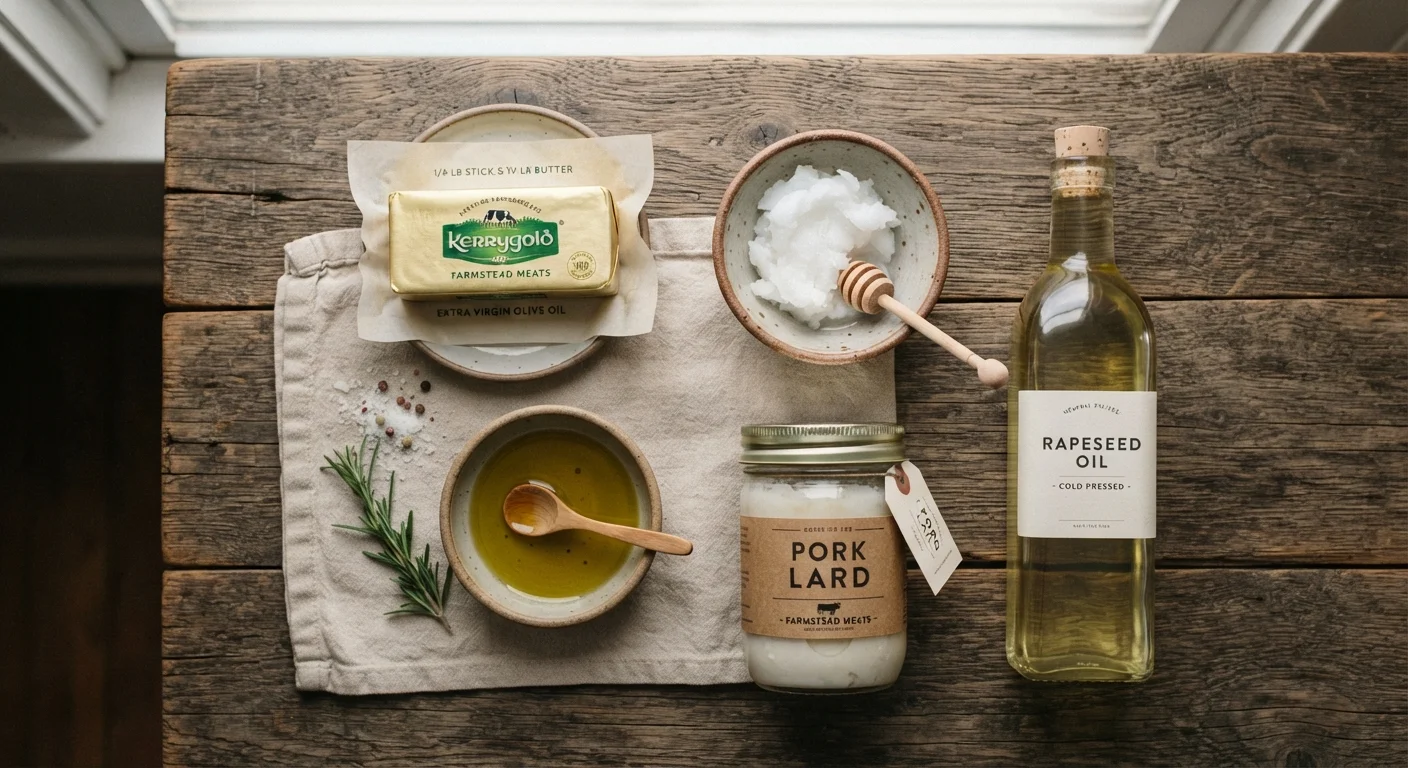
- Made from churned cream, butter is about 80% fat with the rest being water and milk solids. Its smoke point sits around 300–350°F (150–175°C), so it burns quickly on high heat. It shines in baking and for finishing sauces at low heat. For baking specifics, see why recipes call for unsalted butter.
- Extra-Virgin Olive Oil (EVOO)
- Cold-pressed from olives, EVOO has a smoke point of roughly 375°F (190°C) and a distinct fruity, peppery flavor. It's excellent for salad dressings, drizzling over finished dishes, and low-to-medium heat cooking. Using it for deep frying wastes its flavor and cost.
- Neutral Vegetable or Canola Oil
- These refined oils have smoke points above 400°F (205°C) and almost no flavor of their own. They are the workhorses of high-heat cooking — stir-frying, deep-frying, and any time you don't want the fat to compete with the dish's other flavors.
- Lard
- Rendered pork fat with a smoke point around 370°F (188°C). It produces exceptionally flaky pie crusts and is traditional in many cuisines for frying and sautéing. Its flavor is mild and savory.
- Coconut Oil
- A solid plant-based fat with a moderate smoke point and a light coconut flavor. It works well for medium-heat cooking and in recipes where that flavor is welcome, such as certain baked goods or curries.
Start With Two Fats
If you're just building your kitchen pantry, start with one neutral oil (canola or vegetable) and one butter. These two cover the vast majority of everyday cooking tasks. Add olive oil once you're cooking more regularly and want to experiment with flavor.
Flavor Matters Too
Smoke point is not the only factor to weigh. Every fat brings its own flavor personality to a dish. Butter adds richness and a dairy sweetness. EVOO contributes grassy, fruity notes that stand out in a simple pasta. Lard brings a faint savory depth. Neutral oils contribute nothing — which is exactly what you want when the star of the dish is a spice rub, not the cooking fat.
A useful rule: when you want the fat's flavor to contribute, choose butter or EVOO. When you want the fat to stay in the background, reach for canola or vegetable oil. As you practice tasting as you cook, you'll start to detect the difference these fats make to a finished dish.
Cooking Basics Hub
A collected resource of foundational cooking techniques for beginners, covering everything from knife skills to heat management — a natural next stop after understanding your ingredients.
Recipe Reading Guide
Decoding recipe language helps you use fats correctly from the first step. This guide explains common terms and measurements so nothing gets lost in translation.
Storing Fats Correctly
Fat goes rancid when it is exposed to heat, light, or oxygen over time. Rancid fat smells stale and musty and will ruin whatever you cook with it. Follow these basics to keep your fats fresh:
- Butter: Refrigerate and use within a few weeks, or freeze for longer storage. Keep it covered, as butter absorbs nearby odors easily.
- Olive oil: Store in a dark, cool cupboard — not next to the stove. A dark glass or tin container is ideal. Use within 12–18 months of pressing.
- Neutral oils: Cool, dark storage is sufficient for most. Once opened, use within six months to a year.
- Lard and coconut oil: Both can be stored at room temperature in a sealed container, away from direct heat and sunlight.
When in doubt, give any fat a quick smell before using it. Fresh fat smells clean or mildly characteristic of its source. If it smells off, discard it. Starting with fresh, correctly stored fat is one of the simplest ways to improve your cooking immediately. For more beginner-friendly guidance, reading a recipe without getting confused can help you decode what the instructions are actually asking.