Why These Two Methods Get Mixed Up
Both sautéing and pan-frying happen on the stovetop, in a skillet or frying pan, with some amount of fat. That shared setting is exactly why recipes — and cooks — confuse them. But the similarities stop there. Each method operates on a different logic, produces a different result, and suits a different type of ingredient.
If you've ever followed a recipe and ended up with food that was oddly greasy, stubbornly pale, or half-raw in the middle, there's a good chance the technique was misread. Understanding the distinction gives you a reliable framework for every stovetop recipe going forward. For a broader look at how all cooking methods are categorized, see dry heat vs. moist heat — both sautéing and pan-frying belong to the dry-heat family.
What Sautéing Actually Is
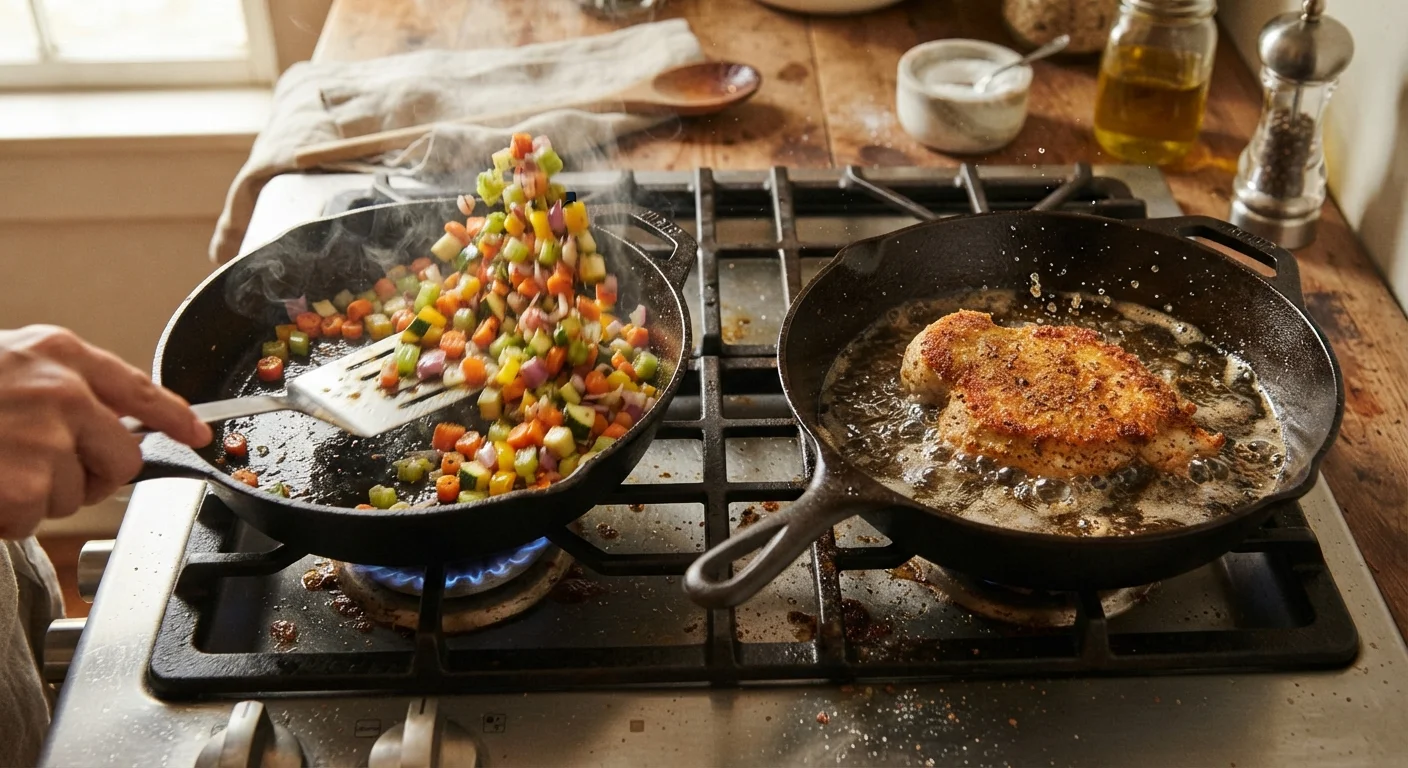
The word sauté comes from the French verb meaning "to jump" — and that tells you almost everything. Sautéing means cooking small, uniform pieces of food in a very small amount of fat over high heat, while moving them frequently. The goal is fast cooking with browning and flavor development, not a thick crust.
Classic examples include sweating onions and garlic as a recipe base, cooking shrimp until just pink, or flash-cooking ribbons of zucchini. Because the pieces are small and the heat is high, the whole process often takes two to five minutes. The pan should be hot before the food goes in — if it isn't, the food steams instead of sautés.
Oil quantity matters too. A tablespoon or less is typical. More than that and you've shifted into different territory. For guidance on which fats work best at high heat, a first-time cook's guide to fats and oils explains smoke points and fat behavior clearly.
| Criterion | Sautéing | Pan-Frying |
|---|---|---|
| Heat level | High | Moderate to high |
| Oil quantity | Very little (1 tbsp or less) | More (enough to partially submerge food) |
| Food movement | Frequent tossing or stirring | Minimal — let it sit and crust |
| Ideal food size | Small, thin, or diced pieces | Thick cuts, fillets, or cutlets |
| Cook time | Very fast (2–5 minutes typical) | Longer (5–15 minutes depending on thickness) |
| Result | Browned, tender, quick-cooked | Crispy crust, fully cooked interior |
What Pan-Frying Actually Is
Pan-frying uses more oil — enough to come partway up the side of the food, though not enough to fully submerge it — at a moderate-to-high temperature. The food is placed in the pan and left largely undisturbed so a proper golden crust can form before it's flipped.
Think of a bone-in chicken thigh, a breaded pork cutlet, or a thick salmon fillet. These are too dense to cook through on fierce heat alone. Pan-frying solves this by using the oil as a heat-transfer medium that surrounds more of the food's surface and keeps the cooking temperature stable. The result is a crisp, caramelized exterior and a fully cooked interior — achieved without an oven.
One common beginner mistake with pan-frying is overcrowding the pan, which drops the oil temperature and causes steaming rather than frying. Overcrowding and other stovetop habits that undermine your cooking explains exactly why this happens and how to avoid it.
Pan-Frying Is Not Deep-Frying
Deep-frying fully submerges food in oil at a controlled temperature, requiring a much larger volume of fat and a deeper vessel. Pan-frying only uses enough oil to reach partway up the food's sides, making it far more practical for everyday home cooking. The two techniques produce similar crispness, but their setup and oil requirements are quite different.
How to Read a Recipe and Know Which One It Means
Recipes don't always label the technique clearly. Here are the signals to look for:
- "Sauté the onions" — small pieces, short time, high heat, keep stirring.
- "Pan-fry until golden" — thicker food, more oil, let it sit.
- Ingredient size is your biggest clue. If the recipe calls for diced, minced, or thinly sliced food, it almost certainly means sautéing. Whole fillets, chops, or cutlets point to pan-frying.
- Oil quantity in the ingredient list is a secondary signal. One tablespoon suggests sautéing; several tablespoons or a quarter cup suggests pan-frying.
Pan temperature is the underlying factor both methods hinge on. Heat zones explained walks through how different temperature ranges affect food — essential reading for getting either technique right. And if recipe language in general trips you up, reading a recipe without getting confused is a practical starting point.
2–5 min
Typical sauté time for small vegetables
Small, uniformly cut pieces over high heat cook through quickly — making sautéing one of the fastest flavor-building techniques in the kitchen.
~350°F
Common pan-frying oil temperature
Most pan-frying occurs between 325°F and 375°F — hot enough to crisp the exterior rapidly while allowing the interior time to cook through safely.