Why Most Beginners Only Taste at the End
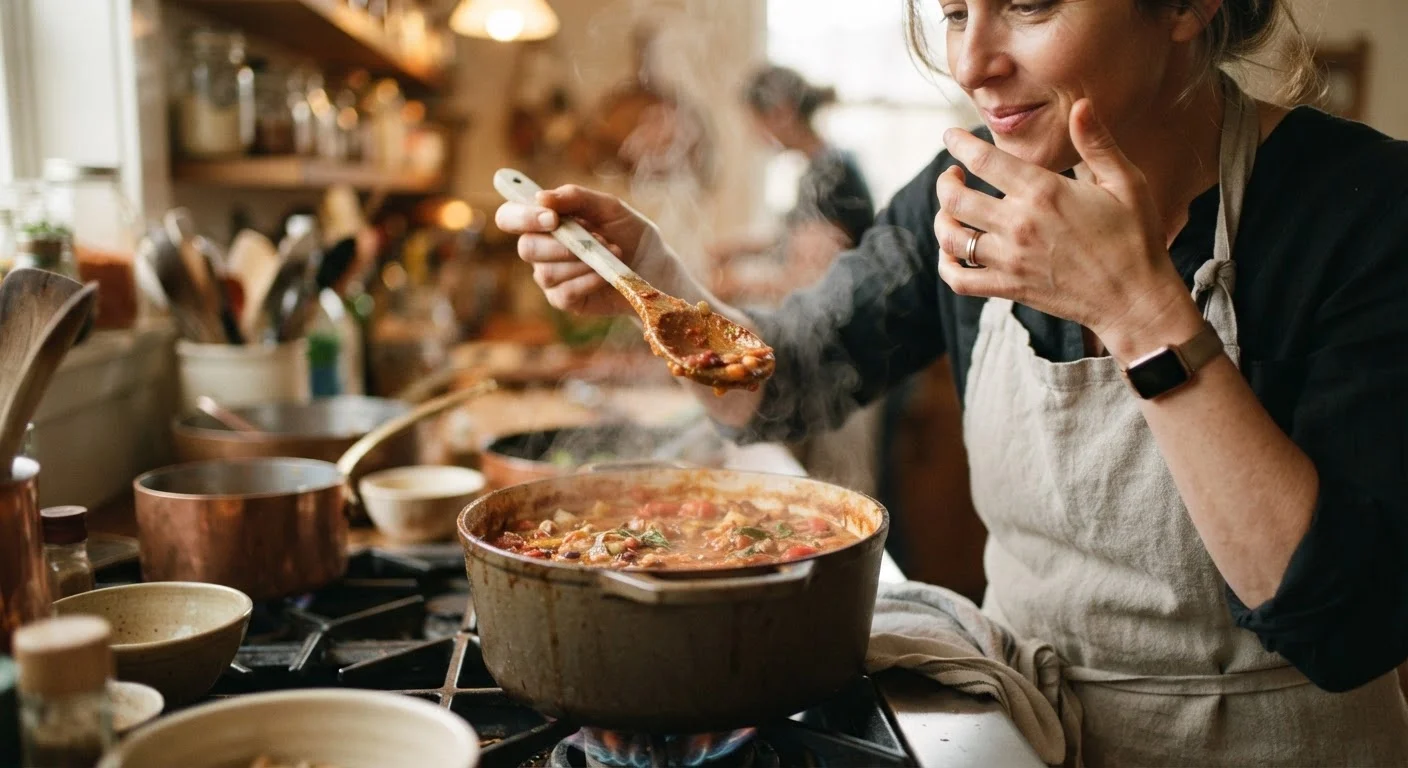
New cooks often treat tasting as a finishing step — something you do right before serving to check whether the dish needs a pinch more salt. It feels logical: the food is almost done, so that's when you judge it. But by that point, many of the decisions that shape a dish's flavour have already been locked in.
Aromatics that were never quite sautéed long enough, a sauce that turned bitter halfway through without anyone noticing, broth that was always a little flat — these problems don't announce themselves at the end. They accumulate quietly across every stage of cooking. The habit of tasting throughout the process is what lets you catch and correct them while you still can.
If you're still learning to work through a recipe systematically, our guide to reading recipes without confusion can help you understand how the steps connect before you start tasting at each one.
Best Practices for Tasting as You Cook
These habits don't require any special equipment — just attention and a clean spoon.
Taste your base ingredients before they meet the heat
Every ingredient brings its own flavour profile — broth can be salty or bland, canned tomatoes can be sweet or acidic, raw onion has a sharpness that cooking will mellow. Knowing where you're starting from lets you adjust your technique and additions before the dish is built on a shaky foundation.
Taste after each major step, not just at the end
Flavour develops and changes throughout cooking — aromatics deepen as they soften, sauces concentrate as liquid evaporates, and spices bloom when they hit fat. Each stage creates a new dish worth evaluating. Catching a problem early — say, a sauce that's reducing too aggressively and turning bitter — gives you time to add liquid, lower heat, or balance with a touch of sweetness.
Use a clean spoon every time you taste
Tasting with the same spoon repeatedly introduces saliva into the pot, which can affect food safety when cooking for others. More practically, a spoon that's already coated in the sauce gives you a less accurate reading. A clean spoon on a fresh palate is a more reliable tool.
Allow hot food to cool slightly before you judge it
Very hot food dulls your ability to detect salt and nuance — everything registers as 'hot' rather than 'flavourful'. A moment's cooling brings the actual taste into focus. This is especially important when tasting soups, sauces, and braises where balance matters most.
Make one adjustment at a time, then taste again
Adding salt, acid, and heat simultaneously makes it impossible to know which change made the difference — or whether one of them tipped the dish in the wrong direction. Incremental adjustments teach you what each element does, and protect against over-correcting.
What You're Actually Tasting For
Tasting isn't just a vague check-in. Trained cooks evaluate four core elements every time they taste: salt, acid, fat, and heat (in this case, spice level). Most flat or disappointing dishes are missing or over-weighted in one of these areas.
4
Core flavour elements to assess when tasting
Salt, acid, fat, and heat (spice) are the primary levers professional cooks adjust to balance and improve a dish at any stage.
~60°F
Temperature at which salt perception peaks
Research in sensory science indicates that humans detect saltiness most accurately at moderate temperatures — very hot food suppresses the perception of salt and other subtle flavours.
Salt amplifies every other flavour in a dish — it doesn't just make food taste salty, it makes everything taste more like itself. Acid — think a squeeze of lemon or a splash of vinegar — lifts and brightens flavour, cutting through richness. You can learn more about how common acids behave in cooking in our explainer on food acids like vinegar and lemon juice. Fat carries flavour and adds body; a sauce that tastes thin and harsh may simply need a small knob of butter stirred in at the end.
When Your Dish Tastes Flat, Try Acid First
Many cooks reach for more salt when a dish tastes dull, but a flat flavour is often a sign the dish lacks brightness rather than seasoning. A small squeeze of lemon juice or a teaspoon of vinegar can transform a sauce or soup without making it taste sour — it simply makes every other flavour more vivid. Try acid before adding more salt and taste the difference.
Understanding the interplay between these elements takes practice, but the first step is simply naming what you notice when you taste: Is this sharp? Flat? Rich? Bland? Getting specific trains your palate faster than any other method.
Build the Habit Into Your Cooking Routine
Tasting regularly becomes natural once you link it to specific moments in your cooking — not as an afterthought, but as part of the workflow. Think of it the way you'd think about mise en place: a structured approach that keeps you in control. Our article on the logic behind mise en place shows how preparatory habits reduce stress and improve outcomes in exactly the same way.
The more you taste with intention, the more your cooking becomes a conversation between you and the dish — adjusting, responding, and improving in real time rather than hoping the recipe did the work for you.