
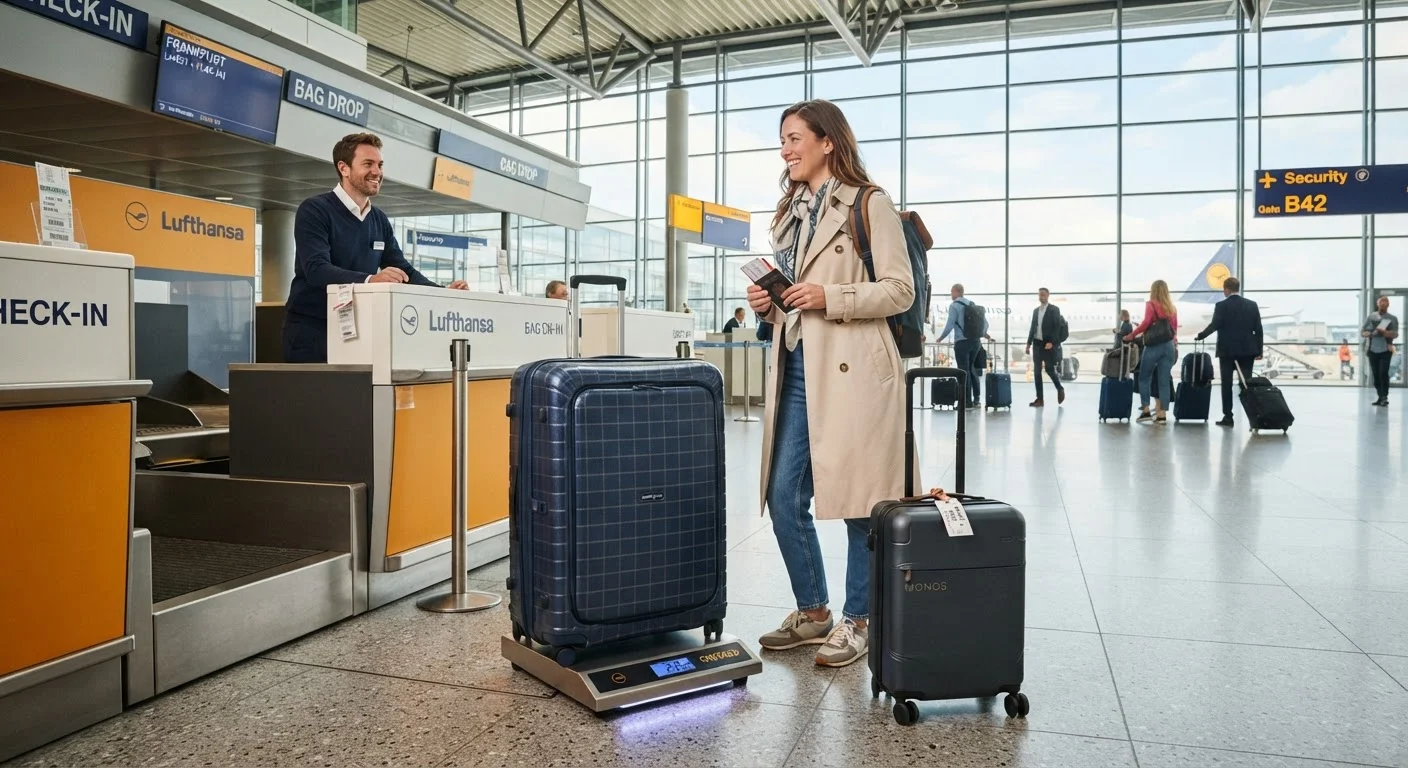
What's Actually at Stake When You Choose
The choice between checking a bag and travelling carry-on only might feel like a minor logistical detail, but it shapes your entire airport experience — and sometimes your trip budget. Checked bag fees on US domestic routes typically run from $30 to $40 per bag each way, and many international carriers have their own fee structures. On a round trip, that adds up quickly. But the cost of not checking a bag is measured in discipline: strict airline size limits, liquid restrictions, and the mental puzzle of fitting everything you need into a smaller space.
The good news is that neither approach is universally better. The right strategy is the one that matches your specific trip. Understanding the real trade-offs — not just the fees — is where smart packing decisions start. If you're still figuring out the big picture of your trip, our guide to planning a trip abroad walks through how luggage decisions fit into the broader process.
| Criterion | Checked Luggage | Carry-On Only |
|---|---|---|
| Typical extra cost | $30–$40+ per bag, per flight | Usually free (fare-dependent) |
| Packing space | Large — up to 62 linear inches | Limited by airline size rules |
| Airport wait time | Added time at check-in & carousel | Skip bag drop and baggage claim |
| Risk of lost bag | Present, especially on connections | Minimal — bag stays with you |
| Liquid restrictions | No restriction on quantities | TSA 3-1-1 rule applies in US |
| Best trip length | Two weeks or longer | Up to one to two weeks |
| Specialty gear | Accommodated (extra fees may apply) | Not possible for oversized items |
| Flexibility to rebook | Less flexible mid-trip | Easier to change flights quickly |
The Case for Checking a Bag
Checked luggage makes the most sense when your trip length, destination, or activities genuinely require more stuff. A two-week trip through multiple countries likely means multiple outfit types, adapters, toiletries in full sizes, and possibly gifts on the way home. Trying to compress that into cabin-legal dimensions can mean sacrificing comfort for the sake of principle.
Checked bags also remove the stress of overhead-bin competition. On busy flights, carry-on space fills fast, and passengers who board late sometimes have their bags gate-checked anyway — paying a fee and losing the time advantage they were hoping for. If you're travelling with young children or managing medical supplies that exceed liquid limits, checking a bag is often the more practical path, not the lazy one.
The main risks to weigh: bags do occasionally get delayed or misrouted, particularly on tight connections. Travel insurance can cover some of the financial fallout from lost luggage — our article on what travel insurance covers explains how that protection typically works. Pack a change of clothes and essential medications in your personal item regardless of what else goes below deck.
$7.5B+
US airline checked bag fee revenue in 2023
According to the US Bureau of Transportation Statistics, US carriers collected over $7.5 billion in baggage fees in 2023, reflecting how common — and how costly — checked luggage has become.
~0.6%
Rate of mishandled bags per passenger
The SITA 2023 Baggage IT Insights report found that roughly 6 bags per 1,000 passengers were mishandled globally in 2022, a figure that rises on itineraries with tight connections.
20+ min
Average baggage carousel wait time
Industry estimates suggest passengers wait an average of 20 or more minutes at baggage claim after landing — time carry-on travellers spend heading to their destination instead.
The Case for Carry-On Only
Travelling carry-on only is genuinely transformative once you get the hang of it. You walk off the plane and straight to ground transport — no 20-minute wait at the baggage carousel, no hoping your bag made the connection. For city breaks, business trips, or any journey where time and agility matter, that freedom is worth the packing discipline it requires.
The financial savings are real, too. If you fly even a handful of times per year, eliminating checked bag fees adds up to a meaningful amount. And carry-on travel pairs naturally with more flexible itineraries: it's much easier to change flights or catch an earlier departure when you're not waiting on checked luggage.
The key constraint is size. Airlines enforce cabin bag dimensions, and they vary. Most US carriers allow a carry-on in the overhead bin plus one personal item (like a backpack or tote) that fits under the seat. Budget and ultra-low-cost carriers may charge for the overhead bin bag and include only the personal item in the base fare. Always check the specific airline's policy before you pack. Our carry-on packing list shows exactly what fits within common airline size limits — a useful starting point if you're new to this approach.
Liquids in carry-ons are limited by the TSA's 3-1-1 rule in the US: containers of 3.4 oz (100 ml) or less, in one quart-sized clear bag, one bag per passenger. Full-size toiletries must go in checked luggage or be purchased at your destination. For destination-agnostic strategies on making this work across different climates, see our guide to living out of a carry-on.
Ultra-Low-Cost Carriers: Read the Fine Print
Airlines such as Spirit, Frontier, and Allegiant in the US — and equivalents in other markets — often charge separately for overhead bin bags, making a 'carry-on' more expensive than it sounds. On these carriers, the only truly free item is typically a small personal item that fits under the seat. Always review the specific fare class rules on the airline's website before assuming what's included in your ticket price.
How to Decide: A Practical Framework
Run through these four questions before you book your bag strategy:
- How long is the trip? Up to a week, carry-on only is very achievable for most travellers. Beyond two weeks, checked luggage becomes increasingly practical — unless you plan to do laundry along the way.
- How many connections do you have? Every connection is a chance for a checked bag to go astray. Short layovers and checked bags are a risky combination. Our article on airport layovers explains how connection time affects your options.
- What type of travel is this? City-hopping or a beach week suits carry-on. Ski trips, dive trips, or adventure travel almost always require checked gear.
- What does your ticket include? Budget fares on ultra-low-cost carriers may not include any overhead bin bag. Read the fare rules — not just the headline price — before assuming what's included.
If you consistently find yourself overpacking, the problem may not be the bag size — it's the packing mindset. Our piece on why overpacking happens tackles the psychology behind bringing too much and offers concrete ways to cut down.