Why One Bag Changes Everything
Living out of a carry-on isn't about deprivation — it's about intentionality. When every item in your bag earns its place, you move through airports faster, skip baggage-claim carousels entirely, and arrive at your destination with energy left over for the actual adventure. For first-time travellers especially, the psychological freedom of not wrestling a checked suitcase through cobblestone streets or crowded transit systems is genuinely life-changing.
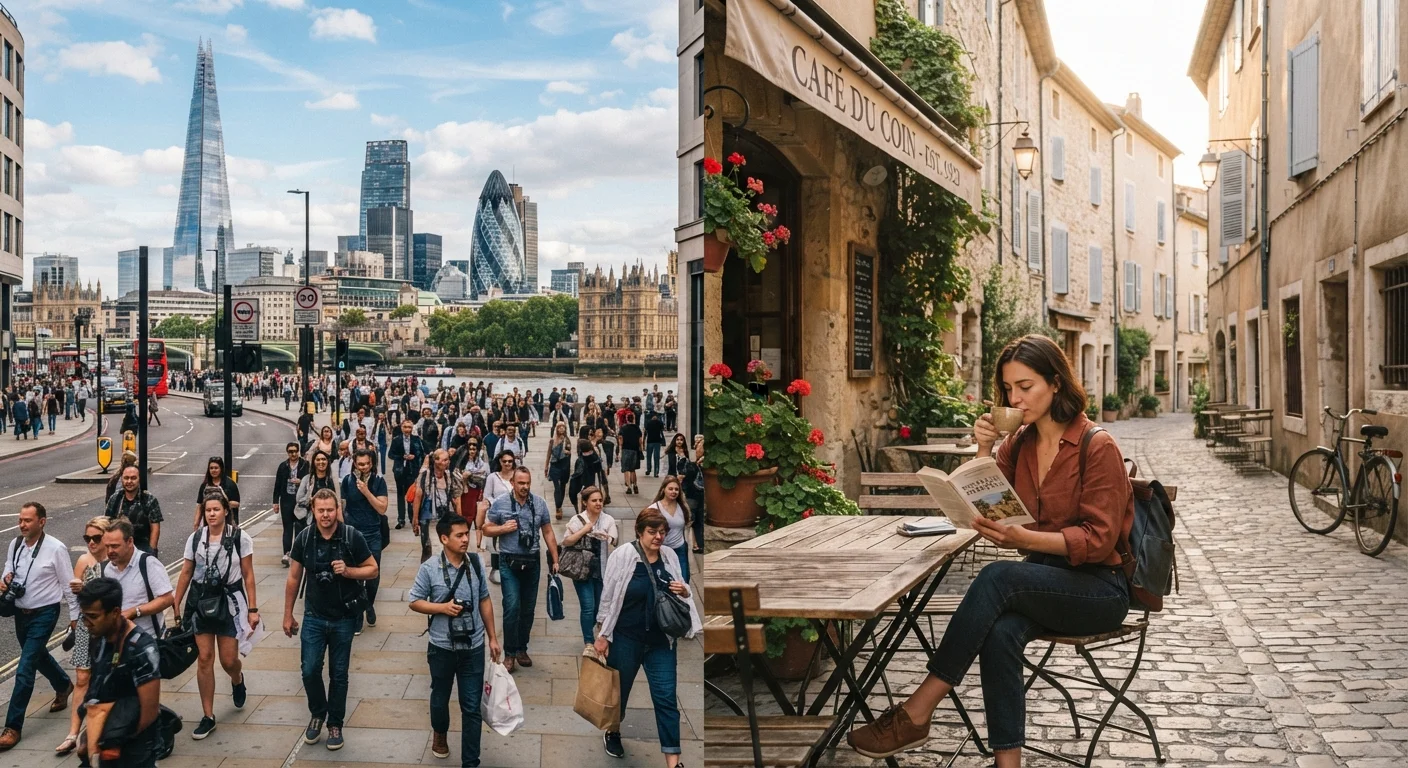
The challenge, of course, is that most of us pack for worst-case scenarios rather than likely ones. We toss in a bulky rain jacket for a sunny destination, four pairs of shoes for a five-day trip, and an outfit for a formal dinner we may never attend. Swap that mindset for one grounded in versatility, and a single carry-on becomes surprisingly roomy. For a broader look at how your travel style affects packing demands, see City Break vs. Slow Travel.
Build your wardrobe around a single neutral colour palette
When every item shares a colour family — think navy, grey, white, and tan — every piece works with every other piece. This multiplies outfit combinations dramatically without adding a single extra item to your bag.
Choose shoes intentionally and limit yourself to two pairs
Shoes are the single heaviest, bulkiest category in most bags. Two pairs — one comfortable walking shoe and one slightly smarter option — cover the vast majority of travel scenarios. Wear your bulkiest pair on travel days.
Follow the one-in-one-out rule for toiletries
Toiletries consistently exceed expectations for both volume and weight. Switching to solid formats (shampoo bars, solid moisturiser) and decanting products into small containers keeps the toiletry pouch lean and liquid-rule compliant.
Roll don't fold — and use packing cubes to compress
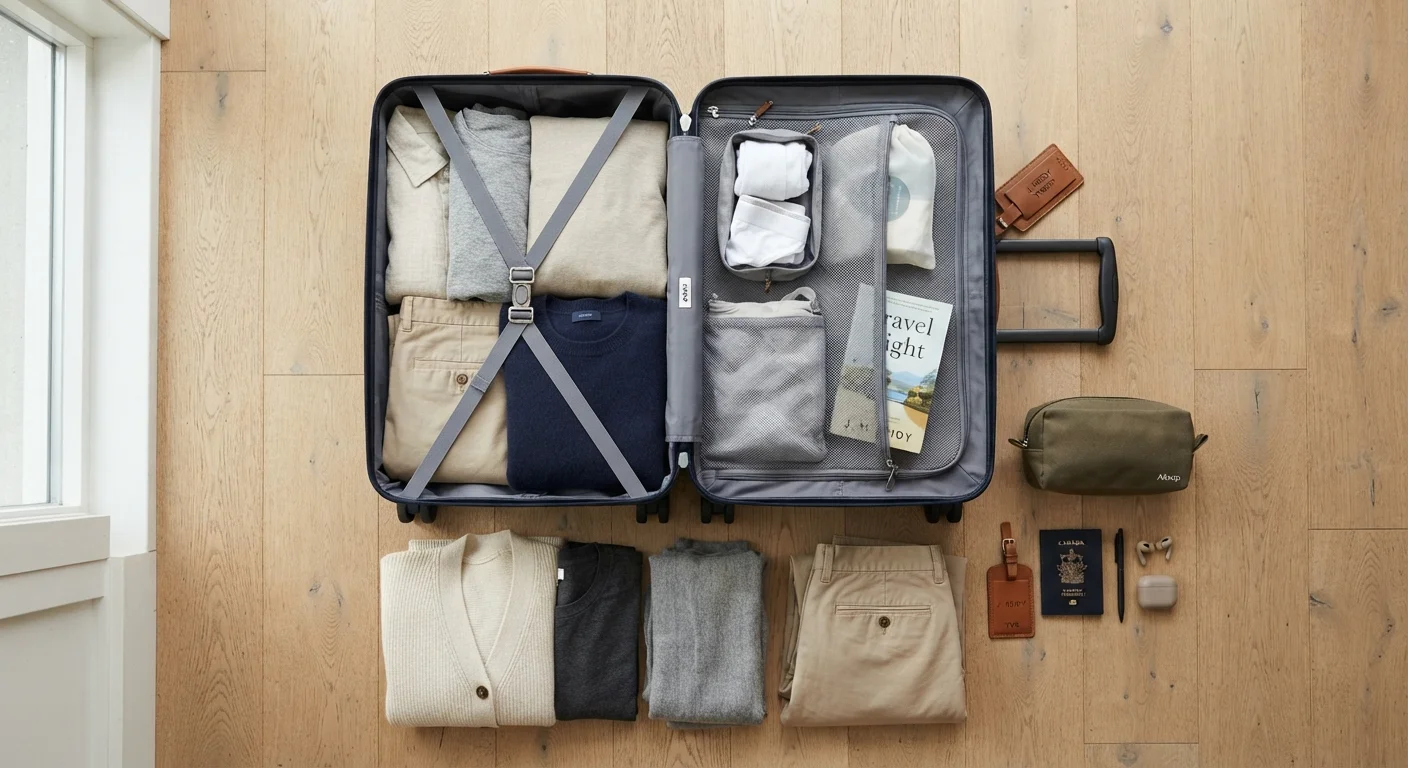
Rolling clothes reduces wrinkles and creates a tighter, more space-efficient pack than flat folding. Packing cubes add a layer of organisation that makes unpacking faster and helps you spot at a glance if anything was forgotten.
Apply the 5-4-3-2-1 formula as a starting ceiling
A popular framework among frequent carry-on travellers sets a ceiling of five sets of socks and underwear, four tops, three bottoms, two pairs of shoes, and one jacket. Starting from a ceiling prevents gradual over-addition.
Climate-Proof Packing: The Layering Formula
The secret to packing for wildly different climates — say, a Nordic city in autumn followed by a beach stop in the Caribbean — is the layering formula: one base layer, one mid-layer, one outer layer. Each piece must work independently on warm days and stack together when temperatures drop. This isn't a rigid rule, but it's a framework that consistently outperforms the "pack for every scenario" approach.
Merino Wool Is Worth the Investment
A single merino wool top can be worn three to four times before needing a wash, making it one of the most space-efficient fabrics for travel. It performs in both cool and warm climates, which means one shirt can handle destinations that a conventional wardrobe would need three or four items to cover. Look for lightweight travel-specific versions that dry overnight when hand-washed in a sink.
Fabric selection is where this strategy either succeeds or falls apart. Merino wool is genuinely remarkable for travel: it regulates temperature in both heat and cold, resists odour far longer than cotton, and packs into surprisingly compact rolls. Lightweight synthetic fabrics dry quickly after hand-washing — a useful habit for longer trips. Avoid denim and thick cotton, which are heavy, slow to dry, and inflexible in both temperature and style.
If your itinerary spans very different climates, consider whether a carry-on-only approach is right for the whole trip. Our piece on carry-on vs. checked luggage walks through exactly when checking a bag actually makes sense.
Core Practices for Packing Light Without Packing Wrong
Beyond fabric choices, a handful of practical habits separate travellers who consistently make carry-on work from those who give up and check a bag every time. The practices below are the building blocks — each one is straightforward to adopt, and together they create a system that holds up across destinations and trip lengths.
One habit worth singling out: always verify your airline's specific carry-on dimensions and weight limits before you pack. Policies vary significantly between carriers and regions, and what clears security at one airline may be gate-checked at another. Our carry-on packing list covers what actually fits within common restrictions.
Making It Stick: From First Trip to Every Trip
The best packing system is one you actually use consistently. After your first successful carry-on trip, resist the urge to gradually add items back on subsequent trips. The psychology of overpacking is sneaky — it creeps back in trip by trip. If you want to understand why that happens and how to counter it, Why Overpacking Happens is a useful read.
~$35
Average US domestic checked bag fee (first bag)
Airline baggage fee surveys consistently place average first-bag fees in the $30–$40 range on major US carriers, though policies change frequently.
20–30%
Typical reduction in packing list after first carry-on trip
Frequent carry-on travellers commonly report cutting their packing list by this margin after reviewing what they actually used on their first minimalist trip.
A practical ritual that helps: after each trip, note what you actually wore versus what stayed folded at the bottom of your bag. That list becomes your personal packing guide for next time. Over two or three trips, most travellers find they can comfortably cut their original packing list by 20–30% without missing a single item. Pair this habit with the broader trip-planning process outlined in our guide to planning a trip abroad, and you'll arrive at every destination lighter, calmer, and ready to explore.