
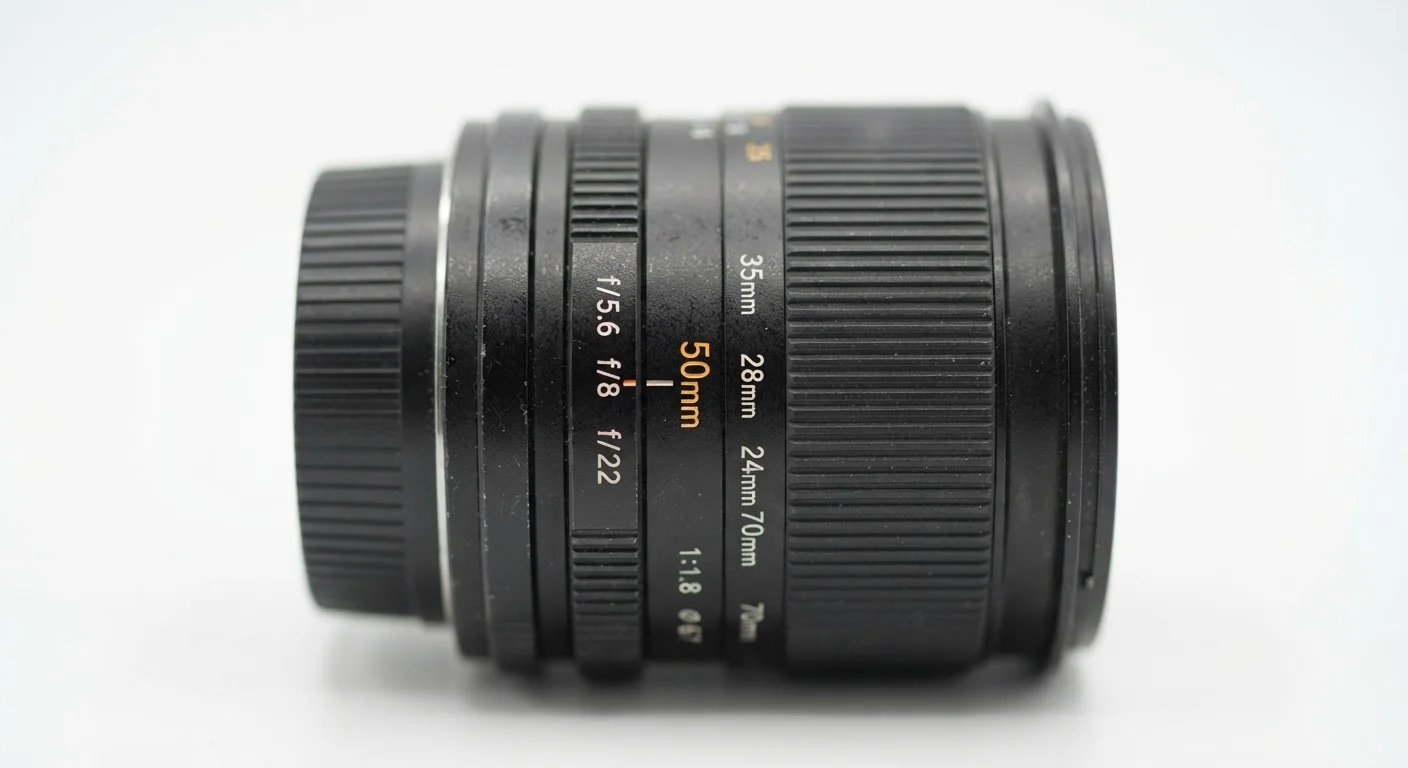
Why Lens Markings Look So Confusing
Pick up any camera lens and you will find a ring of numbers, abbreviations, and symbols stamped or engraved around the barrel. At first glance it looks like an engineering spec sheet — and that is essentially what it is. But each marking answers a simple, practical question about what the lens can do. Once you know what question each number answers, the barrel becomes surprisingly readable.
This guide walks through the most common markings in the order you are most likely to encounter them. For a broader look at how specs work across devices, see our everyday gadget glossary.
| Focal length unit | Millimetres (mm) |
| Wide-angle range | Typically below 35mm |
| "Normal" focal length (full-frame) | Around 50mm |
| Lowest common consumer aperture | f/5.6 |
| Fast aperture threshold | f/2.8 or lower |
| Filter thread symbol | Ø (diameter in mm) |
Focal Length: The First Big Number
The largest number on any lens — expressed in millimetres, such as 50mm, 24–70mm, or 200mm — is the focal length. It describes how much of the scene in front of you the lens captures, and how large subjects appear in the frame.
- Short focal lengths (wide angle): A 16mm or 24mm lens captures a wide sweep of a scene — great for landscapes or tight indoor spaces.
- Mid-range focal lengths: Around 35mm–85mm approximates how the human eye perceives a scene. A 50mm lens in particular is often called a "nifty fifty" because its perspective feels natural.
- Long focal lengths (telephoto): A 200mm or 400mm lens magnifies distant subjects, making it useful for sports or wildlife photography.
When you see two numbers separated by a dash — such as 18–55mm — the lens is a zoom lens that covers a range of focal lengths. A single number means it is a prime lens with one fixed focal length.
Focal length
A measurement in millimetres that describes how much of a scene a lens captures and how magnified subjects appear. Shorter values show more of the scene; longer values zoom in on distant subjects.
Aperture
The adjustable opening inside the lens that controls how much light reaches the sensor. Expressed as an f-number — a smaller number means a larger, more light-admitting opening.
Prime lens
A lens with a single, fixed focal length that cannot zoom. Prime lenses are often sharper and offer wider maximum apertures than zoom lenses at comparable prices.
Zoom lens
A lens covering a range of focal lengths, allowing the photographer to frame shots without physically moving. Indicated by two numbers separated by a dash, such as 18–55mm.
Bokeh
The aesthetic quality of the out-of-focus blur in an image, most pronounced with lenses that have a wide maximum aperture (low f-number). Often used deliberately to separate subjects from backgrounds.
Image stabilisation
A built-in lens or camera mechanism that reduces blurring caused by hand movement. Particularly useful in low light or when using long focal lengths.
Aperture: The f/ Number
Immediately after the focal length you will usually see something like f/1.8 or f/3.5–5.6. This is the aperture, which describes the maximum size the lens opening can reach to let light in.
Here is the counterintuitive part: a smaller f-number means a larger opening. An f/1.4 lens lets in far more light than an f/5.6 lens. A large opening (low f-number) also creates that blurry background look — called bokeh — that portrait photographers love.
When a zoom lens shows two aperture numbers (f/3.5–5.6), it means the maximum aperture changes depending on which end of the zoom range you are using. A single aperture across the zoom range — such as f/2.8 — is a premium feature and is priced accordingly.
f/1.4
Maximum aperture on many fast prime lenses
An f/1.4 aperture lets in approximately 16 times more light than an f/5.6 aperture, illustrating how dramatically the f-number affects exposure.
4 stops
Typical image stabilisation benefit
Many modern optical image stabilisation systems claim to compensate for up to four stops of camera shake, according to lens manufacturer specifications.
Other Common Markings Decoded
Beyond focal length and aperture, several abbreviations describe additional features. These vary by manufacturer but follow common patterns:
- IS, OS, VR, OIS, IBIS
- All refer to image stabilisation — a system that compensates for hand shake, reducing blurry photos in low light or at long focal lengths. The exact abbreviation depends on the brand.
- USM, STM, AF-S, HSM
- These describe the type of autofocus motor built into the lens. Ultrasonic motors (USM, HSM, AF-S) are generally fast and quiet; stepping motors (STM) are designed to be near-silent for video.
- Ø followed by a number (e.g. Ø77mm)
- This is the filter thread diameter — the size of screw-on filters (like UV or polarising filters) that fit the front of the lens.
- Macro or 1:1
- Indicates the lens can focus extremely close to a subject and reproduce it at life size on the sensor. Useful for detailed shots of small objects like flowers or insects.
Understanding specs across consumer electronics works the same way — our piece on TV specs decoded shows how this kind of translation applies to your television too.
Putting It All Together
Consider a lens labelled 24–70mm f/2.8 IS USM Ø82mm. Reading left to right: it is a zoom lens covering 24mm to 70mm, with a constant maximum aperture of f/2.8, built-in image stabilisation, an ultrasonic autofocus motor, and accepts 82mm screw-on filters. You now have a complete picture of its capabilities without opening a brochure.
The key insight is that none of these numbers are arbitrary — each one describes a measurable physical property of the lens. Once you anchor each number to the question it answers (how wide? how much light? how stable?), any lens label becomes easy to read at a glance.
If you enjoy decoding what numbers really mean, you might also find it useful to look at how nutrition facts labels work — a surprisingly similar exercise in translating dense specs into practical understanding.
Sensor Size Changes the Effective Focal Length
Focal length values are typically referenced against a full-frame sensor. If your camera has a smaller sensor — called a crop sensor or APS-C — the effective field of view is narrower. A 50mm lens on a crop-sensor camera behaves more like a 75–80mm lens would on a full-frame body. Check your camera's crop factor (usually 1.5× or 1.6×) to calculate the equivalent focal length.