Why Paint Finish Matters as Much as Color
Most first-time painters spend hours agonizing over color chips and barely glance at the finish options. That's a mistake. The finish determines how the paint interacts with light, how it holds up to scrubbing, and whether every dent and roller mark on your wall becomes visible. Picking the wrong finish for the room can mean repainting far sooner than you'd like.
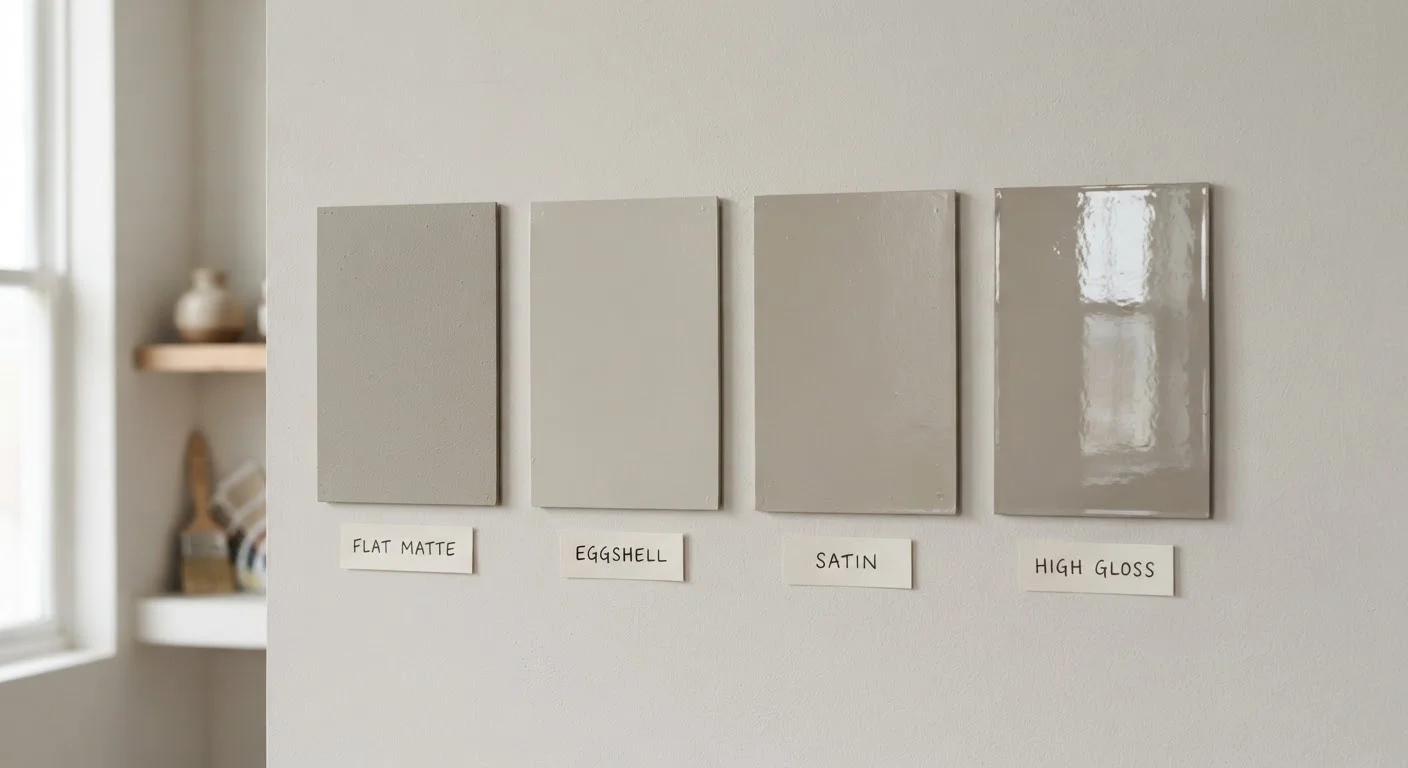
Paint finishes sit on a spectrum from flat to high-gloss. As sheen increases, so does durability and cleanability — but so does the finish's tendency to highlight surface flaws. Understanding this trade-off is the key to making a smart choice before you open a single can.
4
Main interior paint finish levels
Most paint manufacturers organize their interior lines into flat/matte, eggshell, satin, and gloss categories, each with distinct sheen and durability properties.
~10–25%
Light reflectivity range for satin finish
Industry paint standards generally place satin sheen between roughly 10 and 25 percent gloss units, sitting clearly between eggshell and semi-gloss on the reflectivity scale.
Matte: The Flat Finish That Hides Flaws
Matte paint (sometimes called flat paint) reflects almost no light. That characteristic makes it excellent at disguising surface imperfections like nail pops, uneven texture, or old patch repairs — the light simply doesn't catch the irregularities. It delivers rich, true color and a non-distracting look that works well in formal dining rooms, adult bedrooms, and low-traffic hallways.
The downside: matte paint is porous and absorbs moisture easily. Scrubbing a fingerprint off a matte wall can lift or dull the finish. Reserve it for spaces where the walls are rarely touched. If you're painting over a dark color, matte formulas often require more coats to achieve full coverage.
Eggshell and Satin: The Middle-Ground Finishes
Eggshell has a very slight sheen — roughly the same low luster as the surface of an egg. It's significantly more washable than matte and still forgiving enough to downplay minor wall imperfections. Eggshell is considered the standard finish for most living areas, bedrooms, and dining rooms where durability matters but you don't want a shiny wall.
Satin sits one step up the sheen scale. It has a soft, velvety reflectivity that resists moisture and holds up to repeated cleaning. Satin is the go-to finish for kitchens, bathrooms, kids' rooms, and laundry areas — anywhere humidity or handprints are a daily reality. Keep in mind that satin shows brush marks and lap lines more easily than eggshell, so careful application technique matters.
Test Before You Commit
Buy a small sample pot of each finish you're considering and paint a large swatch — at least 12 inches square — directly on the wall. Observe it under both natural daylight and artificial evening lighting before deciding. Sheen differences are much more obvious on a real wall than on a paint chip.
Gloss: Maximum Durability for High-Impact Surfaces
Gloss paint (and its close relative, semi-gloss) creates a hard, highly reflective surface that practically repels stains and moisture. It's the standard finish for interior trim, baseboards, doors, window frames, and cabinetry — surfaces that endure constant contact and need frequent wiping.
The trade-off is unforgiving. Gloss magnifies every scratch, drip, and surface flaw underneath it. Proper surface preparation — sanding, priming, and filling any gaps — is non-negotiable before applying a gloss finish. Once applied correctly, it offers the longest-lasting result of any interior finish. See our guide to finishing a painted room properly for the prep steps most beginners skip.
Matching Finish to Room: A Quick Reference
Think about each room's traffic level, moisture exposure, and how often the walls get touched. Here's a simple framework:
- Ceilings: Flat/matte — no sheen means imperfections disappear and glare is eliminated.
- Bedrooms and formal living rooms: Matte or eggshell — lower traffic, less cleaning needed.
- Family rooms, hallways, kids' rooms: Eggshell or satin — durable enough for daily life.
- Kitchens and bathrooms: Satin or semi-gloss — moisture and grease resistance is essential.
- Trim, doors, and cabinets: Semi-gloss or gloss — hardest-wearing surfaces need the toughest finish.
If you're starting a project from scratch, it also helps to understand when and how to strip old paint before applying a new finish, especially on trim with built-up layers.
“The finish is the first thing light touches when it enters a room. Get it wrong and even a perfect color can feel off — too bright, too flat, or just not what you imagined.”
— Home & Garden Editorial Team, Interior painting guidance writers