Why Ingredient Lists Feel Confusing
Ingredient lists are written to satisfy legal requirements, not to be reader-friendly. In the United States, the FDA mandates that all packaged foods display a complete ingredient list, but the formatting rules that make lists compliant don't automatically make them readable. The result is a dense paragraph of scientific names, category codes, and nested brackets that most people skip entirely.
The good news: a handful of consistent rules govern every single list. Once you know those rules, any label becomes predictable. This guide walks you through them step by step. If you also want to understand the numbers beside the list, our companion piece on decoding the Nutrition Facts panel covers the numerical side of the label.
What you will need
How to Read Any Ingredient List
Follow these steps with a real label in hand. Even a cereal box or a jar of pasta sauce is enough to practice on.
Read from left to right — that order is weight
Ingredients are listed in descending order by weight before cooking or processing. The first ingredient is present in the greatest amount; the last is present in the smallest. If sugar or a refined grain is the first or second item, that ingredient dominates the product by mass. Conversely, an ingredient near the very end — like a vitamin or spice — is present in a trace amount.
Identify compound ingredients and their brackets
When an ingredient is itself made of multiple components, it appears with those components listed in parentheses or brackets immediately after it. For example: Chocolate chips (sugar, cocoa butter, cocoa mass, emulsifier: soy lecithin). The bracketed items belong entirely to the chocolate chips, not to the product as a whole. This nesting can go one level deep, so scan for opening and closing brackets to understand where one compound ingredient ends and the next begins.
Locate allergen declarations
Major allergens — including milk, eggs, wheat, peanuts, tree nuts, soy, fish, and shellfish — must be declared. They may appear in bold within the ingredient list itself (wheat flour), or in a separate 'Contains:' statement below the list, or both. Scan both locations. Also note 'May contain' or 'Made in a facility that processes' statements, which signal cross-contact risk rather than intentional inclusion.
Decode additive entries
Additives follow the pattern: category name followed by a colon, then either the additive's specific name or a standardized number code. Common categories include Preservative, Emulsifier, Stabiliser, Colour, and Antioxidant. For example, Preservative: sodium benzoate and Preservative: E211 refer to the same substance. If you want to know what a number means, food authority websites in your country publish searchable databases of approved additives.
Count sugar names and note their positions
Run through the full list and flag every form of added sugar you recognize: glucose, fructose, sucrose, dextrose, maltose, corn syrup, honey, agave, invert sugar, and molasses, among others. Because each is technically a different ingredient, they can appear separately across the list — diluting each one's apparent weight ranking even though their combined contribution may be substantial. Spotting multiple sugar types is more informative than focusing on any single entry.
Assess the list as a whole, not in isolation
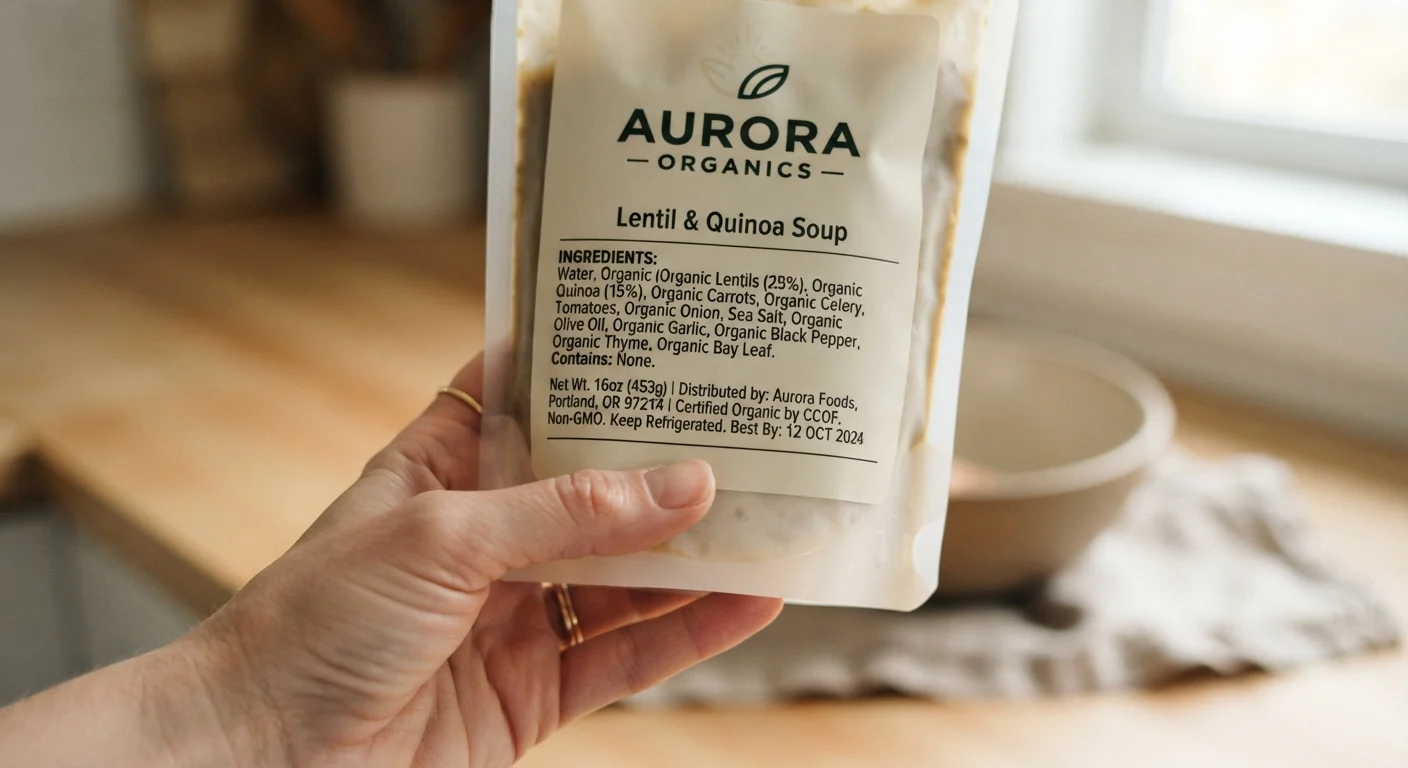
Length alone is not a reliable indicator of quality. A long list on a multi-ingredient dish like a soup or spice blend may simply reflect a complex recipe. A short list on a heavily processed item can still be nutritionally unbalanced. After scanning for order, allergens, and additives, consider what the list tells you about the primary ingredients and how processed those ingredients appear to be — rather than making a judgment on length alone.
Common Stumbling Blocks
Even after learning the basic rules, a few patterns consistently trip up first-time label readers.
Additive codes
Additives — preservatives, emulsifiers, colours — can appear as either a category name plus a specific name (Emulsifier: lecithin) or a category name plus a number (Colour: E102). Both formats are legal and mean the same type of thing. The number is simply a standardized code used in some regulatory systems.
Sugar aliases
Sugar appears under many names: glucose, fructose, dextrose, maltose, corn syrup, invert sugar, and more. Each is a separate ingredient, so if several appear in one list, their combined presence may be more significant than any single entry suggests.
Flavours
The words natural flavour and artificial flavour carry specific legal meanings that are less intuitive than they sound. For a deeper look at that distinction, see our article on natural and artificial flavours.
Practice Makes Labels Readable
Pick three different products from your kitchen and read their ingredient lists back to back using these steps. The patterns — descending weight order, bracketed compounds, allergen declarations — repeat across every label. A few practice runs and the format becomes second nature.
Putting It in Context
Reading ingredients is one part of understanding what you're eating — and it pairs naturally with other reading skills. If you cook from scratch, our guide to reading a recipe covers how written instructions use their own set of conventions. Understanding both label language and recipe language gives you a fuller picture of what goes into your food.
For broader nutrition context, the Nutrition Basics hub covers how different nutrients function in the body — useful background once you start recognizing specific ingredients on labels.
Ingredient lists on food follow the same underlying logic as those on personal care products, though the substances differ. If you're curious how the same principle applies elsewhere, our piece on decoding a skincare ingredient list shows the parallel.