What Actually Happens Inside Meat as It Cooks
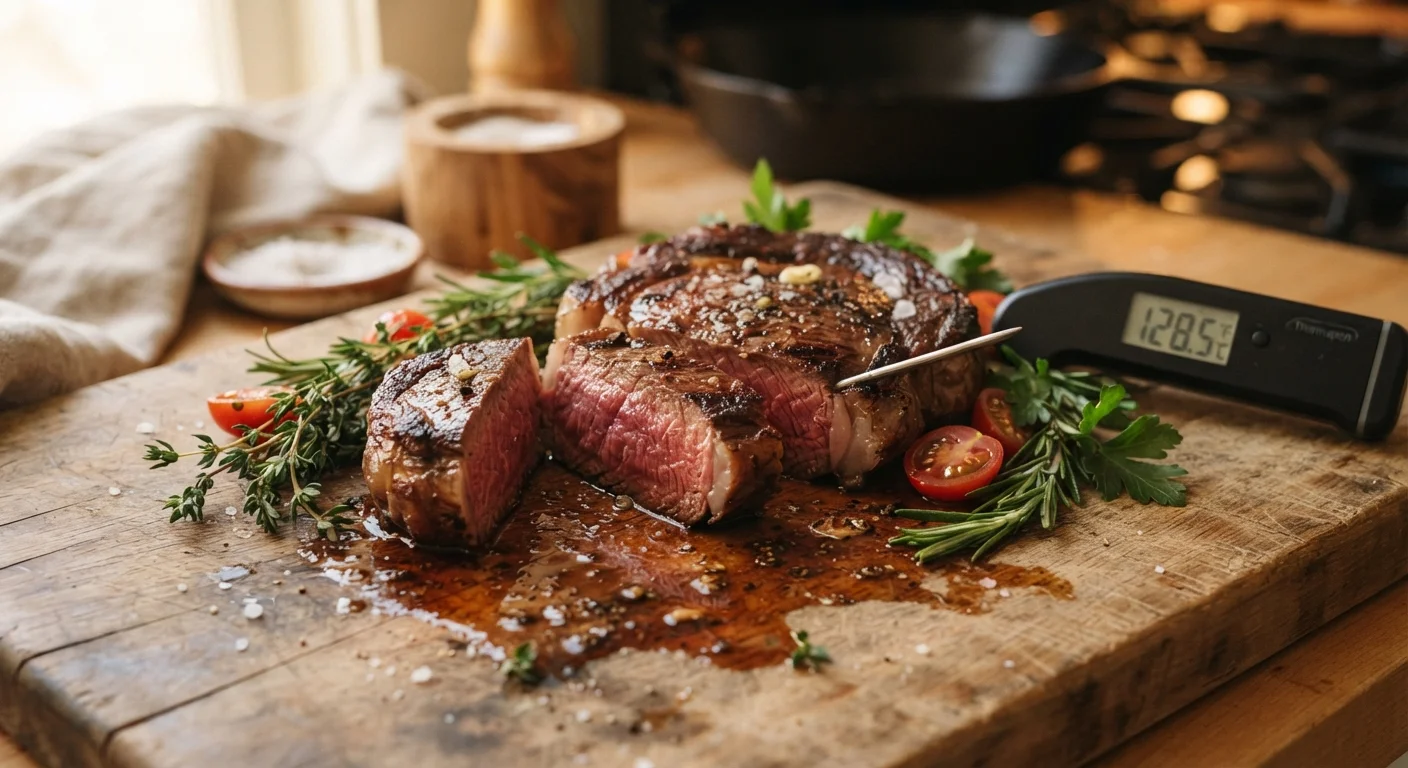
When meat hits heat, its muscle fibers contract and push moisture toward the center of the cut. Think of it like squeezing a wet sponge — pressure builds up and liquid has nowhere to go. If you slice through the meat the moment it leaves the pan or oven, that pressurized juice rushes straight out onto your cutting board. The result is dry, tough meat and a puddle of lost flavor.
During a rest period, the muscle fibers gradually relax. As they loosen, moisture that was forced toward the center begins to redistribute evenly throughout the cut. By the time you slice, every part of the meat — edge to center — holds onto its juice. This is not a culinary trick or chef's preference; it is straightforward food physics.
A second thing happens during the rest that beginners often overlook: the meat keeps cooking. Residual heat stored in the outer layers continues to move inward even off the heat source. This is called carryover cooking, and it can raise the internal temperature by as much as 5–10°F (3–6°C) depending on the size of the cut. Knowing this means you should pull meat from the heat slightly before it hits your target temperature — not at it.
How Long Each Cut Actually Needs
Resting time is not one-size-fits-all. It scales with the size and density of the cut. Here is a practical reference:
- Thin steaks and chicken breasts (under 1 inch thick): 5 minutes minimum.
- Thick steaks, pork chops, and bone-in chicken pieces: 8–10 minutes.
- Whole roast chicken or duck: 15–20 minutes.
- Large beef roasts, leg of lamb, whole turkey: 20–30 minutes.
A useful rule of thumb: rest the meat for roughly one minute per 100 grams of weight, though size and shape also matter. A compact rolled roast rests differently than a flat brisket of the same weight.
To keep the meat warm without causing the crust to go soggy, loosely tent it with a sheet of aluminum foil. Do not seal it tightly — trapped steam will soften any crisp exterior you worked to build.
5–10°F
Temperature rise from carryover cooking
Food science research consistently shows large cuts can continue rising in internal temperature by this range after being removed from heat.
Up to 40%
More juice retained when meat is rested
Culinary studies on meat cookery have demonstrated significantly less juice loss on a cutting board when an adequate rest period is observed before slicing.
Common Myths That Lead Beginners Astray
Despite being one of the most well-established steps in cooking, resting is also one of the most skipped — usually because of a myth. Here are the most persistent ones, corrected.
Myth
Resting meat makes it go cold, so it is better to serve immediately.
Fact
Properly tented meat stays warm for 10–20 minutes and the internal temperature often rises during the rest.
Carryover cooking means the internal temperature of a rested cut is frequently higher just after resting than it was the moment it left the heat. A foil tent traps enough warmth that thin cuts served after a 5-minute rest are still piping hot. For thicker roasts, the insulating mass of the meat itself retains heat effectively for 20–30 minutes.
Myth
Only expensive, thick cuts like ribeye need to rest — thin cuts and chicken can be sliced straight away.
Fact
All meat benefits from resting, including chicken breasts, pork tenderloin, and even fish fillets.
Muscle fiber contraction happens at any thickness. Even a thin chicken breast will lose noticeably more juice if sliced immediately versus after a 5-minute rest. Fish is more delicate and needs only 2–3 minutes, but the principle still applies — the flesh firms and holds together better after a short pause.
Myth
Searing seals in the juices, so resting afterward is unnecessary.
Fact
Searing creates flavor through browning (the Maillard reaction) but does not create a moisture-proof seal.
The idea that a seared crust locks in juices is a long-debunked kitchen myth. Seared meat still loses moisture when cut too early — it simply has a better flavor and texture on the outside. Resting is the mechanism that actually preserves internal moisture, and searing and resting work together, not as substitutes for each other.
Myth
If you cover the meat tightly with foil while it rests, it stays juicier.
Fact
Tight foil trapping steam softens a crisp crust — a loose tent is the correct approach.
Steam trapped under a tight foil wrap will condense and drip back onto the meat's surface, ruining any caramelized exterior. A loosely tented sheet of foil — raised slightly above the meat — retains heat while allowing steam to escape. If preserving a very crisp crust (such as on a roast chicken) is a priority, you can even rest it uncovered in a warm kitchen for shorter periods.
Building good kitchen habits early prevents these errors from becoming ingrained. Just as mise en place organizes your prep work before cooking begins, factoring rest time into your plan helps everything land on the table at the right moment.
Putting It Into Practice
The simplest way to make resting automatic is to build it into your cooking sequence. Before you start cooking, decide where your meat will rest and for how long. Set a timer the moment it comes off the heat — do not rely on memory when you are also managing sides, sauces, and plating.
Use that window productively. Rest time is ideal for finishing a pan sauce with the drippings, plating vegetables, or doing a final taste check on your seasoning. Speaking of which, the habit of tasting throughout the cooking process is another simple discipline that dramatically improves results — worth developing alongside your understanding of resting.
And once the rest is complete, how you slice matters too. For guidance on cutting technique that protects the work you have just done, see our beginner knife skills guide. Slicing against the grain of the muscle fiber, for instance, keeps each bite tender rather than chewy.
Don't Rest Meat at Room Temperature Too Long
Food safety guidelines advise that cooked meat should not sit at room temperature for more than two hours total. For most home-cooked cuts, a 5–30 minute rest is well within that window. However, do not treat resting as an excuse to leave meat out indefinitely while you finish other tasks. If you need to hold a large roast for longer before serving, keep it in a low oven (around 170°F / 75°C) rather than leaving it uncovered on the counter.