Why Knife Skills Come First
Before you learn to sauté, braise, or season with confidence, you need to be able to break down an ingredient safely and efficiently. Knife skills are the foundation almost every other cooking technique depends on. Uneven cuts mean uneven cooking — some pieces burn while others stay raw. Slow, uncertain cutting makes recipes frustrating rather than enjoyable.
Think of knife work the way you'd think of learning to read before studying literature. Once it becomes second nature, everything downstream gets easier. If you're just beginning to navigate the kitchen, pairing your knife practice with a broader understanding of kitchen layout helps enormously — see A Beginner's Map of the Kitchen for context on how to organise your workspace before you start.
Pinch grip
A knife-holding technique where the thumb and bent index finger pinch the blade itself, just above the handle, giving the cook better control and stability.
Claw grip
A way of holding food while cutting where the fingertips are curled under and the knuckles face the blade, preventing cuts to the fingertips.
Honing
Using a honing steel to realign a knife blade's edge between sharpenings — it doesn't remove metal, it straightens the edge back into alignment.
Dice
A knife cut that produces small, uniform cube-shaped pieces by making a series of slices in multiple directions through an ingredient.
Guiding hand
The hand that holds the food being cut, responsible for controlling the spacing and steadiness of each slice while staying safely positioned.
How to Hold a Knife Correctly
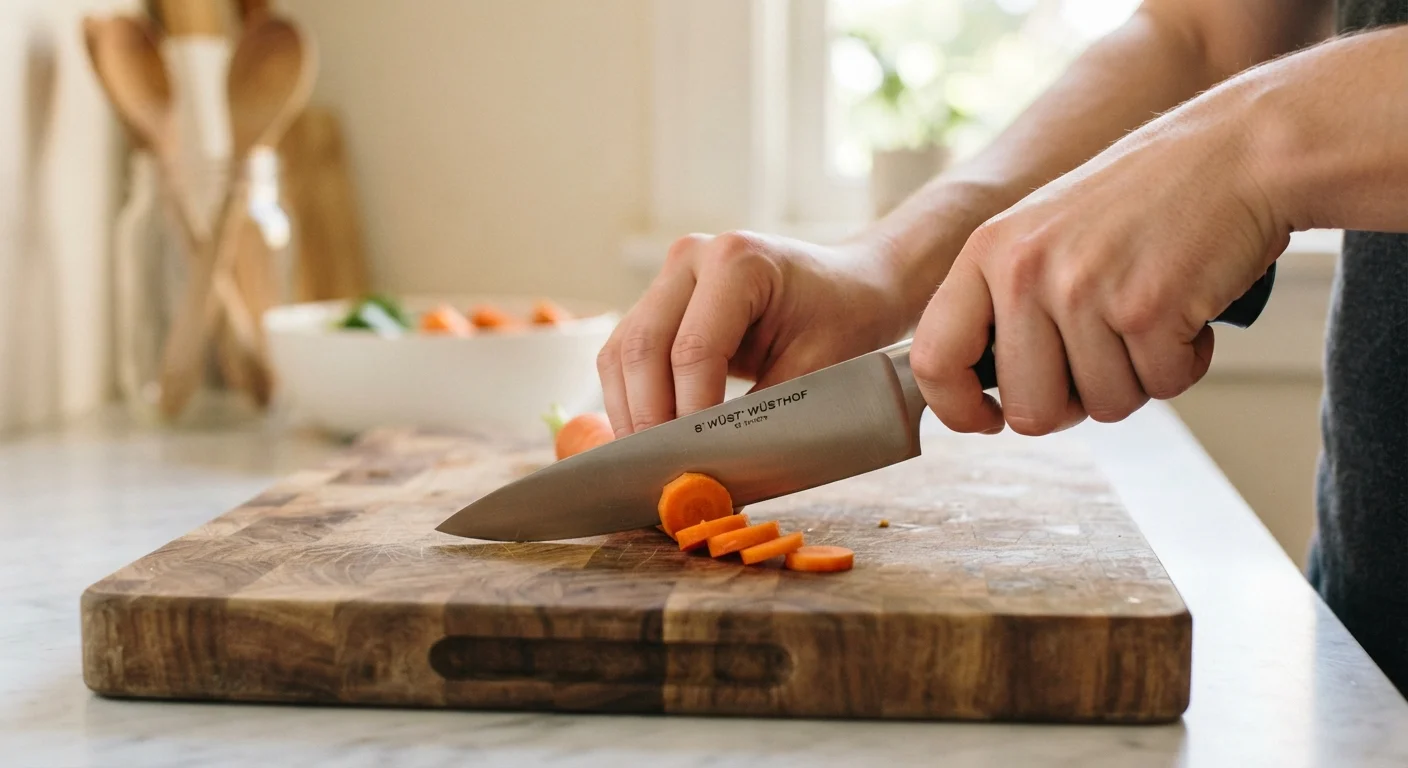
Most beginners grip the handle the way they'd hold a hammer — all fingers wrapped around the grip. This actually reduces control significantly. Professional cooks use a pinch grip: the thumb and the side of the bent index finger pinch the flat of the blade just above the handle, while the remaining three fingers wrap the handle.
This grip keeps the knife stable, reduces wrist fatigue over time, and gives you a much clearer sense of where the blade is pointing. It feels unnatural for the first few minutes, but it becomes intuitive quickly. Practice the grip on a clean, stationary knife before you even try cutting anything.
Practice the Grip Before Cutting Anything
Spend two minutes just holding the knife in a pinch grip and moving it gently through the air before you approach the cutting board. This builds muscle memory for the correct position without the pressure of cutting. Most beginners find the grip clicks into place within one or two cooking sessions.
The Guiding Hand and the Claw Grip
The hand that holds the food — called the guiding hand — is where most kitchen cuts happen. The claw grip eliminates that risk. Curl your fingertips under so your knuckles form a vertical wall facing the blade. The knife slides along your knuckles with each cut, and your fingertips stay safely tucked away.
At the same time, your guiding hand controls the spacing of each cut. Move it back in small, even increments to produce slices of consistent thickness. This is how professional cooks achieve uniform results — not through speed, but through deliberate hand placement. Speed follows naturally once the mechanics are solid.
Core Cuts Every Beginner Should Practice
You don't need to master every knife cut in culinary school's repertoire. Focus on three to start:
- Slice: A single smooth forward-and-down stroke. Use this for onions, tomatoes, bread, and most proteins.
- Chop: A repeated up-and-down motion with the blade's tip anchored to the board. Used for herbs, garlic, and rough vegetable prep.
- Dice: A sequence of slices in multiple directions to produce small, uniform cubes. Start with an onion — it's forgiving and the layered structure naturally guides your cuts.
Practice each cut on inexpensive, high-volume vegetables like onions, carrots, and celery. These are the same ingredients you'll use in countless recipes, so every practice session produces something useful. As your confidence grows, you can explore how to build on these fundamentals — including how to taste as you cook to check seasoning at every stage.
Never Cut with a Dull Knife
A dull blade requires you to press harder to get through food, which dramatically increases the chance of the knife slipping sideways. Always test your knife's sharpness before prep and hone or sharpen it when needed. This is one of the most common — and preventable — causes of kitchen cuts.
Setting Up Your Cutting Station Safely
Even perfect technique is undermined by an unstable setup. Place a damp kitchen towel or a non-slip mat underneath your cutting board before you begin. A board that slides during cutting is a genuine hazard.
Choose a board large enough that food doesn't fall off the edges as you work. Keep your workspace uncluttered — a crowded counter forces awkward angles and rushed movements. Store knives on a magnetic strip or in a knife block rather than loose in a drawer, where reaching in blindly creates unnecessary risk.
Finally, a reminder that applies to all tool-based skills: a sharp knife requires less force, which means less chance of slipping. Commit to keeping your blade maintained from the beginning. Just as DIY beginners often underestimate the importance of proper tool care, kitchen beginners frequently overlook blade maintenance — and both pay for it in frustration and avoidable mistakes.
You Only Need One Good Knife to Start
Beginners often feel pressured to own a full knife block before they start cooking. In practice, a single well-maintained 8-inch chef's knife will handle the vast majority of home cooking tasks. Focus on mastering that one tool before expanding your collection.