A Small Gesture With Big Meaning
It seems like such a minor thing — slipping off your shoes before stepping inside. But across much of the world, this single act communicates volumes about who you are as a guest, a visitor, or a worshipper. Shoe removal is one of the most widespread and symbolically loaded customs in human culture, and travelers who understand it navigate social situations with far greater ease and grace.
The custom isn't uniform. It doesn't mean the same thing everywhere, and it's practiced for different reasons depending on where you are. What unites these traditions is the idea that shoes carry the outside world with them — its dirt, its chaos, its spiritual impurity — and that some spaces deserve to be shielded from all of that.
Just as greetings vary dramatically across cultures, so does the etiquette around footwear. Getting either one wrong can create an awkward first impression — but getting them right opens doors (quite literally).
1.8B+
Muslims worldwide who follow shoe-removal customs during prayer
Islamic prayer requires ritual cleanliness; mosques globally maintain this practice as a core part of worship.
90%+
Japanese households where shoe removal at entry is standard
The genkan entryway is a near-universal architectural feature in Japanese homes, designed specifically for shoe removal.
30+
Countries with documented indoor shoe-removal customs
Cultural anthropology research identifies shoe removal traditions across Asia, the Middle East, Northern Europe, and parts of the Americas.
Where Shoe Removal Is Expected — and Why
In Japan, the concept of uchi (inside) and soto (outside) governs much of daily life. Homes, traditional restaurants, and many guesthouses (ryokan) have a designated entryway called a genkan — a slightly recessed area where you remove shoes before stepping onto the main floor. The floor itself is treated as a clean living surface, since people sit and sometimes sleep directly on it.
Across much of Southeast Asia — Thailand, Indonesia, Vietnam, and beyond — the same principle applies, with an additional layer of spiritual significance. Feet are considered the lowest, most humble part of the body, and shoes worn on the street are seen as spiritually unclean. Bringing them into a home or temple is a sign of deep disrespect.
In Scandinavia, shoe removal is rooted in practical hygiene rather than spirituality. Nordic winters make outdoor footwear genuinely dirty, and the practice of leaving boots at the door is simply good household sense — now so normalized that many hosts would be quietly horrified if you kept your shoes on.
Across the Middle East, shoes are removed before entering mosques and many private homes, reflecting Islamic traditions of cleanliness that precede prayer. Similar customs apply in Sikh gurdwaras and Hindu temples worldwide. For more on navigating these spaces respectfully, see our guide on sacred sites and visitor behavior.
How to Read the Room — Practical Tips for Travelers
You don't need to memorize every country's customs before you travel. A few reliable cues will guide you almost everywhere:
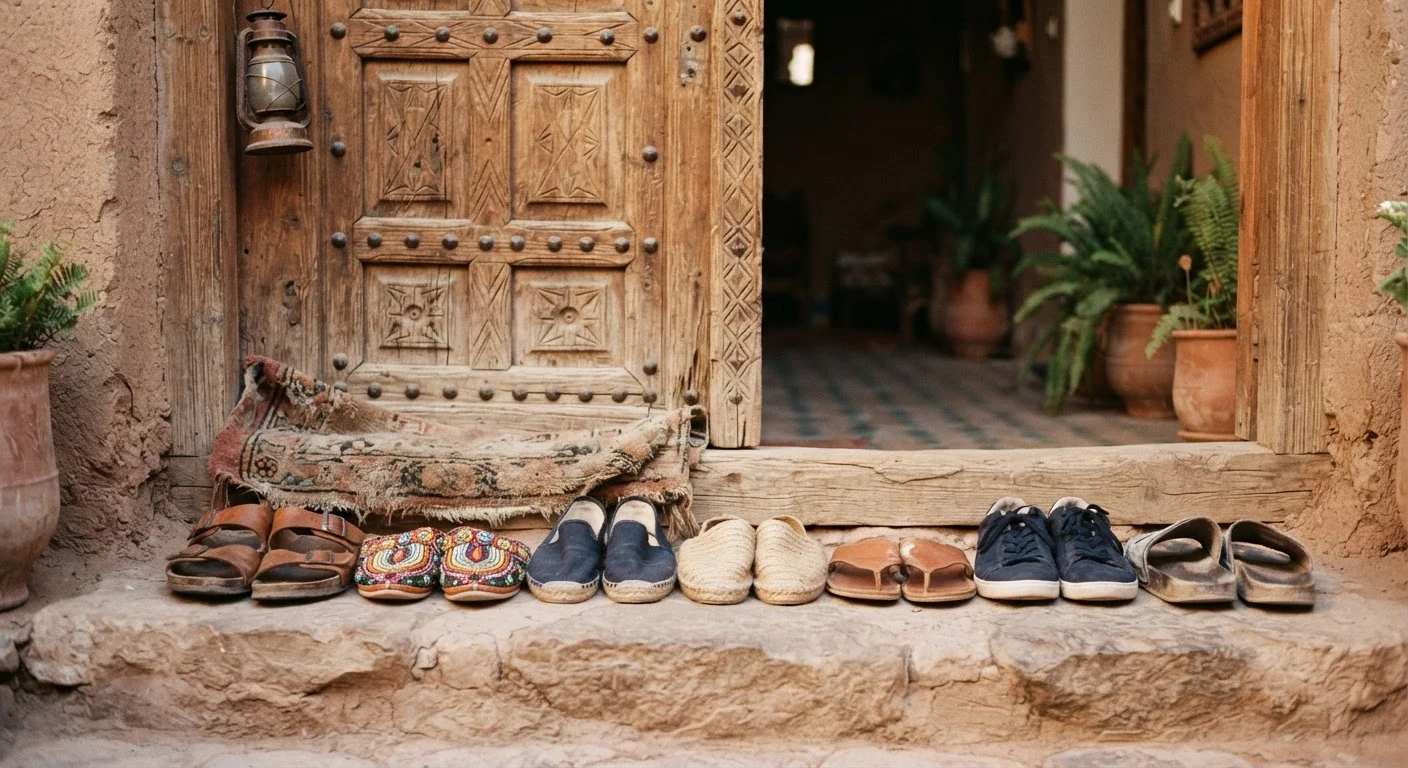
- Look for a shoe rack or mat near the entrance — this is a near-universal signal that footwear stays outside.
- Watch what locals do the moment they arrive at a doorway. If others are removing shoes, follow their lead without hesitation.
- When visiting religious sites, always research the specific site beforehand. Many temples and mosques post signs at the entrance, but not all do. Our article on dress codes and modesty covers related expectations that often go hand-in-hand with shoe rules.
- Pack clean socks when traveling in regions where shoe removal is common. Arriving barefoot isn't always appropriate, and worn-out socks can be an awkward surprise.
Travel Tip: Wear Easy-to-Remove Footwear
When visiting countries where shoe removal is common — Japan, South Korea, Thailand, and parts of the Middle East — choose footwear that slips on and off easily. Shoes with complex laces or buckles slow you down at doorways and can create bottlenecks, especially at popular temples. A clean, simple pair of slip-on shoes or sandals goes a long way.
One final note: don't assume that because a custom feels unfamiliar, it's optional. Shoe removal is rarely just about cleanliness — it signals that you recognize and honor the values of the space you're entering. That awareness, more than any single rule, is what separates a thoughtful traveler from an oblivious one.
Curious about other etiquette myths that trip up travelers? Common misconceptions about cultural customs are more widespread than you might expect.
“Etiquette is not about rigid rules — it's about being aware of how your actions affect the people around you. Something as simple as removing your shoes can communicate volumes of respect without saying a word.”
— Judith Martin, American author and etiquette authority, known for her writing on manners and social conduct