
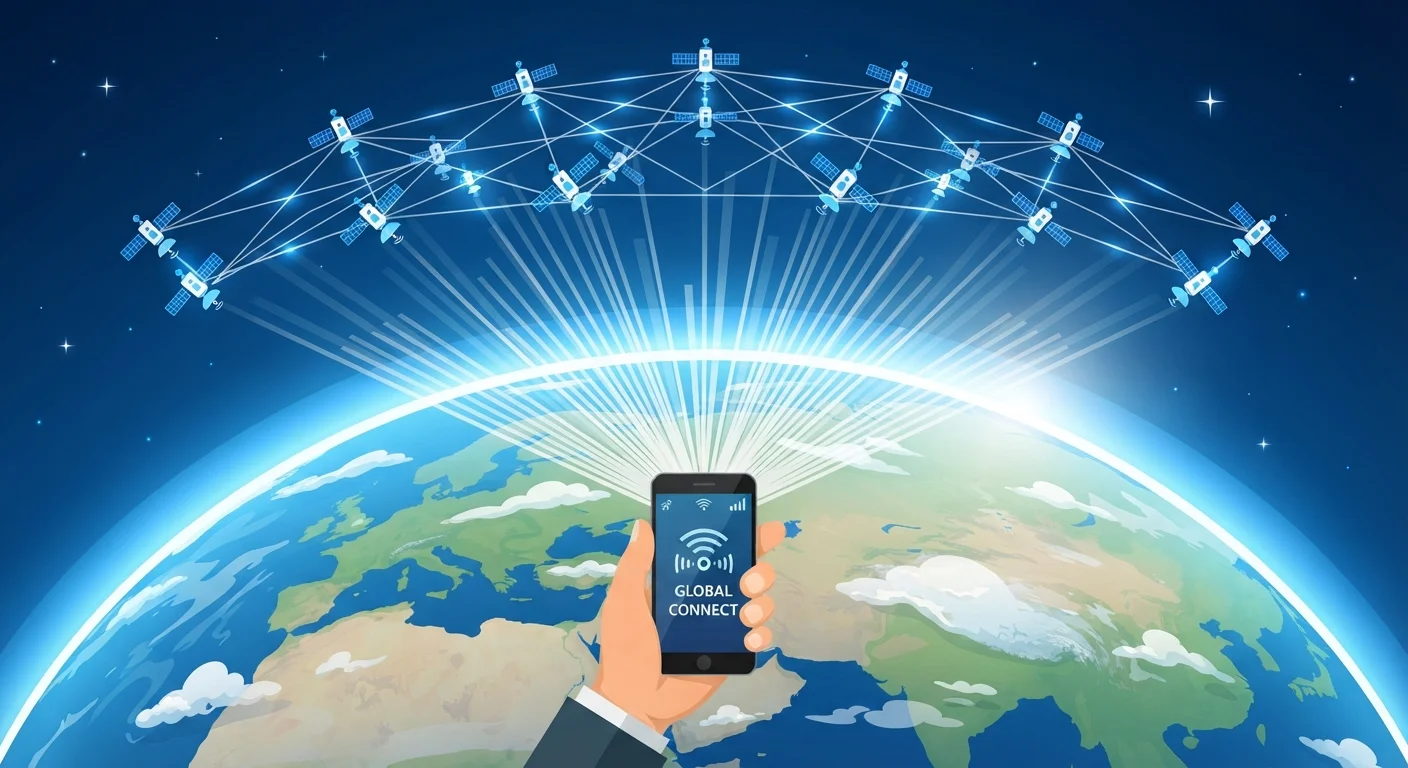
The Core Idea: Timing Is Everything
GPS works on one elegant principle: if you know how long a signal took to reach you, you know how far away its source is. Radio signals travel at the speed of light — about 186,000 miles per second. Each GPS satellite constantly broadcasts a time-stamped signal. Your phone receives that signal, compares the arrival time to the broadcast time, and calculates the distance to that satellite.
One distance measurement gives you a sphere of possible locations — you're somewhere on the surface of that sphere. A second satellite narrows it to a circle where two spheres intersect. A third satellite narrows it to two specific points. A fourth satellite resolves the ambiguity and adds altitude, giving you a precise three-dimensional fix.
This technique is called trilateration (not triangulation, which uses angles). It requires no input from you, no internet, and no signal sent back to space — your phone is purely a listener.
24+
Active GPS satellites in orbit
The U.S. Space Force maintains a minimum of 24 operational satellites to ensure global coverage at all times.
12,500 mi
Altitude of GPS satellites above Earth
GPS satellites orbit in medium Earth orbit, far higher than the International Space Station but well below geostationary orbit.
~10 ft
Typical civilian GPS accuracy
Under open sky, most modern smartphones can pinpoint your location to within approximately 10–16 feet (3–5 meters).
The Satellites Above Your Head
The GPS constellation maintained by the U.S. Space Force consists of at least 24 operational satellites orbiting about 12,500 miles above Earth. They're arranged so that at least four satellites are visible from virtually any point on the planet at any time.
Each satellite carries extremely precise atomic clocks — accurate to within a few nanoseconds — and continuously broadcasts its position and the exact time. Without that precision, errors would compound quickly: a one-microsecond timing error translates to roughly 1,000 feet of positional error.
GPS Is a One-Way Street
A common misconception is that GPS satellites track you. In reality, satellites only broadcast — they never receive. Your phone listens passively to satellite signals and does all the math locally. The satellites have no idea you exist. Privacy concerns about location data relate to the apps and services on your phone, not to the GPS system itself.
Your phone has its own GPS receiver chip — a component dedicated to picking up these weak satellite signals. To learn more about what other chips do the heavy lifting inside your device, see what every smartphone component actually does.
Why Your Phone Is Even Faster Than Pure GPS
Waiting for a cold GPS fix can take nearly a minute. Smartphone makers solve this with a technique called Assisted GPS (A-GPS). Your phone downloads a compact file from the internet telling it where satellites currently are in the sky, so it knows exactly where to look rather than scanning blindly. This slashes fix time from a minute to just a few seconds.
Beyond A-GPS, your phone continuously blends three positioning technologies:
- GPS satellites — most accurate outdoors with open sky
- Cell tower triangulation — works indoors, accurate to a few hundred feet
- Wi-Fi positioning — uses known router locations, accurate to tens of feet inside buildings
This blended approach, sometimes called sensor fusion, is why your map app often shows your location nearly instantly — even before a full satellite fix is established. The same principle of keeping data synchronized across sources underpins other phone features too; see how your devices stay in sync for a related look at how phones share information seamlessly.
Improve GPS Lock Speed Outdoors
If your GPS is slow to acquire a fix, step away from tall buildings and look for open sky. Disabling and re-enabling Location Services can also force your phone to refresh its satellite data. Keeping your phone's software up to date ensures it has the latest A-GPS assistance data for fastest lock times.
What Can Interfere With GPS Accuracy
GPS signals are surprisingly faint by the time they travel 12,500 miles — about as weak as a car headlight seen from halfway around the Earth. Several things degrade them:
- Urban canyons — tall buildings cause signals to bounce before reaching your phone, introducing timing errors called multipath interference
- Dense tree canopy — leaves absorb and scatter radio waves
- Indoors — walls and roofs block direct line-of-sight to satellites
- Atmospheric conditions — the ionosphere and troposphere slightly slow signals; GPS systems apply correction models to compensate
Despite these challenges, consumer devices routinely achieve accuracy within 10–16 feet under normal outdoor conditions — more than sufficient for turn-by-turn navigation or finding a nearby restaurant.