
Why These Three Things Work Together
Most financial guides treat savings, credit, and debt as separate subjects. In real life, they're tightly connected. A decision in one area almost always ripples into the others.
Think of it this way: if you have savings, you're less likely to need to borrow money in a pinch. If you borrow responsibly and repay on time, your credit score rises. A strong credit score means you'll pay less interest if you ever do need to borrow. These aren't three separate topics — they're three parts of one system.
This guide explains each piece in plain language and shows you how they fit together. No prior knowledge needed. For a deeper look at everyday money decisions and habits, that hub is a useful companion to what you'll read here.
Savings Accounts: Your Financial Safety Net
A savings account is a bank account designed to hold money you're not spending right now. Unlike a checking account (used for daily spending), a savings account typically earns a small amount of interest — meaning the bank pays you a little for keeping money there.
The most important function of a savings account isn't earning interest. It's having a buffer. When an unexpected expense hits — a car repair, a medical bill, a lost job — savings mean you can handle it without going into debt.
Start Small With Your Emergency Fund
You don't need thousands of dollars saved before your emergency fund becomes useful. Even $300–$500 can cover common small emergencies like a minor car repair or an unexpected utility bill. Build it gradually rather than waiting until you can save a larger amount all at once.
Financial educators commonly suggest working toward an emergency fund of three to six months of essential living expenses. Starting with even $500 set aside provides meaningful protection compared to having nothing.
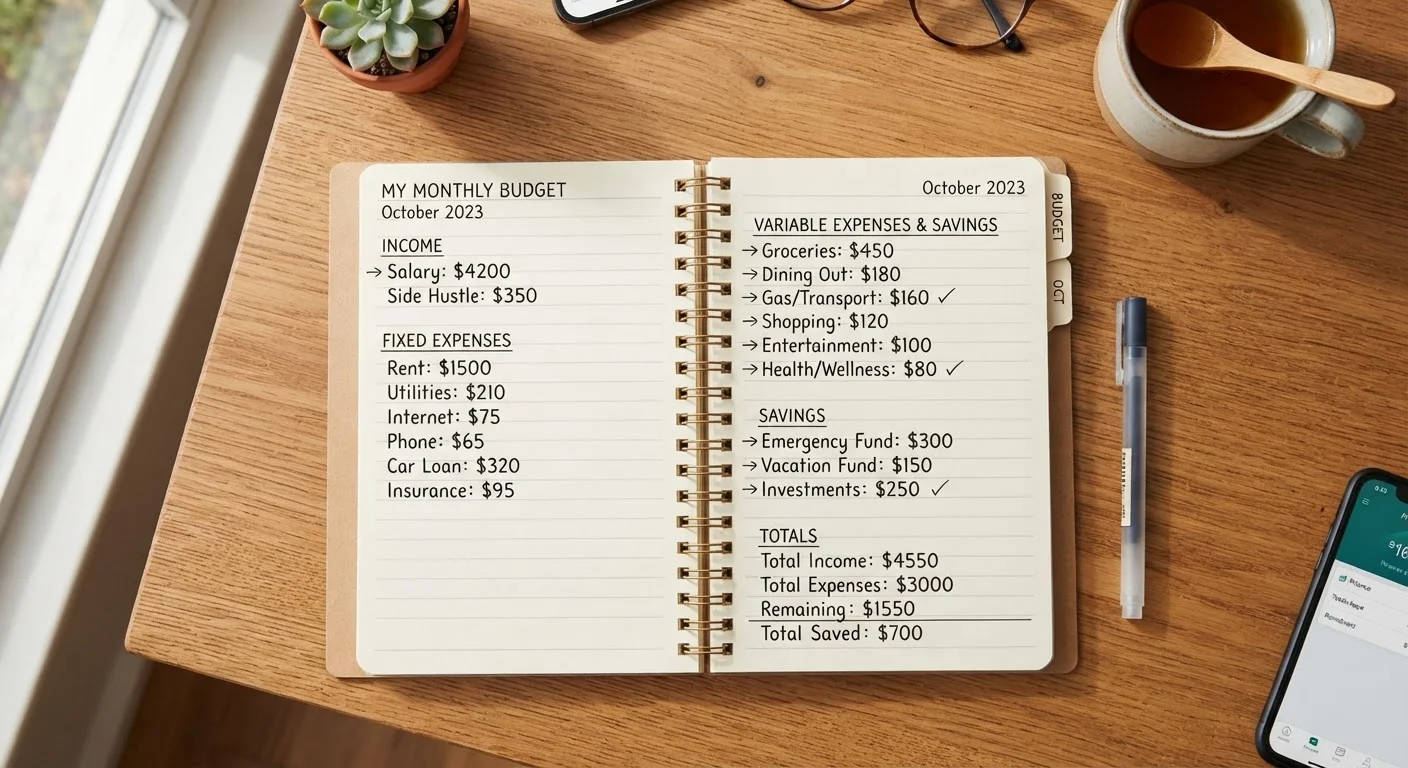
If budgeting is new to you, the complete beginner's budgeting walkthrough can help you find room to save each month.
Credit Scores: What They Are and Why They Matter
A credit score is a three-digit number — typically ranging from 300 to 850 in the U.S. — that summarizes how reliably you've repaid borrowed money in the past. Lenders use it to decide whether to lend you money and at what interest rate.
Five main factors shape your score:
- Payment history — Do you pay on time? This is the biggest factor.
- Credit utilization — What percentage of your available credit are you using? Lower is better.
- Length of credit history — How long have your accounts been open?
- Credit mix — Do you have different types of credit (cards, loans)?
- New credit — Have you applied for a lot of new credit recently?
35%
Share of credit score from payment history
According to FICO, the payment history category carries more weight than any other single factor in your credit score calculation.
57%
Americans with less than 3 months of emergency savings
A Bankrate survey found that a majority of U.S. adults do not have enough savings to cover three months of expenses without borrowing.
30%
Recommended credit utilization ceiling
Credit experts generally advise keeping your credit utilization ratio below 30% to avoid negatively impacting your score.
If you've never borrowed before and want to understand the basics before you do, our first-time credit guide covers the fundamentals clearly.
Debt Basics: Borrowing Without Getting Trapped
Debt is money you've borrowed and agreed to pay back, usually with interest. Interest is the cost of borrowing — expressed as a percentage of what you owe.
Not all debt is equally risky. A low-interest student loan or mortgage is very different from a high-interest credit card balance. The key variables to understand are:
- Interest rate (APR)
- The annual cost of borrowing, expressed as a percentage. A 5% rate costs far less over time than a 25% rate.
- Minimum payment
- The smallest amount you're required to pay each month. Paying only the minimum on high-interest debt means you pay much more over time.
- Principal
- The original amount you borrowed, separate from any interest that has accumulated.
Minimum Payments Can Be Misleading
Credit card minimum payments are designed to keep you in debt longer. On a $2,000 balance at 20% APR, paying only the minimum each month could take over a decade to fully repay and cost more in interest than the original purchase. Always aim to pay more than the minimum when you can.
How Savings, Credit, and Debt Interact
Here's where it gets practical. Consider a few real scenarios:
- No savings, surprise expense: Without savings, you put a $900 car repair on a credit card at 22% APR. If you pay only the minimum, that repair costs significantly more in the end — and your credit utilization rises, which can lower your score.
- Savings cushion exists: Same repair, but you pay cash from your emergency fund. No debt, no interest, no credit score impact. You then gradually rebuild the fund.
- Good credit score, planned borrowing: When you eventually need a larger loan — say, for a car or home — a strong credit score qualifies you for a lower interest rate, saving you money over the life of the loan.
Automate a small savings transfer on the same day you get paid — even $20 or $50. Treating savings as a fixed 'bill' removes the temptation to spend it first.
Behavioral finance research consistently shows that automatic transfers outperform manual saving intentions because they eliminate the decision point entirely.
Before applying for new credit, check whether the lender does a 'soft' or 'hard' credit inquiry. Multiple hard inquiries in a short window can temporarily lower your score.
Each hard inquiry signals to lenders that you may be taking on new obligations, which can reduce your score by a few points — especially significant if you're planning a major loan soon.
The complete personal budgeting resource shows how a budget ties all of this together month to month.
Your First Steps Forward
You don't need to fix everything at once. Here's a practical starting order:
- Open a savings account if you don't have one. Even small regular deposits build the habit.
- Check your credit score. In the U.S., you can access free credit reports at AnnualCreditReport.com. Many banks and credit card issuers also show your score for free.
- List any debts you have — write down the balance, interest rate, and minimum payment for each.
- Pay at least the minimum on all debts on time, every month. Payment history is the most influential factor in your credit score.
- Direct any extra money first toward high-interest debt, then toward building savings.
Credit Scores Vary by Scoring Model
There are multiple credit scoring models in use — FICO and VantageScore are the most common. Different lenders may pull from different models and different credit bureaus (Experian, Equifax, or TransUnion). Slight variations between scores you see are normal and expected.
These are general financial education principles. For guidance tailored to your specific situation — especially around significant debt or major financial decisions — consider consulting a licensed financial professional.
This article is for general informational and educational purposes only. It is not personalized financial, investment, tax, or legal advice. Consult a qualified financial professional before making decisions about your specific circumstances.