How Each Method Works
Understanding these two approaches starts with seeing exactly what each one asks you to do day to day.
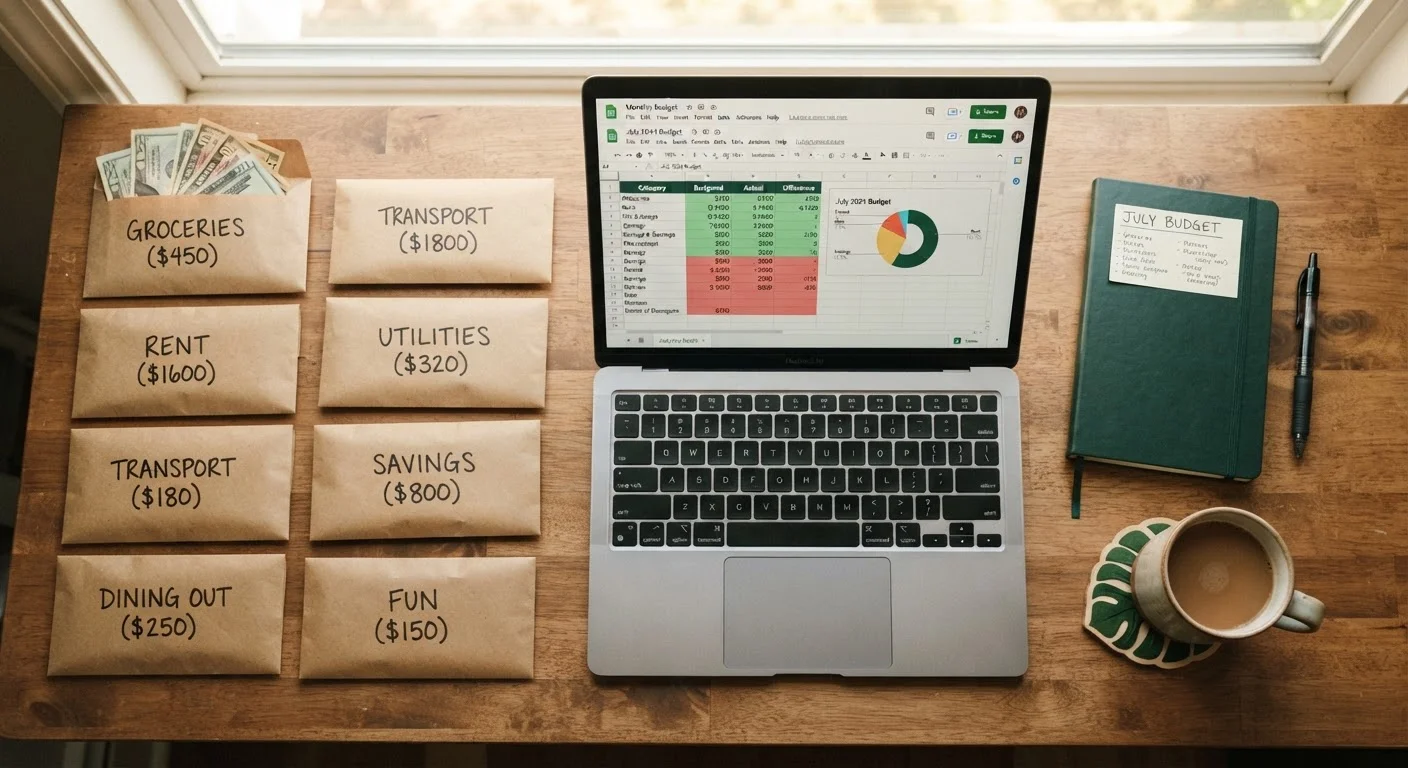
Envelope budgeting is straightforward: when you get paid, you withdraw cash and divide it into labeled envelopes — one for groceries, one for gas, one for dining out, and so on. Each envelope holds only what you've decided to spend in that category. When the money is gone, spending in that category stops until next payday. No math required mid-month — the envelope balance is the answer.
Spreadsheet budgeting works differently. You set up a digital document — in a program like Google Sheets or similar — with columns for each spending category, your income, and your planned limits. Every time you spend money, you record the transaction. At any point you can see how much you've spent versus how much you planned, across every category at once.
Both methods follow the same core principle: assign every dollar a job before you spend it. If you want a broader look at how budgeting frameworks compare, see Popular Budgeting Methods, Compared.
| Criterion | Envelope Budgeting | Spreadsheet Budgeting |
|---|---|---|
| Format | Physical cash in labeled envelopes | Digital document with rows and columns |
| Setup time | Minutes — just envelopes and cash | Longer — requires building or finding a template |
| Works with card payments | Not directly — workarounds needed | Yes — log any transaction type |
| Spending enforcement | Automatic — empty envelope = stop spending | Manual — relies on self-discipline |
| Flexibility mid-month | Low — moving cash between envelopes takes effort | High — edit numbers instantly |
| Historical tracking | Limited — cash doesn't leave a record | Strong — all data stays in the file |
| Tech skills required | None | Basic spreadsheet familiarity helpful |
Where Each Method Tends to Struggle
Knowing the limitations of each approach helps you pick realistically — or plan around the gaps.
Envelope budgeting's main friction point is the modern economy. Most bills, subscriptions, and online purchases don't accept cash. Workarounds exist — like using a debit card and manually moving money between accounts mirroring your envelopes — but they add steps and reduce the simplicity that makes the method appealing in the first place. Keeping physical cash also carries a small security risk.
Spreadsheet budgeting's challenge is consistency. The system only works if you log transactions regularly. Miss a week and you're estimating, which undermines the whole point. It also has a setup cost: building a useful spreadsheet from scratch takes time, and a poorly designed one can feel more confusing than helpful.
A Note on Digital Envelope Systems
Several apps attempt to replicate envelope budgeting digitally — you allocate money to virtual 'envelopes' and deduct from them as you spend. These can be a useful middle ground if you like the envelope logic but pay mostly by card. They carry the same consistency requirement as spreadsheets, however: you still need to log transactions to keep the balances accurate.
For practical ideas on staying consistent with either method, Money Habits That Make Budgeting Easier Over Time covers the everyday routines that make tracking feel less like a chore.
Which One Actually Fits Your Life?
The honest answer: the best budgeting method is the one you'll actually stick with.
Envelope budgeting tends to work well for people who spend mostly in cash-friendly categories — groceries, gas, restaurants — and who benefit from a visible, tactile limit. It's particularly effective for anyone who has noticed that seeing a card balance doesn't feel as real as holding physical bills.
Spreadsheet budgeting tends to suit people who pay most things digitally, have variable income, or want to track more than a handful of categories. It also scales easily: you can add complexity (like savings goals or debt tracking) without rebuilding the system.
~30%
U.S. adults with a detailed monthly budget
Surveys by the National Foundation for Credit Counseling have consistently found that fewer than a third of American adults maintain a detailed household budget.
1 in 3
Adults who say cash helps them spend less
Research on payment psychology, including studies cited by the Federal Reserve, suggests a meaningful share of consumers feel more spending restraint when using physical cash versus cards.
Some people blend the two — using a spreadsheet for the overall picture and cash envelopes for just one or two problem categories, like dining out or entertainment. That hybrid approach can reduce the downsides of both.
If you're starting from scratch, Building a Monthly Budget: A Step-by-Step Approach walks through the basics of setting spending categories and limits regardless of which tracking method you choose. And once a month, a quick review using a Monthly Budget Review Checklist helps either system stay accurate.
This article is for general informational purposes only and does not constitute personalised financial advice. Consider speaking with a qualified financial professional about decisions specific to your situation.