Why Dough Rises: The Basic Idea
Every leavened baked good — bread, muffins, pancakes, pizza — gets its airy texture from one process: gas bubbles forming inside the dough or batter, then expanding in the oven's heat. The gas is almost always carbon dioxide (CO₂). What differs between methods is how that CO₂ is generated.
Think of dough as a stretchy net made from gluten — the protein that forms when flour meets water. That net traps gas bubbles, and as they expand, the dough puffs up. Lock those bubbles in place with oven heat, and you get a light, open crumb. Understanding the source of those bubbles explains everything about timing, flavor, and texture. It also helps you understand the flour itself — see our article on how different flour types affect baking for more context.
Commercial Yeast: Fast, Predictable, and Reliable
Commercial yeast is a single-strain microorganism — Saccharomyces cerevisiae — cultivated specifically for baking and sold in three main forms: active dry, instant (also called rapid-rise), and fresh cake yeast. All three work the same way: the yeast cells consume simple sugars in the dough and produce CO₂ and a small amount of alcohol as byproducts. This is fermentation.
For yeast to work, it needs three things: food (sugars from flour or added sugar), moisture, and warmth — typically between 75°F and 95°F (24°C–35°C). Too cold and the yeast goes dormant; too hot and it dies. This is why recipes ask you to "proof" yeast in warm water first.
Try a Cold Slow Rise for More Flavor
After mixing a yeast dough, cover it and refrigerate overnight instead of letting it rise at room temperature. The cold slows fermentation dramatically, giving enzymes more time to break down starches into flavorful compounds. The result is a noticeably more complex-tasting loaf with very little extra effort.
The fermentation time in a yeast bread — even a quick 90-minute rise — allows a modest amount of flavor development. Longer, slower fermentation in the refrigerator deepens that flavor considerably, which is why many bakers use a cold overnight rise.
Sourdough Starter: A Living Community
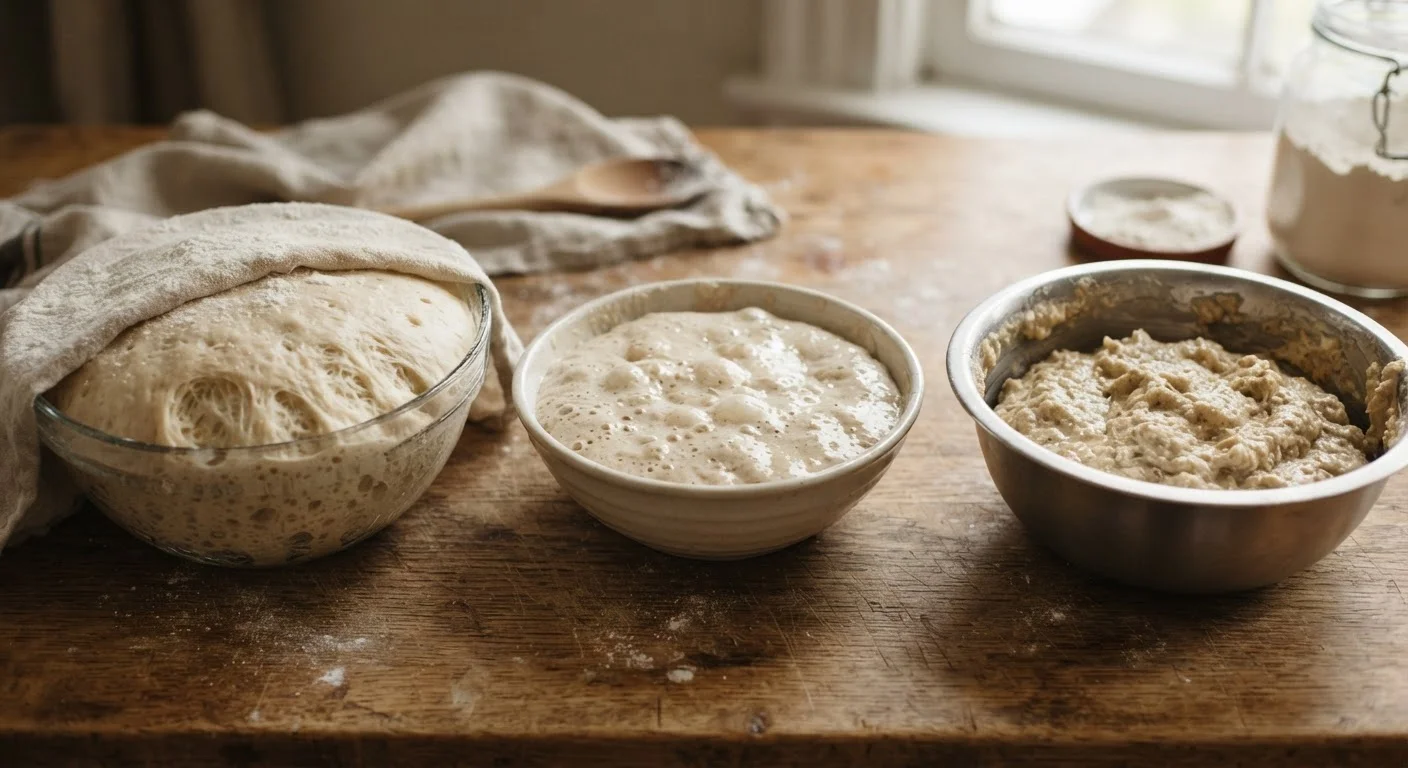
A sourdough starter is not a single organism but an ecosystem — a mixture of wild yeasts and lactic acid bacteria that colonize a paste of flour and water over several days. The wild yeasts produce CO₂ just as commercial yeast does, but the bacteria are the key difference: they produce lactic and acetic acids, which give sourdough its characteristic tang.
Because wild yeasts are less concentrated and less uniform than commercial strains, sourdough fermentation is significantly slower — typically 8 to 24 hours for a full rise at room temperature, sometimes longer. That extended fermentation isn't a drawback; it's the point. It develops complex flavor, improves digestibility of certain proteins and starches, and produces a loaf that stays fresh longer than commercial-yeast bread.
Maintaining a starter requires regular feeding with fresh flour and water. If neglected, the acid balance shifts and the starter weakens. The acids in sourdough also interact with other ingredients — our explainer on how food acids affect texture and flavor can deepen your understanding of that chemistry.
| Commercial Yeast | Sourdough Starter | Baking Soda | Baking Powder | |
|---|---|---|---|---|
| Leavening mechanism | Biological fermentation | Wild yeast + bacterial fermentation | Acid-base chemical reaction | Double acid-base chemical reaction |
| Time to leaven | 1–3 hours | 8–24+ hours | Immediate | Immediate + oven boost |
| Flavor contribution | Mild yeasty aroma | Complex, tangy, sour | Neutral (may taste soapy if excess) | Neutral |
| Needs acids in recipe? | No | No (produces its own) | Yes — essential | No (acid included) |
| Skill level required | Beginner-friendly | Intermediate — requires starter care | Very easy | Very easy |
| Best used in | Bread, pizza, rolls | Artisan bread, crackers | Muffins, pancakes, soda bread | Cakes, biscuits, quick breads |
Chemical Leaveners: Baking Soda and Baking Powder
Chemical leaveners generate CO₂ through acid-base reactions rather than biological ones. No living organisms are involved, and no waiting is required.
Baking soda (sodium bicarbonate) is a pure base. It needs an acidic ingredient in the recipe — buttermilk, yogurt, molasses, cocoa — to react and release CO₂. The reaction begins the moment baking soda meets moisture, so batters using it should go into the oven promptly.
Baking powder contains baking soda plus a dry acid (usually cream of tartar or sodium aluminum sulfate) and a starch to prevent premature reaction. Most modern baking powder is "double-acting," meaning it releases some CO₂ when it gets wet and a second burst when it hits oven heat. This gives bakers more flexibility.
Neither leavener adds flavor the way yeast or sourdough does — though baking soda can leave a soapy taste if used in excess or without enough acid to neutralize it. Chemical leaveners are ideal for quick breads, cakes, muffins, and scones where a light crumb and fast preparation are the priorities.
~8–24 hrs
Typical sourdough bulk fermentation time
Wild yeast strains are less concentrated than commercial varieties, requiring significantly longer fermentation to achieve a full rise.
2 reactions
CO₂ release stages in double-acting baking powder
Double-acting baking powder releases gas once when wetted and again when heated, providing more lift than single-acting formulas.