Why So Many Sugars?
Walk down any grocery aisle or open a recipe, and you'll meet a parade of sugar names: caster sugar, turbinado, dextrose, high-fructose corn syrup. They're not interchangeable, and knowing the difference helps you cook smarter, read labels more confidently, and understand what you're actually eating.
All sugars are carbohydrates made of one or two simple molecules. How they're processed, which molecules they contain, and what moisture or molasses is left behind determines their color, sweetness, texture, and behavior in cooking. Think of the various forms as members of the same family — related, but with distinct personalities.
| Primary source of granulated sugar | Sugarcane or sugar beet |
| Sweetest common sugar type | Fructose (found in fruit and invert sugar) |
| What makes brown sugar soft | Molasses content — it retains moisture |
| Main use of powdered sugar | Frostings, icings, and decorative dustings |
| What invert sugar prevents | Crystallization in candies and baked goods |
| Least sweet commonly used sugar | Dextrose (glucose) |
The Core Sugar Types, Explained
Granulated (White) Sugar
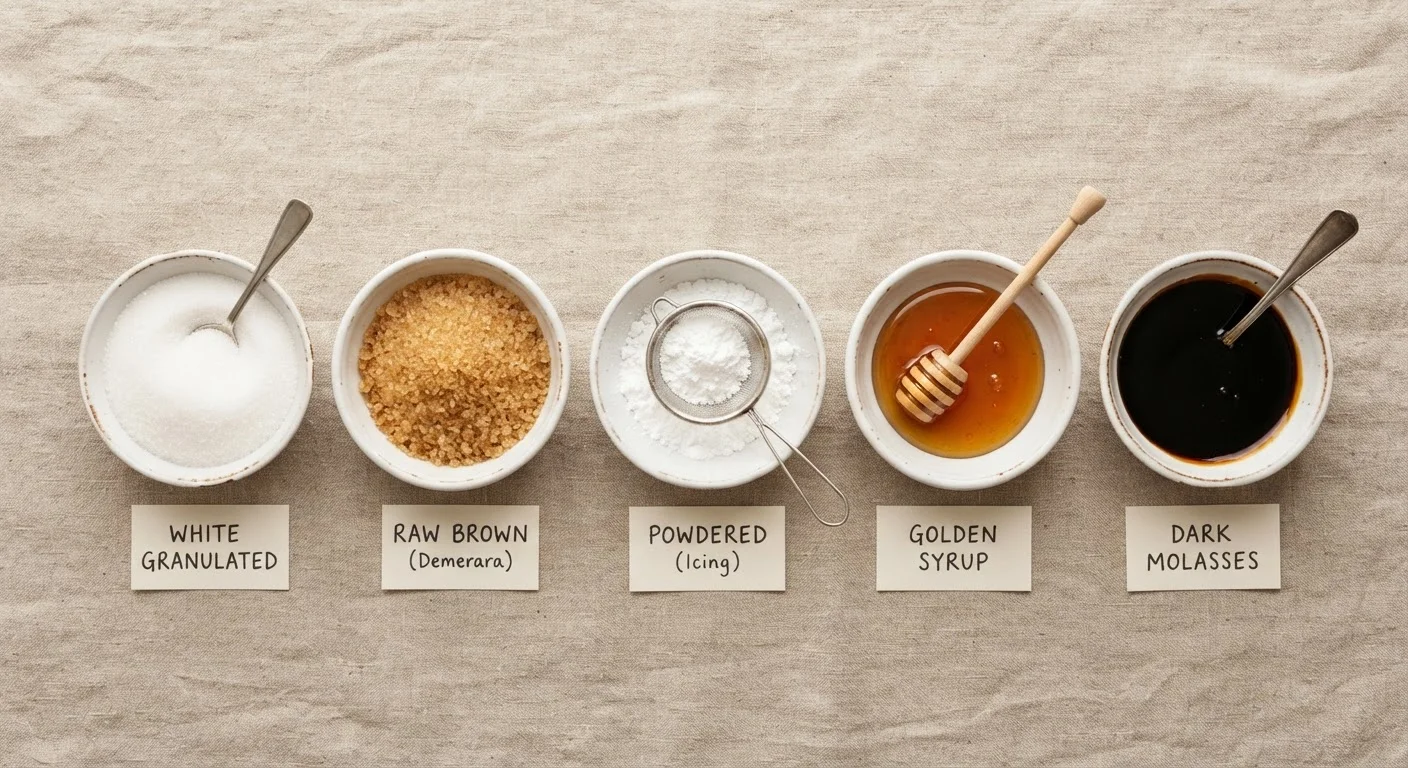
The most common kitchen sugar, made from either sugarcane or sugar beet. It's been refined to remove molasses, leaving pure sucrose crystals. Reliable and neutral, it dissolves well in most applications.
Caster (Superfine) Sugar
Same chemistry as granulated, but the crystals are ground much finer. This makes it dissolve faster — ideal for meringues, cocktails, and delicate cakes where undissolved grit would be a problem.
Powdered (Confectioners') Sugar
White sugar ground to a powder, typically with a small amount of starch (often cornstarch) added to prevent clumping. Used in frostings, icings, and dusting baked goods.
Brown Sugar
White sugar with molasses added back in. Light brown sugar has a subtle caramel note; dark brown sugar has a more pronounced, almost toffee-like depth. The moisture from molasses keeps it soft and lends chewiness to cookies and baked goods.
Raw and Turbinado Sugar
Minimally refined sugars where some natural molasses is retained in the crystal. Turbinado has large, amber crystals and a mild molasses flavor — popular as a finishing sugar on muffins and scones.
Muscovado Sugar
An unrefined cane sugar that retains significant molasses, giving it a moist, sticky texture and a bold, almost smoky-sweet flavor. It's used in rich cakes, chutneys, and barbecue sauces.
Sucrose
The scientific name for common table sugar. It's a disaccharide composed of one glucose molecule and one fructose molecule bonded together.
Invert Sugar
Sucrose that has been split into its two component sugars, glucose and fructose. It's sweeter than whole sucrose and prevents crystallization in confections.
Molasses
The dark, syrupy byproduct left over when sugarcane juice is refined into white crystals. It ranges from mild (light molasses) to intensely flavored (blackstrap).
Dextrose
Another name for glucose in its pure form. It's the simplest sugar unit, less sweet than sucrose, and commonly used in food manufacturing and sports nutrition.
Caramelization
The browning reaction that occurs when sugar is heated to high temperatures without protein present. It creates the characteristic amber color and complex flavor of caramel.
Refining
The industrial process of removing impurities, plant material, and molasses from raw sugar to produce white crystals of near-pure sucrose.
Liquid and Processed Sugars
Invert Sugar
When sucrose is broken down (either by acid or enzymes) into its two component molecules — glucose and fructose — the result is invert sugar. It's sweeter than regular sugar, resists crystallization, and keeps baked goods moist longer. You'll see it in professional pastry recipes and on many ingredient labels.
High-Fructose Corn Syrup (HFCS)
Made from cornstarch, this liquid sweetener is processed to convert some glucose into fructose, producing a sweetness level similar to sucrose. It's common in commercially produced beverages, breads, and condiments. For more on how sugars appear in fruit drinks, see reading fruit beverage labels.
Dextrose
Another name for pure glucose. Less sweet than sucrose, it's used in sports drinks, baked goods, and processed foods because it browns well under heat (a reaction called caramelization and the Maillard reaction) and is quickly absorbed by the body.
Molasses
The dark, thick byproduct of refining sugarcane into white sugar. Blackstrap molasses — the final extraction — is the least sweet but richest in minerals. It's the base flavor in dark rum and gingerbread.
Understanding which sugar is added versus which occurs naturally in food is a different but equally important topic — natural sugars vs. added sugars covers that distinction in depth.
Sugar Names on Ingredient Labels
Food labels may list sugar under many different names: sucrose, dextrose, maltose, fructose, syrup, and more. All of these count as added sugar for nutritional purposes. Scanning an ingredient list for any word ending in '-ose' or including 'syrup' is a quick way to spot them.