What MSG Actually Is
Monosodium glutamate is a sodium salt of glutamic acid, an amino acid that occurs widely in nature. Glutamic acid is a building block of proteins, and when it appears in its free (unbound) form — either through fermentation, aging, or natural breakdown — it registers as the taste scientists call umami, often described as savory, deep, or broth-like.
MSG was first isolated in 1908 by Japanese chemist Kikunae Ikeda from kombu seaweed. Today it is commercially produced through bacterial fermentation of starch or molasses, a process similar to how yogurt and vinegar are made. The result is identical in chemical structure to the glutamate your body already produces and processes daily.
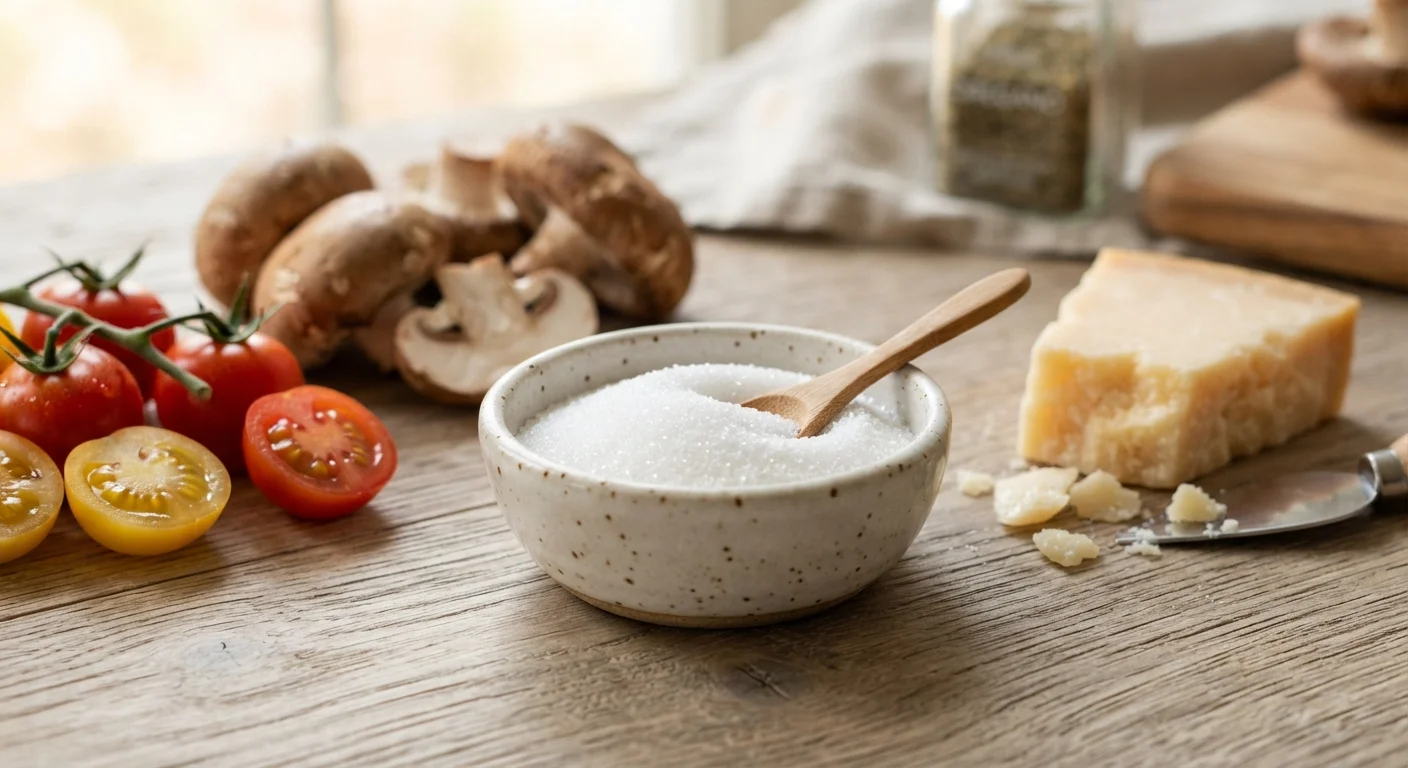
Because glutamate is present in so many whole foods, you almost certainly eat it regularly without thinking about it. Ripe tomatoes, parmesan cheese, soy sauce, anchovies, and dried mushrooms are all naturally high in free glutamate — the same compound that makes MSG work. Understanding the ingredient label context is useful here; see our guide on reading a food ingredient list if you want to spot glutamate-containing additives by their listed names.
Common Myths, Corrected
Few food additives carry as much mythology as MSG. Here are the most persistent misconceptions, measured against what evidence actually shows.
Myth
MSG causes headaches, flushing, and other symptoms — a condition known as 'Chinese Restaurant Syndrome.'
Fact
Controlled double-blind studies have repeatedly failed to confirm a reliable link between MSG consumption and these symptoms at normal dietary doses.
The term 'Chinese Restaurant Syndrome' entered popular vocabulary after a 1968 letter in the New England Journal of Medicine described personal symptoms following a meal. It was anecdotal, not a study. Subsequent controlled trials, in which participants consumed MSG or a placebo without knowing which, found no consistent, reproducible reaction attributable to MSG. Regulatory bodies including the U.S. Food and Drug Administration (FDA) and the European Food Safety Authority (EFSA) have reviewed the evidence and concluded MSG is safe at typical intake levels. Some individuals may be sensitive to very large quantities, but the same is true of many common food components, including caffeine and histamine.
Myth
MSG is an artificial chemical with no place in natural food.
Fact
MSG is chemically identical to the glutamate found naturally in many whole foods, and it is produced by a natural fermentation process.
Describing MSG as 'artificial' depends heavily on how you define the word. Its production via fermentation of plant starches is analogous to making vinegar or miso. More importantly, your body cannot distinguish between glutamate from a tomato and glutamate from a packet of MSG — they are the same molecule. The line between 'natural' and 'artificial' in food labeling is often more legal than chemical, as our article on natural and artificial flavours explains in detail.
Myth
MSG is just another form of salt, so it's as bad for blood pressure as adding extra sodium.
Fact
MSG contains significantly less sodium by weight than table salt and can reduce total sodium in a dish when used as a partial substitute.
Table salt (sodium chloride) is approximately 39% sodium by weight. MSG is approximately 12% sodium. Research published in food science journals has explored whether partially replacing salt with MSG in recipes can lower overall sodium content while maintaining acceptable saltiness and savory depth. The results are generally positive for sodium reduction. This doesn't mean MSG is a health treatment or that anyone should self-prescribe dietary changes — anyone managing a sodium-sensitive condition should consult a healthcare professional before adjusting their diet.
Myth
If a product says 'no MSG,' it has no added glutamate at all.
Fact
'No MSG added' labels can be misleading — products may still contain ingredients like yeast extract or hydrolyzed protein that are high in free glutamate.
Labeling rules in the U.S. require that MSG be declared by name when added directly. However, ingredients such as hydrolyzed vegetable protein, autolyzed yeast extract, and certain flavor bases contain substantial free glutamate without triggering an 'MSG' declaration. A product can truthfully say 'no MSG added' while delivering a similar glutamate load through these alternative sources. If you are trying to minimize free glutamate for any reason, reading the full ingredient list carefully matters more than looking for a front-of-pack claim.
MSG in the Kitchen: What It Does and Doesn't Do
MSG enhances umami without adding saltiness, bitterness, or sweetness. A small amount — often less than a quarter teaspoon per serving — can make soups, stir-fries, and marinades taste more complete and satisfying. Because it contains only about 12% sodium by weight (compared to roughly 39% in table salt), cooks who use it as a partial substitute for salt can reduce overall sodium intake while maintaining perceived flavor intensity.
It doesn't, however, make bad food taste good. MSG amplifies existing savory qualities; it won't compensate for undercooked proteins or a poorly balanced dish. This is why learning to taste as you cook remains an essential skill — MSG is a seasoning tool, not a shortcut around technique.
It's also worth understanding that MSG sits in a broader category of flavor-modifying ingredients. If you're curious how regulators draw lines around flavor additives more generally, our explainer on natural and artificial flavours adds useful context.
~12%
Sodium content of MSG by weight
Compared to approximately 39% sodium in table salt, MSG offers a lower-sodium way to enhance savory flavor.
~0.5g/day
Estimated average MSG intake in MSG-consuming populations
Dietary surveys in countries where MSG is commonly used estimate typical daily intake at around 0.3–1.0 grams per day.