What Roasting Actually Does to a Coffee Bean
Before roasting, a coffee bean is green, dense, and tastes of almost nothing pleasant — grassy and intensely bitter if you brewed it. The roasting process is where flavour is born. As the bean heats up, moisture evaporates, the structure expands, and hundreds of new flavour compounds are created through the Maillard reaction and caramelisation of sugars.
Think of it like toasting bread. A lightly toasted slice keeps more of the grain's natural flavour, while heavily charred toast takes on a dominant smoky bitterness that overwhelms everything else. Coffee works the same way. The roaster's job is to decide exactly when to stop that process to land on a target flavour profile.
To understand how this connects to what ends up in your mug, it helps to know how coffee travels from farm to cup — because the bean's origin and processing also shape what roasting has to work with.
~800
Distinct flavour compounds created during roasting
Food chemists have identified around 800 volatile flavour and aroma compounds that form during coffee roasting, according to research published in food chemistry literature.
< 5%
Caffeine lost between light and dark roast
Studies on roasting chemistry consistently show caffeine content remains largely stable, with less than approximately 5% variation across roast levels when measured by weight.
180–230°C
Temperature range covering all roast levels
Light roasts typically finish around 180–205°C, while dark roasts can exceed 220–230°C, with the entire spectrum determining the bean's final flavour profile.
Light Roast: Bright, Fruity, and Complex
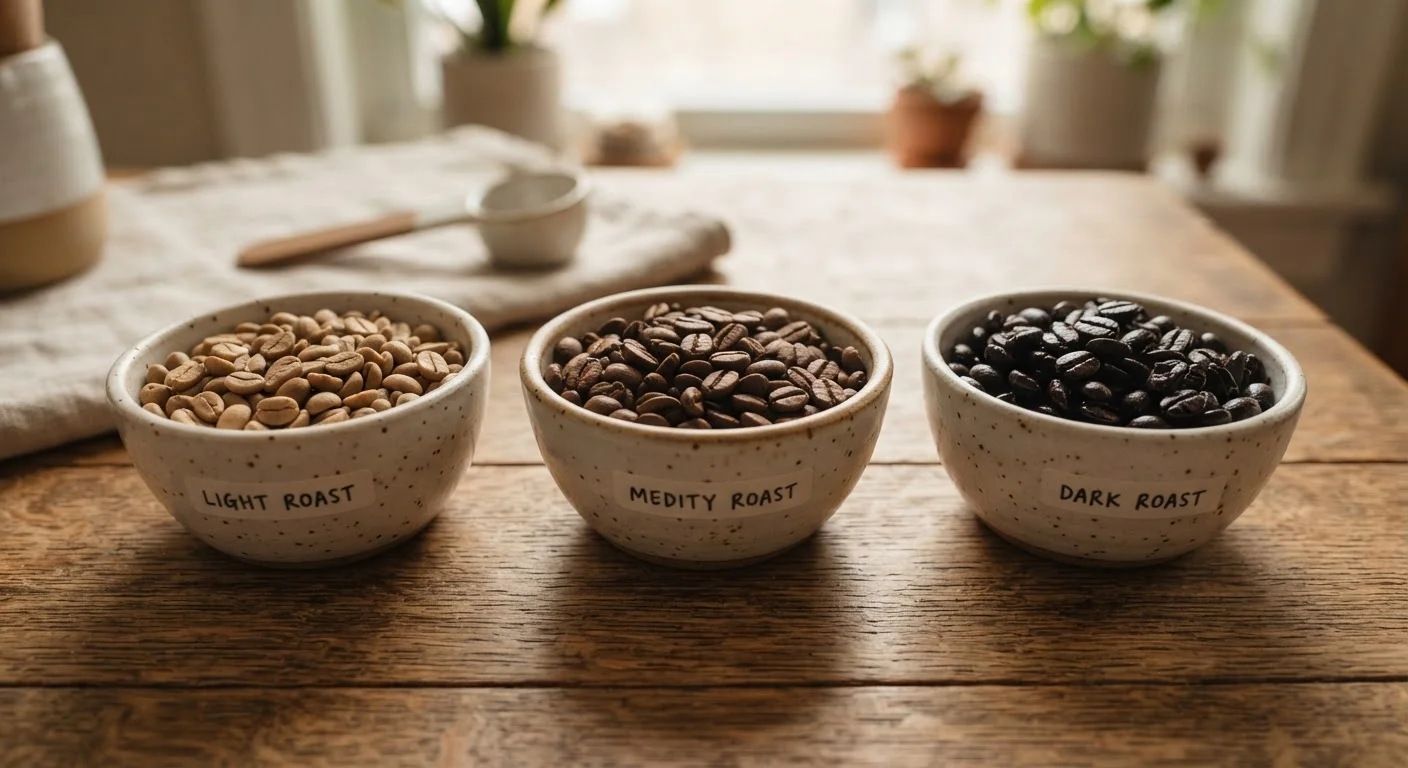
Light roasts reach an internal temperature of roughly 180–205°C and are pulled from the roaster just after or at what roasters call the 'first crack' — an audible pop as steam expands inside the bean. The bean is tan to light brown, dry on the surface, and retains most of its original character.
In the cup, light roasts are often described as bright, with noticeable acidity and flavours that mirror the coffee's growing region: tropical fruit, floral notes, berries, or citrus. Ethiopian light roasts, for example, are known for a jasmine-like aroma and blueberry undertones. The body (the weight or thickness of the liquid) tends to be lighter and tea-like.
Light roasts suit drinkers who want to taste the specific personality of a particular origin or variety — what the coffee world calls terroir.
Try the Same Bean at Different Roasts
If you want to understand roast impact clearly, look for a roaster that offers the same single-origin coffee at multiple roast levels. Tasting them side by side removes the variable of origin and lets you hear exactly what heat is doing to the flavour. Many specialty roasters offer tasting flights for this reason.
Medium and Dark Roast: Caramel, Chocolate, and Smoke
Medium roasts (roughly 210–220°C) develop further toward a balanced profile. The original fruit notes soften and sweeter, more familiar flavours emerge — caramel, milk chocolate, and nuts. Acidity mellows, body becomes fuller, and the coffee is often easier to drink without milk or sugar. Most everyday commercial coffee blends target this range.
Dark roasts (above 220°C, approaching or passing the 'second crack') go further still. By this stage, the bean's natural sugars have fully caramelised and many of the origin-specific flavour compounds have been replaced by roast-derived ones: dark chocolate, tobacco, smoke, and a pronounced bitterness. The surface of the bean turns oily as internal oils migrate outward.
At the extreme dark end — sometimes labelled French or Italian roast — the roasting flavour itself completely dominates. Critics argue this masks the bean's quality; proponents enjoy the bold, low-acid intensity.
The Caffeine Myth and What Roast Level Really Signals
One of the most persistent coffee misconceptions is that dark roast means more caffeine. In fact, caffeine survives roasting almost entirely intact. Dark beans are less dense because moisture and mass have been driven off, so if you measure by volume (scoops), a dark roast may deliver slightly less caffeine than a light one. By weight, the difference is negligible for most people.
What roast level genuinely signals is flavour philosophy. A coffee labelled 'light roast' tells you the roaster prioritised preserving the bean's original character. 'Dark roast' tells you they wanted bold, roast-forward intensity. Neither is superior — they serve different tastes and brewing contexts.
Interestingly, the way roasting manipulates flavour through heat is not so different from how other dry-heat cooking methods work. If you're curious how roasting compares to other oven techniques, roasting vs. baking breaks that distinction down.
“The roast level is a lens. It can either magnify what the farmer grew or replace it entirely with what the roaster chose. Neither is wrong — but knowing which you're drinking changes everything.”
— James Hoffmann, World Barista Champion and author of 'The World Atlas of Coffee'