Why Knowing Your Tools Matters
Picking up a heat tool without understanding how it works is a bit like cooking on an unfamiliar stove — the results can be unpredictable, and the risk of damage is real. Heat styling works by temporarily breaking the hydrogen bonds inside each hair strand, allowing you to reshape it. Different tools apply that heat in very different ways, which is why a curling wand and a flat iron are not interchangeable even though both get hot.
Before reaching for any tool, it helps to know your hair's natural structure. Understanding your hair type — whether it's straight, wavy, curly, or coily — directly affects which tools and temperatures are appropriate for you. You should also review your hair's current condition first; see our pre-routine health check before building any styling habit.
| Flat iron purpose | Smooths and straightens by clamping heated plates along the hair shaft |
| Curling wand vs. iron | Wand (no clamp) = natural waves; iron (with clamp) = uniform curls |
| Diffuser best for | Enhancing natural curl and wave without frizz-causing airflow |
| Heat protectant role | Reduces moisture loss and direct heat transfer to the hair strand |
| Temperature guidance | Fine/straight hair: lower temps (~300°F); thick/coarser hair: higher may be needed |
| General damage risk | Increases with frequency, high heat, and repeated passes over the same section |
The Main Heat Tools, Explained
Flat Iron (Straightening Iron)
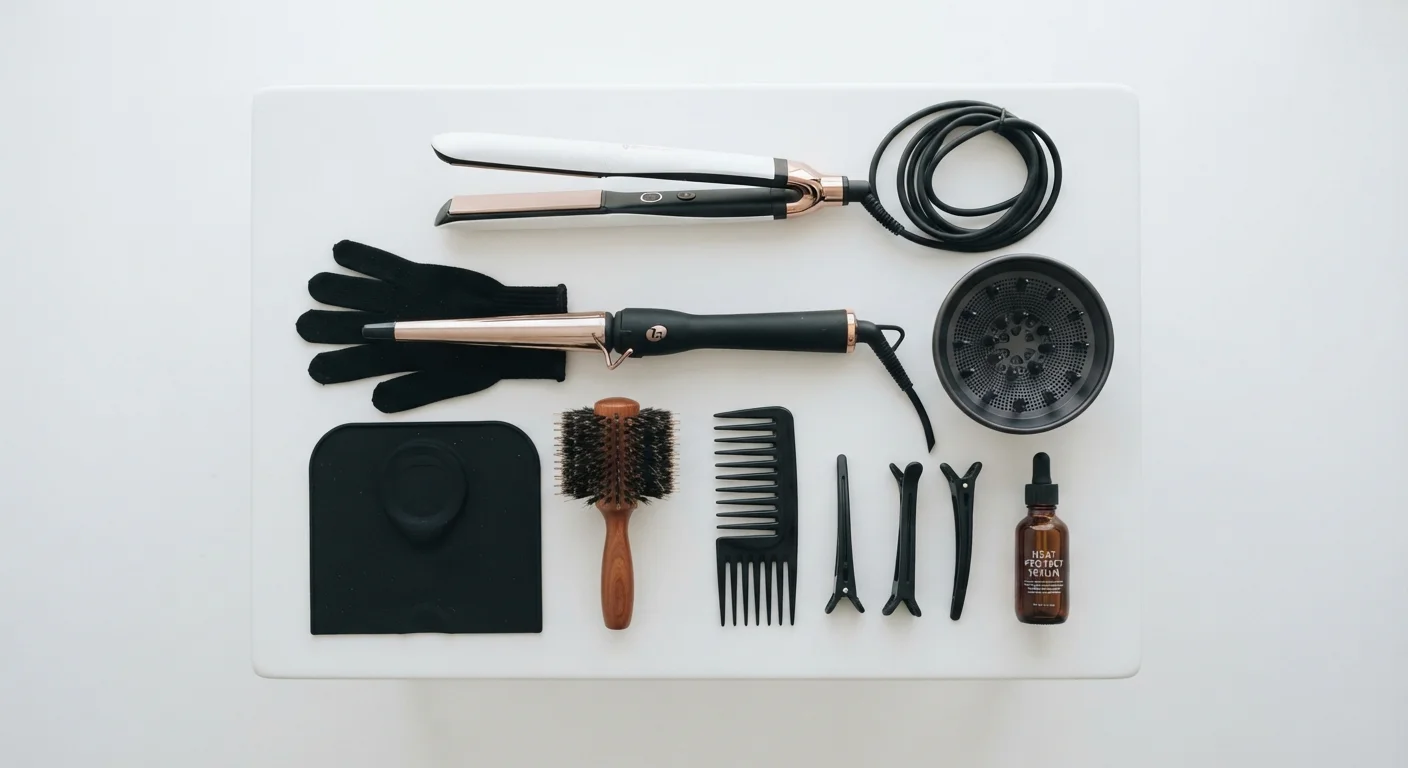
A flat iron uses two heated plates that clamp around a section of hair and glide from root to tip. The sustained, even pressure and heat smooth the hair cuticle, reducing wave and curl. The result is sleek, straightened hair. Fine or already-straight hair typically needs lower temperatures (around 300°F), while thick or coarser hair may need higher settings. Repeatedly passing the iron over the same section causes cumulative damage, so one or two slow passes are always better than several quick ones.
Curling Iron vs. Curling Wand
A curling iron has a clamp that holds the hair in place while heat is applied, producing a consistent, uniform curl from root to end. A curling wand has no clamp — you wrap the hair around the barrel manually, which gives more natural-looking waves and varied texture. The size of the barrel determines the curl: smaller barrels create tight ringlets, larger ones produce loose waves. Both tools work by holding hair in a curved shape under heat long enough for the bonds to reset in that new position.
Blow Dryer
A blow dryer uses a motor-driven stream of hot air to evaporate water from the hair shaft. On its own, it speeds up drying time considerably. When paired with a round brush, it can add volume, smooth the cuticle, or create a subtle bend. Using a concentrator nozzle directs airflow precisely for smoothing, while a diffuser attachment disperses airflow gently — ideal for enhancing natural curl patterns without disrupting them. For a deeper look at how blow drying compares to air drying, see this trade-off breakdown.
Hot Brush (Heated Styling Brush)
A hot brush combines the shape of a round brush with built-in heat, allowing you to smooth and add volume in a single step. It's generally gentler than a flat iron because it doesn't clamp the hair, making it a practical option for people seeking a polished look with lower heat contact.
Hot Air Styler (Airwrap-Style Tool)
These tools use a controlled jet of air — sometimes combined with heat — to attract and wrap hair around a barrel without direct plate contact. Because less direct heat touches the strand, the heat exposure is generally lower than with a traditional curling iron. Results vary by hair type and attachment used.
Hydrogen bonds
Temporary chemical bonds within the hair shaft that give hair its natural shape. Heat breaks these bonds, allowing hair to be reshaped; they re-form as hair cools.
Hair cuticle
The outermost layer of the hair strand, made up of overlapping scale-like cells. When the cuticle lies flat, hair appears smooth and shiny; when raised or damaged, it looks dull and feels rough.
Diffuser
A blow dryer attachment with a wide, perforated cup shape that disperses airflow over a large area. It dries curly and wavy hair gently, reducing frizz caused by concentrated airflow.
Heat protectant
A hair product — available as a spray, serum, or cream — applied before heat styling to help shield strands from moisture loss and thermal damage.
Barrel size
The diameter of a curling iron or wand's cylindrical rod. Smaller barrels produce tighter curls; larger barrels create looser waves.
Using Heat Tools Safely
No matter which tool you choose, a heat protectant product applied before styling is a widely recommended step. These products typically coat the hair shaft to reduce moisture loss and limit direct heat transfer. Understanding what's in your styling products can help you choose one suited to your hair's needs.
General guidance for safer heat styling includes: always starting at the lowest effective temperature, keeping the tool moving rather than holding it stationary, and avoiding heat on already-damaged or very wet hair. Limiting heat styling frequency — and alternating with protective styles — gives hair time to recover.
Heat Tools and Hair Porosity
Hair porosity — how readily your hair absorbs and retains moisture — affects how it responds to heat. High-porosity hair loses moisture faster under heat, while low-porosity hair may resist heat more. If you're unsure about your hair's porosity, a licensed cosmetologist can assess it and recommend appropriate heat settings.
This article is for informational and educational purposes only. For personalised advice about hair damage or scalp concerns, consult a licensed cosmetologist or dermatologist.