The Four Main Hair Type Categories
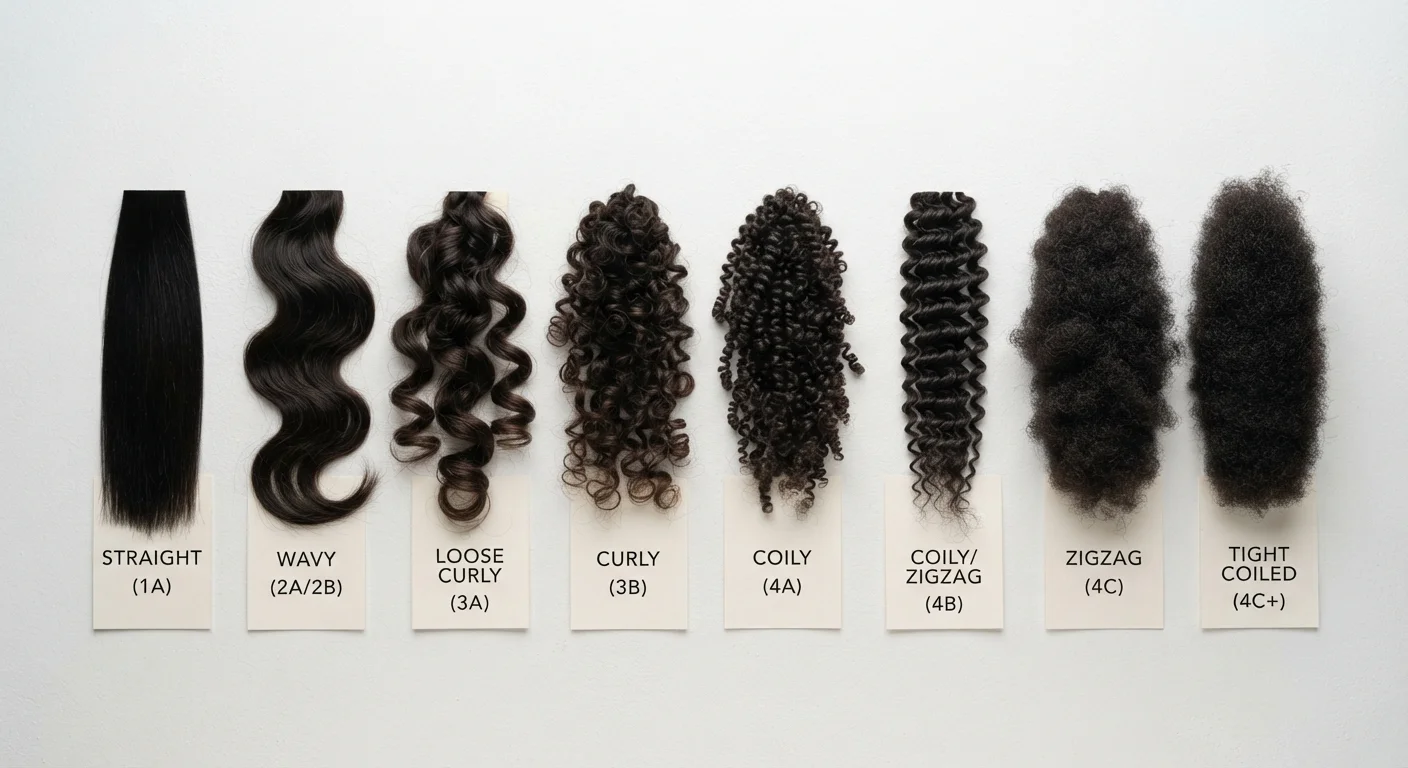
The hair typing system organizes all natural textures into four numbered groups based on the shape of the curl or wave pattern. Think of the number as the broad category and the letter as the fine-tuning.
- Type 1 — Straight: Hair lies flat from root to tip with no natural wave or curl. It tends to look shiny because scalp oils travel down the shaft easily.
- Type 2 — Wavy: Hair forms a gentle S-shape. It is neither fully straight nor fully curly, and it can be prone to frizz in humidity.
- Type 3 — Curly: Hair forms defined springy loops or spirals. Curl diameter varies within this category from loose to tight.
- Type 4 — Coily: Hair forms very tight coils or Z-shaped bends. It is highly prone to dryness and shrinkage, often appearing much shorter than its actual length.
Within each number, the letters A, B, and C describe how tight or loose the pattern is — A being the loosest and C the tightest. So 2A is a barely-there wave, while 2C approaches the border of curly hair.
4
Main hair type categories in the system
The André Walker Hair Typing System, widely adopted by the beauty industry, defines four numbered categories each with A, B, and C subcategories.
~70%
Shrinkage possible in Type 4C hair
Type 4C coily hair can appear up to 70% shorter than its actual length due to the tightness of its curl pattern, according to commonly cited natural hair care references.
12
Total distinct hair type classifications
When all four categories and their A, B, and C subtypes are counted, the system identifies 12 distinct hair type classifications.
Breaking Down the Subtypes: A, B, and C
Understanding the letter subtypes helps you get much more precise about your hair's behavior and needs.
Types 1A, 1B, and 1C
All straight hair, but 1A is ultra-fine and limp, 1B has more body and slight bends, and 1C is coarser with a little natural volume. Straight hair rarely needs extra curl definition, but can struggle with oiliness at the roots.
Types 2A, 2B, and 2C
2A is a loose, tousled wave that straightens easily. 2B forms more defined S-waves that hug the head. 2C waves are thicker, more resistant to straightening, and begin to show some ringlet formation at the ends.
Types 3A, 3B, and 3C
3A has large, loose spirals — roughly the diameter of a piece of sidewalk chalk. 3B curls are springier and medium-sized, similar in width to a marker. 3C has tight corkscrews or ringlets close in size to a pencil, with significant volume.
Types 4A, 4B, and 4C
4A coils are tightly wound with a visible S-pattern. 4B features Z-shaped angles rather than a round curl. 4C is the most densely packed type, with minimal visible definition when dry and the highest degree of shrinkage — sometimes 70% or more of its actual length. For 4C hair especially, protective styles can be an important tool for retaining length and reducing breakage.
How to Test Your Hair Type at Home
Wash your hair with a clarifying or gentle shampoo to remove any product buildup. Allow it to air-dry completely without touching it or applying anything. The pattern that forms on its own — with no manipulation — is your natural hair type. Assess different sections of your head, as the pattern may vary from front to back.
Why Hair Type Is Only Part of the Picture
Hair type describes curl pattern — but curl pattern alone does not predict how your hair absorbs moisture, how much of it you have, or how thick each individual strand is. These additional factors shape your hair's behavior just as much.
Porosity refers to how readily your hair absorbs and retains moisture. Two people with identical 3B curls might need completely different products based on their porosity levels. Hair porosity is worth understanding alongside your type.
Density is the number of strands on your scalp — low, medium, or high. High-density hair can feel heavy with rich creams that work beautifully on low-density hair of the same curl pattern.
Strand width (fine, medium, or coarse) affects how much protein or moisture a hair strand can handle without becoming limp or brittle. To understand how ingredients interact with these factors, see our guide to hair product ingredients.
Using Your Hair Type to Build a Better Routine
Once you have a working idea of your hair type, you can start making smarter decisions about how you wash, dry, and style.
Straight and wavy types (1 and 2) often benefit from lighter products that add texture without weighing hair down. Heavy creams can flatten natural movement and contribute to oiliness.
Curly types (3A–3C) generally need more moisture and benefit from products applied to soaking-wet hair to encourage curl clumping. Diffusing rather than rough-towel-drying helps preserve definition — something our article on heat styling tools covers in more detail.
Coily types (4A–4C) typically require the most moisture and the most gentle handling. The LOC method (Liquid, Oil, Cream) is a common layering technique used to lock hydration into tightly coiled strands.
Before committing to any new routine, it is also worthwhile to assess your hair's current health. Our pre-routine hair health check walks you through the key things to look for, including moisture balance, scalp condition, and signs of damage.
“Your hair type is not a prescription — it is a starting point. The more you observe how your hair responds to moisture, heat, and products, the more tailored your routine becomes.”
— curl pattern and texture education experts, Natural hair care educators and trichology communicators