
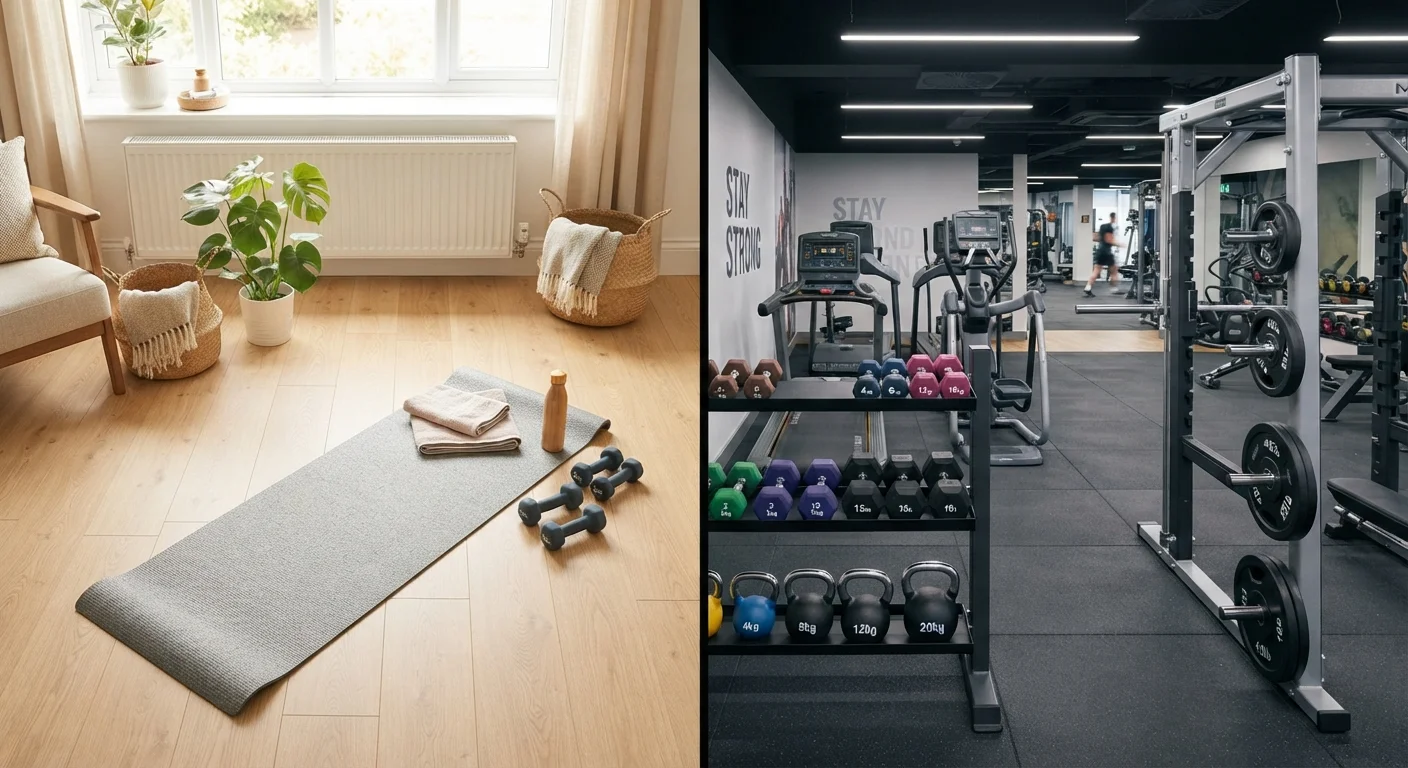
What Each Environment Actually Offers
When you're just starting a fitness routine, the question of where to exercise can feel as daunting as the workouts themselves. Home workouts take place in your own space using bodyweight movements, resistance bands, or a modest set of dumbbells. Gym workouts happen in a dedicated facility equipped with treadmills, weight machines, free weights, and often group fitness classes.
Neither environment is inherently better. Each has real, practical trade-offs worth understanding before you commit. If some of the terminology here feels unfamiliar, the Beginner's Fitness Glossary is a helpful starting point.
| Home Workouts | Gym Workouts | |
|---|---|---|
| Cost | Low ongoing cost after minimal setup | Monthly membership fee required |
| Convenience | No commute, available anytime | Requires travel to a fixed location |
| Equipment variety | Limited unless you invest significantly | Wide range of machines and free weights |
| Social motivation | Minimal unless using virtual classes | Community, classes, and trainers available |
| Space required | Small dedicated area is enough | No personal space needed |
| Privacy | Completely private environment | Shared public space |
| Beginner guidance | Self-directed or app-guided only | Staff, trainers, and classes on hand |
Cost, Convenience, and the Time Factor
Cost is often the first consideration. A basic home setup — a yoga mat, a set of resistance bands, and a pair of adjustable dumbbells — can be assembled for a relatively modest one-time expense, with no recurring fees. A gym membership, by contrast, typically involves a monthly cost that adds up over the year, plus any initiation fees.
Convenience, however, cuts both ways. Home workouts eliminate travel time entirely, which research on exercise adherence consistently identifies as a major barrier to regular activity. On the other hand, some people find that leaving the house creates a useful psychological boundary between "rest mode" and "workout mode."
~30 min
Average gym commute time saved per session at home
Estimates from exercise adherence research suggest travel time is a leading reason people skip gym sessions.
6–12 weeks
Typical time to build a consistent workout habit
Behavioral research generally places habit formation in this range, though individual experience varies widely.
Your schedule matters too. If your free time is fragmented or unpredictable, having a home setup means you can exercise in 20-minute windows without logistics. Gym-goers often benefit from set class times that impose helpful structure.
Equipment, Variety, and Progression
One of the gym's clearest advantages is access to progressive overload — the ability to gradually increase resistance as you grow stronger. A well-stocked gym offers dozens of weight increments, cable machines, barbells, and cardio equipment. This variety supports a wide range of aerobic and anaerobic exercise, and allows you to shift focus as your fitness develops.
Home workouts can absolutely deliver results, but progression typically requires more creativity. Bodyweight exercises can be made harder through variations (e.g., moving from standard push-ups to incline or slow-tempo versions), and resistance bands provide some range of intensity. If strength training is a primary goal, the comparison of free weights and resistance machines offers useful context for navigating gym equipment once you're ready.
Avoid Skipping Proper Form
Whether at home or in a gym, performing exercises with poor technique can lead to injury — particularly for beginners. Without a trainer present, home exercisers should use reputable video tutorials and start with lighter resistance until movement patterns feel natural. If you experience pain (beyond normal muscle fatigue), stop the exercise and consult a qualified fitness or healthcare professional.
Motivation, Social Support, and Personality Fit
Motivation is deeply personal. Some people thrive in the energy of a gym environment — surrounded by others working toward their goals, with instructors providing real-time cues. Group fitness classes in particular offer accountability and structure that many beginners find invaluable.
Others find the gym intimidating, especially at first. The common fitness myths that hold beginners back addresses this directly — feeling out of place is a perception, not a reality, and it typically fades with familiarity. Still, if self-consciousness is a genuine barrier, starting at home removes it entirely.
Start With What You'll Actually Do
The most sophisticated gym setup or the most convenient home space is wasted if you don't use it regularly. Before committing to either option, honestly assess your schedule, motivation style, and budget. A few bodyweight sessions at home each week consistently beats an expensive membership you rarely use. Consistency is the single biggest driver of fitness progress for beginners.
A hybrid model — training at home on busy days and visiting the gym when time allows — is increasingly common and works well for many people. Whichever path you choose, tracking what's actually working helps you stay honest about progress and adjust before momentum stalls.
This article is for general informational purposes only and is not a substitute for professional fitness or medical advice. If you have any health conditions or concerns, consult a qualified healthcare professional before starting a new exercise program.