
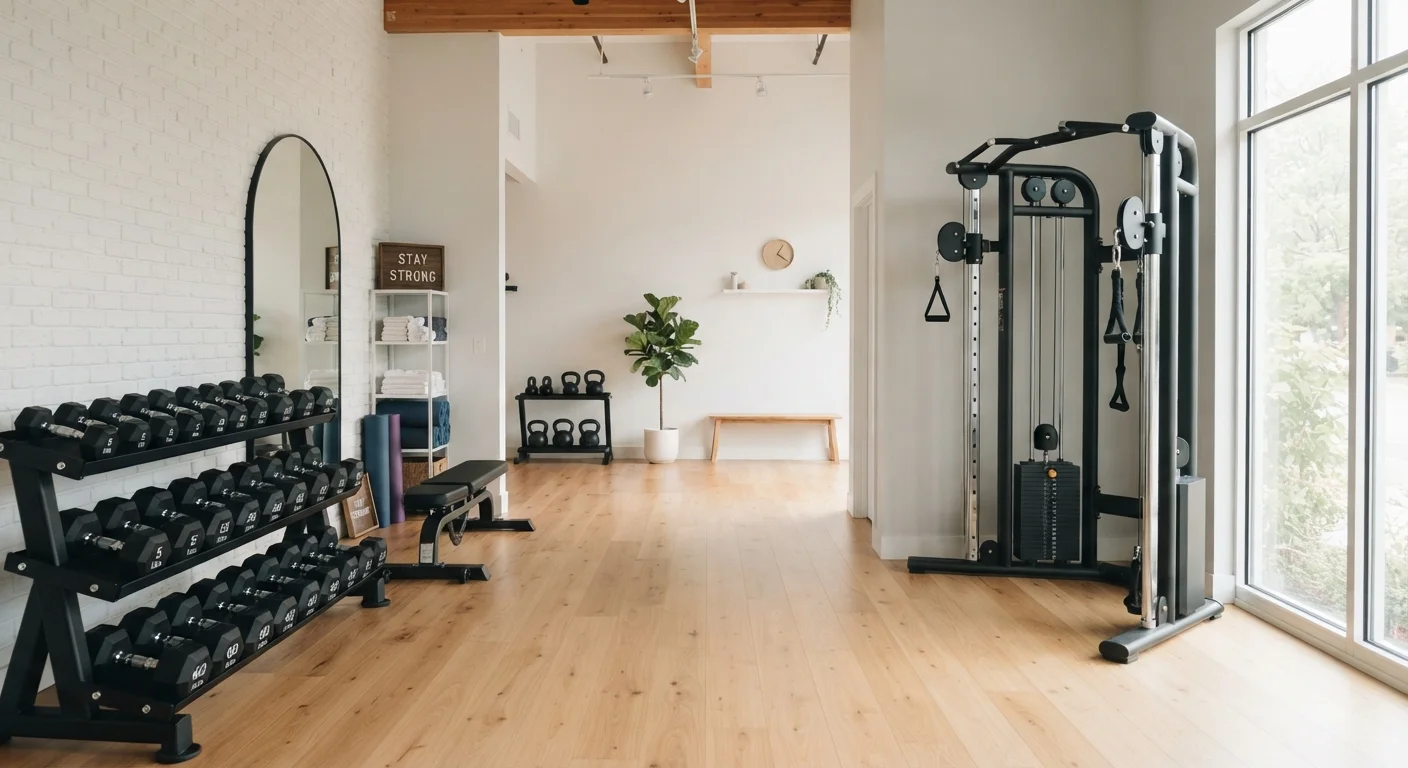
What Are Free Weights and Resistance Machines?
Before comparing the two, it helps to understand what each term actually means. Free weights are any weighted objects not attached to a cable or pulley system — think dumbbells, barbells, and kettlebells. You move them freely through space, which means your body must control not just the weight but also the direction and stability of the movement.
Resistance machines are the large, padded pieces of gym equipment with fixed movement paths — leg press stations, chest fly machines, lat pulldown cable towers, and so on. The machine constrains how your limbs move, so you only push or pull in a predetermined arc. For a plain-English primer on gym terminology, see our beginner's fitness glossary.
How They Compare: A Side-by-Side Look
The table below summarises the key differences across criteria that matter most to beginners.
| Criterion | Free Weights | Resistance Machines |
|---|---|---|
| Learning curve | Higher — technique is essential | Lower — movement is guided |
| Injury risk for beginners | Moderate without proper form | Generally lower |
| Muscles engaged | Primary + stabilising muscles | Primarily target muscle |
| Exercise variety | Very high | Limited to machine's function |
| Portability | Dumbbells and kettlebells travel well | Fixed to gym location |
| Weight adjustment | Manual, requires changing plates/dumbbells | Quick pin-select system |
| Functional carry-over | High — mirrors real-life movement | Moderate |
One important nuance: neither column is a clear winner across the board. The right choice depends on your starting point, your goals, and what feels sustainable for you.
The Case for Starting on Machines
Resistance machines are often recommended as a first step for people who are completely new to strength training — and for good reason. Because the machine controls the movement path, you can focus entirely on the sensation of contracting and releasing a muscle without worrying about balance or coordination at the same time.
Machines also make it straightforward to adjust the load in small increments, typically by moving a pin in a weight stack. This allows very gradual progression, which is particularly helpful early on. Research consistently suggests that injury risk is lower on machines for beginners, since poor technique has fewer consequences when movement is guided.
A Note on Machine Settings
Before using any resistance machine, take a moment to adjust the seat height and pad position to fit your body. Most machines have adjustment levers or knobs with numbered settings. An ill-fitting machine can place strain on your joints even if the weight is light. Many gyms have staff or trainers on the floor who can show you how to set up each machine correctly — don't hesitate to ask.
That said, machines are not a replacement for learning how your body moves. Over-reliance on machines can mean that stabilising muscles — the smaller muscles that support your joints — get less training. This is worth keeping in mind as you progress.
The Case for Free Weights
Free weights recruit a broader network of muscles because your body must stabilise the weight throughout the movement. A dumbbell squat, for example, calls on your core, hips, and ankles in ways that a leg press machine does not. This quality — sometimes called functional strength — can translate more directly to everyday activities like lifting, carrying, and climbing stairs.
Free weights also offer almost unlimited exercise variety. A single pair of dumbbells can be used for dozens of exercises targeting every major muscle group, making them highly adaptable for home or gym use. If you're curious how this fits into the broader home versus gym debate, our home workouts vs. gym workouts comparison covers that territory well.
The main caveat is technique. Incorrect form with free weights — especially with heavier loads — increases injury risk. Starting with lighter weights than you think you need, and ideally learning foundational movements from a certified personal trainer, is strongly advisable. You might also find it useful to read about common misconceptions about strength training before you begin.
2–3×
Stabiliser muscle activation with free weights
Studies in exercise science literature suggest free-weight exercises can engage stabilising muscles significantly more than their machine equivalents, depending on the exercise and individual.
~58%
Beginners citing intimidation as a gym barrier
Surveys of new gym-goers consistently find that unfamiliarity with equipment is one of the top reasons people avoid the weights area altogether.
A Practical Approach for Beginners
Most fitness professionals suggest a practical middle path: use machines to build initial confidence and body awareness, then gradually incorporate free weights as your technique and coordination improve. This isn't a rigid rule — some people take to free weights immediately with proper instruction, while others prefer machines long-term and see excellent results.
What matters most is consistency and progressive overload — gradually increasing the challenge over time. Whether you're using a cable machine or a dumbbell, the same principle applies: your muscles adapt to stress placed on them, and you need to increase that stress incrementally to keep progressing. Be mindful of the patterns that can derail newcomers early; our guide on why beginners burn out fast is worth reading before you get started.
This article is for general informational and educational purposes only and does not constitute medical or professional fitness advice. Consult a qualified healthcare provider or certified fitness professional before beginning any new exercise programme, particularly if you have existing health conditions or injuries.