
Why Your Accommodation Choice Matters More Than You Think
Where you sleep shapes your entire travel experience — your budget, your daily routine, who you meet, and how rested you feel. Yet most first-time travelers default to whatever option they've heard of, rather than thinking through what actually fits their trip. Hotels, hostels, and short-term apartment rentals are the three most common choices, each built around a different set of priorities. Understanding those differences upfront saves money and frustration later. This is especially worth thinking through when planning your first international trip, where unfamiliar logistics can already feel overwhelming.
Hotels: Comfort, Consistency, and Convenience
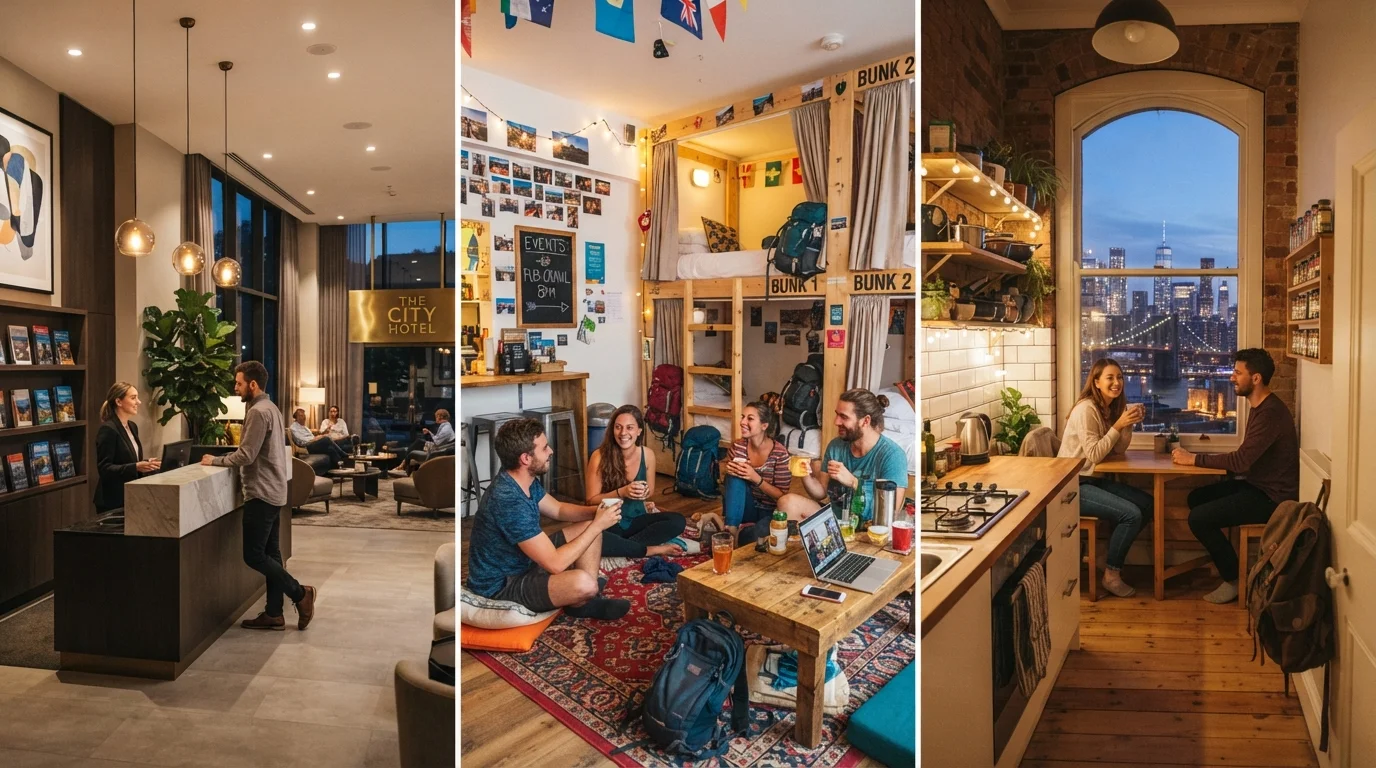
Hotels are the most familiar option for a reason: they're designed to remove friction. You arrive, check in, and everything is handled — clean towels, a made bed, front-desk support if something goes wrong. For a short city break or a destination where you plan to be out sightseeing all day, a hotel delivers exactly what you need with minimal mental overhead.
The trade-off is cost. Hotels typically carry the highest nightly rate of the three options, and extras like breakfast, parking, and Wi-Fi can add up fast. Privacy is guaranteed — your room is your own — but you won't naturally bump into fellow travelers. Hotels make the most sense for short stays (one to four nights), business-adjacent trips, and anyone who genuinely values having a private bathroom and a reliable alarm clock.
Check What's Actually Included
Hotel listings often look affordable until you add resort fees, parking, and Wi-Fi charges at checkout. Before booking, scan the full fee breakdown — not just the headline rate. The same logic applies to apartment rentals, where cleaning fees and service charges can significantly inflate the total for short stays.
Hostels: Social, Affordable, and Full of Energy
Hostels trade privacy for price and people. Most offer dormitory-style bunk rooms — sometimes four beds, sometimes fourteen — with shared bathrooms and communal lounges. The social upside is real: hostels are one of the easiest places in the world to strike up a conversation and find a spontaneous travel companion. Many organize group dinners, walking tours, or bar crawls that solo travelers can simply join.
The obvious downside is noise and limited personal space. Light sleepers, couples wanting privacy, or anyone traveling with young children will likely find hostels uncomfortable. Many hostels now offer private rooms at a middle-ground price, which is worth knowing if you want the community vibe without the dormitory dynamic. For solo travelers focused on safety and connection, a well-reviewed hostel in a central location can be an excellent base.
| Hotel | Hostel | Apartment Rental | |
|---|---|---|---|
| Average cost | Highest nightly rate | Lowest (dorm) to mid (private) | Mid — drops for longer stays |
| Privacy | Full private room & bathroom | Shared dorm; limited privacy | Full private apartment |
| Social opportunities | Low — guests mostly separate | High — built-in community | Low — self-contained living |
| Kitchen access | Rarely available | Shared hostel kitchen | Full private kitchen |
| Best stay length | 1–4 nights | 1–7 nights | 5+ nights |
| On-site support | 24/7 front desk typical | Reception; varies by hostel | Limited; often remote |
| Ideal traveler | Comfort-seekers, first-timers | Solo budget travelers | Families, slow travelers |
Apartment Rentals: Space, Flexibility, and Local Immersion
Short-term apartment rentals — booked through various platforms — offer something hotels and hostels rarely can: a full kitchen, a living room, and the feeling of actually living somewhere rather than passing through. For stays of five nights or more, the nightly cost often drops significantly compared to hotels, and the ability to cook even a few meals dramatically reduces daily expenses.
Families benefit most obviously — separate bedrooms, a proper fridge, and a washing machine make a week abroad far more manageable. But solo travelers and couples also find that apartments enable a slower, more immersive pace. You shop at the local market, learn the neighborhood café, and develop a genuine sense of place. This pairs naturally with slow travel philosophies that prioritize depth over breadth. The catch: check-in can be less flexible, cleaning fees add to costs for short stays, and you won't have front-desk support if something breaks.
Verify Cancellation Policies Before You Pay
Apartment rentals frequently carry stricter cancellation terms than hotels — some are entirely non-refundable. Always read the cancellation policy before confirming a booking, especially if your travel plans might shift. Travel insurance that covers accommodation cancellations is worth considering for any non-refundable reservation.
Mixing Options Across a Single Trip
One underused strategy is combining accommodation types within the same journey. Spend your first night in a hotel after a long-haul flight — when you just want reliable rest — then shift to an apartment for the bulk of a week-long stay. If your itinerary includes multiple destinations, a hostel in a party-friendly beach town and a hotel for a two-night museum city make perfect sense together. Treating each leg separately, rather than locking into one accommodation philosophy for an entire trip, gives you the best of all three worlds. Your luggage strategy is worth aligning with this too — moving between accommodations frequently favors lighter packing.
~40%
Average hostel cost savings vs. budget hotels
Industry travel research consistently finds dormitory hostel beds run roughly 40% less per night than comparable budget hotel rooms in the same city.
5+ nights
Break-even point for apartment rentals
Travel analysts generally find apartment rentals become cost-competitive with hotels once a stay exceeds five nights, factoring in cleaning fees and cooking savings.