How Each Type Sends Sound to Your Ears
Understanding the core difference between wired and wireless earbuds starts with one simple question: how does audio get from your device to your ears?
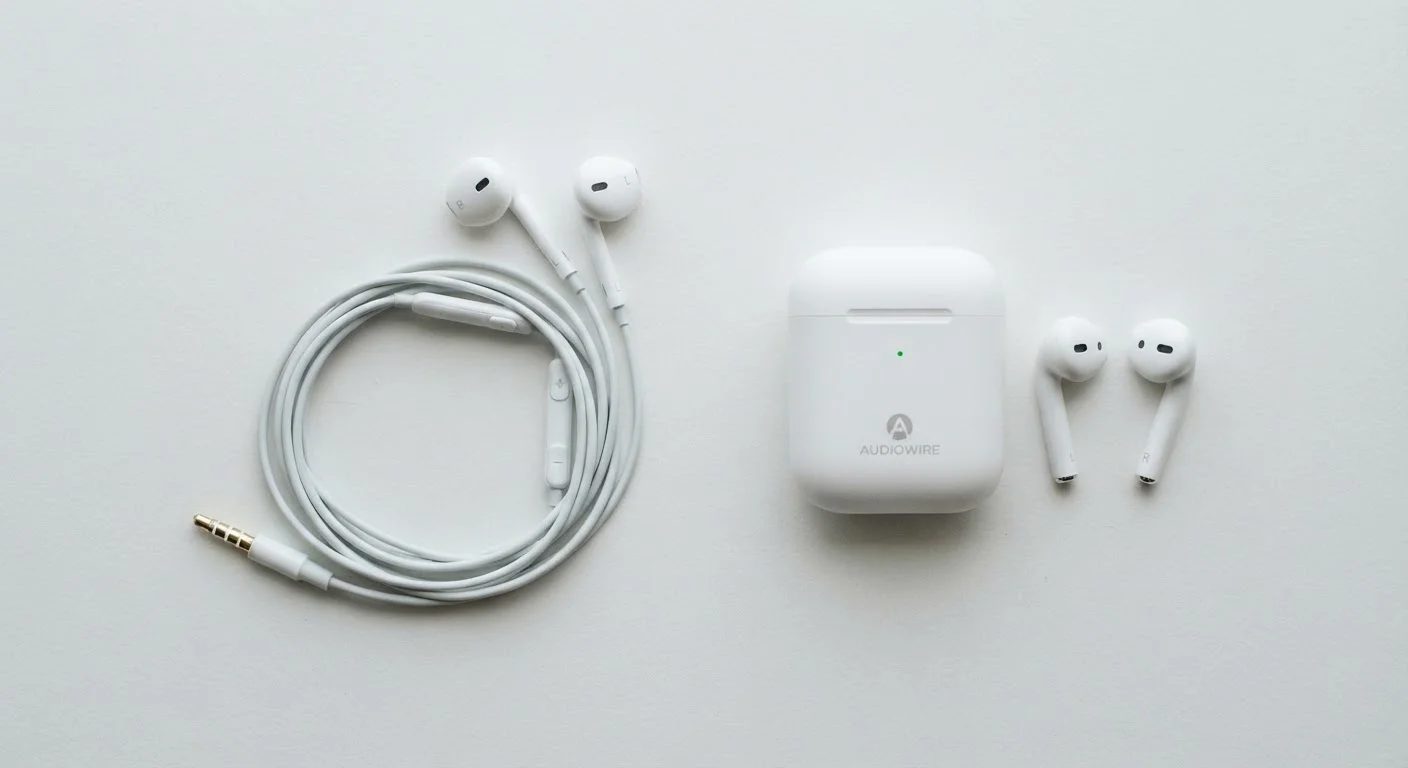
Wired earbuds use a physical cable — usually ending in a 3.5mm headphone jack or a USB-C connector — to carry an electrical audio signal directly from your phone, laptop, or audio player. The signal travels as electricity through copper wires, gets converted to sound by tiny speakers inside the earbuds, and reaches your ears almost instantly. There's no translation step, no wireless hop, no compression — just a direct electrical connection.
Wireless earbuds work very differently. They receive audio via Bluetooth, a short-range radio technology that transmits data between your device and the earbuds wirelessly. Your phone converts the audio into a digital data stream, broadcasts it as a radio signal, and the earbuds receive and decode it before playing sound. To learn more about how this wireless handshake actually works, see our guide to how Bluetooth connects your devices.
This fundamental difference — direct wire versus wireless radio — is what drives nearly every trade-off discussed below.
Sound Quality: Does the Cable Really Matter?
For years, audiophiles argued that wired earbuds always sounded better, and technically they had a point. A wired connection carries a continuous, uncompressed audio signal. Wireless transmission, by contrast, must compress audio data to send it over Bluetooth efficiently — and compression can strip away some fine detail.
However, the gap has narrowed considerably. Modern Bluetooth audio codecs — the software that compresses and decompresses audio — like AAC, aptX, and aptX HD deliver much higher quality than older Bluetooth standards. For most casual listeners playing music, podcasts, or streaming video, the difference is subtle enough to be imperceptible.
Where wired earbuds still hold a clear edge is in critical listening, studio monitoring, or any scenario where you're using high-resolution audio files. The uncompressed signal means every detail the recording contains reaches you intact.
| Criterion | Wired Earbuds | Wireless Earbuds |
|---|---|---|
| Audio signal | Direct, uncompressed electrical | Compressed Bluetooth transmission |
| Sound quality ceiling | Higher (no compression) | Near-comparable with modern codecs |
| Latency | Near-zero | 100–300 ms (40–60 ms in game mode) |
| Battery required | None | Yes, 5–8 hrs per charge |
| Cable freedom | No — tethered to device | Yes — fully wireless |
| Headphone jack needed | Yes (3.5mm or USB-C) | No |
| Setup required | Plug in and play | One-time Bluetooth pairing |
| Best use case | Gaming, studio, budget audio | Commuting, exercise, calls |
The practical takeaway: if you're streaming music on a commute, wireless audio quality is more than adequate. If you're an audio enthusiast playing lossless files and analyzing every instrument, wired remains the purest path.
Latency: Why Timing Matters More Than You Think
Latency refers to the delay between when audio is generated and when you actually hear it. For listening to music, a small delay is unnoticeable. But for gaming, watching video, or video calling, even a fraction of a second of lag creates an obvious mismatch between what you see and what you hear — lips move before words arrive.
~200 ms
Typical Bluetooth audio latency
Standard Bluetooth audio codecs commonly introduce roughly 100–300 ms of delay; low-latency game modes can reduce this to around 40–60 ms.
5–8 hrs
Average wireless earbud playback per charge
Most wireless earbuds deliver 5–8 hours of continuous playback, with charging cases extending total use to 20–30 hours.
~0 ms
Effective latency for wired earbuds
Because wired earbuds carry an electrical signal directly through a cable, the delay is imperceptible under normal listening conditions.
Wired earbuds have negligible latency — essentially zero delay for practical purposes. The electrical signal moves at the speed of electricity through the cable, arriving at your eardrum in fractions of a millisecond.
Wireless earbuds introduce latency because Bluetooth must encode, transmit, receive, and decode the audio data. Standard Bluetooth audio latency ranges from roughly 100 to 300 milliseconds (ms) depending on the codec used and device compatibility. Some wireless earbuds include a dedicated low-latency mode — often labeled "game mode" — that reduces delay to around 40–60 ms by trading some audio quality for speed. That's still not zero, but it becomes much less disruptive for most use cases. For a deeper look at how latency is measured and why it matters across different connections, our explainer on bandwidth, speed, and latency breaks it down clearly.
Battery Life and Convenience
This is where wired and wireless earbuds diverge most dramatically in everyday practicality.
Wired earbuds require no battery at all. They draw tiny amounts of power directly from your device's headphone output. You never charge them, never run out mid-podcast, and never deal with a dead earbud during an important call. Plug them in and they simply work.
Wireless earbuds rely entirely on internal batteries. Most earbuds themselves offer 5–8 hours of playback on a single charge. The accompanying charging case — a small pocket-sized box the earbuds sit in when not in use — typically stores 2–4 additional full charges, extending total use to around 20–30 hours before you need to plug the case in. Charging times vary, but many cases reach full charge in 1–2 hours, and some support fast charging that delivers an hour of playback from just 10 minutes in the case.
No Headphone Jack? You're Not Alone
Many modern smartphones — including most flagship Android phones and iPhones released after 2016 — have removed the 3.5mm headphone jack entirely. If your device lacks this port, wired earbuds require a USB-C to 3.5mm adapter, which adds a small extra step. Wireless earbuds sidestep this issue altogether. Always check which connections your device supports before choosing.
The convenience calculation runs both ways: wireless earbuds eliminate cable tangles, snag-and-yank moments, and connector wear — but they add a charging habit to your routine. Forget to charge them and you're stuck in silence. Wired earbuds sidestep that entirely.