
Why Our Brains Default to Comparison
Humans are wired to size themselves up against others. It's not vanity — it's a deeply embedded cognitive process. Psychologist Leon Festinger identified this as Social Comparison Theory: when we lack objective measures of how we're doing, we instinctively look at the people around us. Money, which is both deeply personal and publicly signaled through visible choices like housing, cars, and clothing, is a prime target for this kind of informal benchmarking.
The problem is that financial situations are far more complex than they appear from the outside. Someone driving a newer car might be carrying significant debt. A colleague who always seems to eat out could be living paycheck to paycheck. Visible spending is not a reliable proxy for financial health — but our brains treat it like one anyway.
This matters because the comparisons we make aren't neutral. They shape how satisfied we feel, what we think we "should" have, and ultimately, how we spend. For a deeper look at the cognitive patterns behind this, see why we spend money the way we do.
~1 in 3
Adults who say social media increases financial pressure
Surveys by financial research organizations have found roughly a third of adults report feeling greater pressure to spend after viewing others' lifestyles online.
40%+
Of U.S. adults spending more than they earn at some point
Research from the Consumer Financial Protection Bureau and similar bodies has consistently found that overspending relative to income is widespread, often linked to social pressure and lifestyle inflation.
The Hidden Costs of Keeping Up
When comparison drives financial decisions, the consequences are rarely obvious at first. Lifestyle inflation — gradually spending more as your income or perceived social circle grows — is one of the most common side effects. You upgrade your apartment not because your current one is inadequate, but because it no longer matches what your peers seem to have. That shift in motivation is significant.
Decisions rooted in social comparison tend to optimize for appearances rather than outcomes. You end up funding someone else's idea of a good life instead of building toward your own. This is compounded by the fact that comparison almost always runs upward — you rarely fixate on someone doing worse financially; you notice the people ahead of you. Research in behavioral economics consistently shows that upward comparison increases dissatisfaction, even when a person's objective situation hasn't changed.
Check the Motivation Behind a Purchase
Before a significant spending decision, ask yourself: am I buying this because it genuinely fits my needs and goals, or because it closes a gap between my life and someone else's? That question won't always be comfortable to answer honestly — but it's one of the most useful financial filters available.
It's also worth noting how this connects to short-term thinking. Comparison-driven spending tends to prioritize immediate social alignment over long-term financial stability — a tension explored in depth in short-term vs. long-term thinking in personal finance.
Social Media's Amplifying Effect
Social media doesn't create financial comparison — but it supercharges it. Platforms reward posts that signal success: the vacation, the home renovation, the new vehicle. What they rarely surface is the financial strain, debt, or trade-offs that made those things possible. The result is a feed full of curated financial highlights that distorts your sense of what's normal.
This matters practically. When your informal benchmark for "how people like me live" is shaped by the most favorable 10% of what your network chooses to share, the gap between where you are and where you feel you should be gets artificially inflated. That gap generates pressure — often the kind that leads to spending decisions you wouldn't otherwise make.
What You See Is Not the Full Picture
Visible spending signals — cars, vacations, clothing — tell you almost nothing about a person's actual financial health. Someone projecting financial comfort may be carrying substantial debt or have little to no savings. Financial appearances and financial reality routinely diverge, which is a core reason why comparison so often misleads.
This dynamic is part of a broader set of patterns that quietly work against financial wellbeing. If you want to examine your own habits more honestly, signs your money habits may be working against you is a practical place to start.
A More Reliable Benchmark: Your Own Goals
The most useful financial comparisons are the ones you make with your own past behavior and your own stated priorities. Instead of asking "Am I saving as much as my coworker?", ask "Am I saving more than I was a year ago?" or "Is my current spending aligned with what I actually value?"
This shifts the frame from social performance to personal progress — which is a more honest and more actionable standard. Your income, obligations, family situation, health costs, and long-term goals are unique to you. A financial decision that makes sense for someone else's life may be genuinely wrong for yours, even if it looks sensible from the outside.
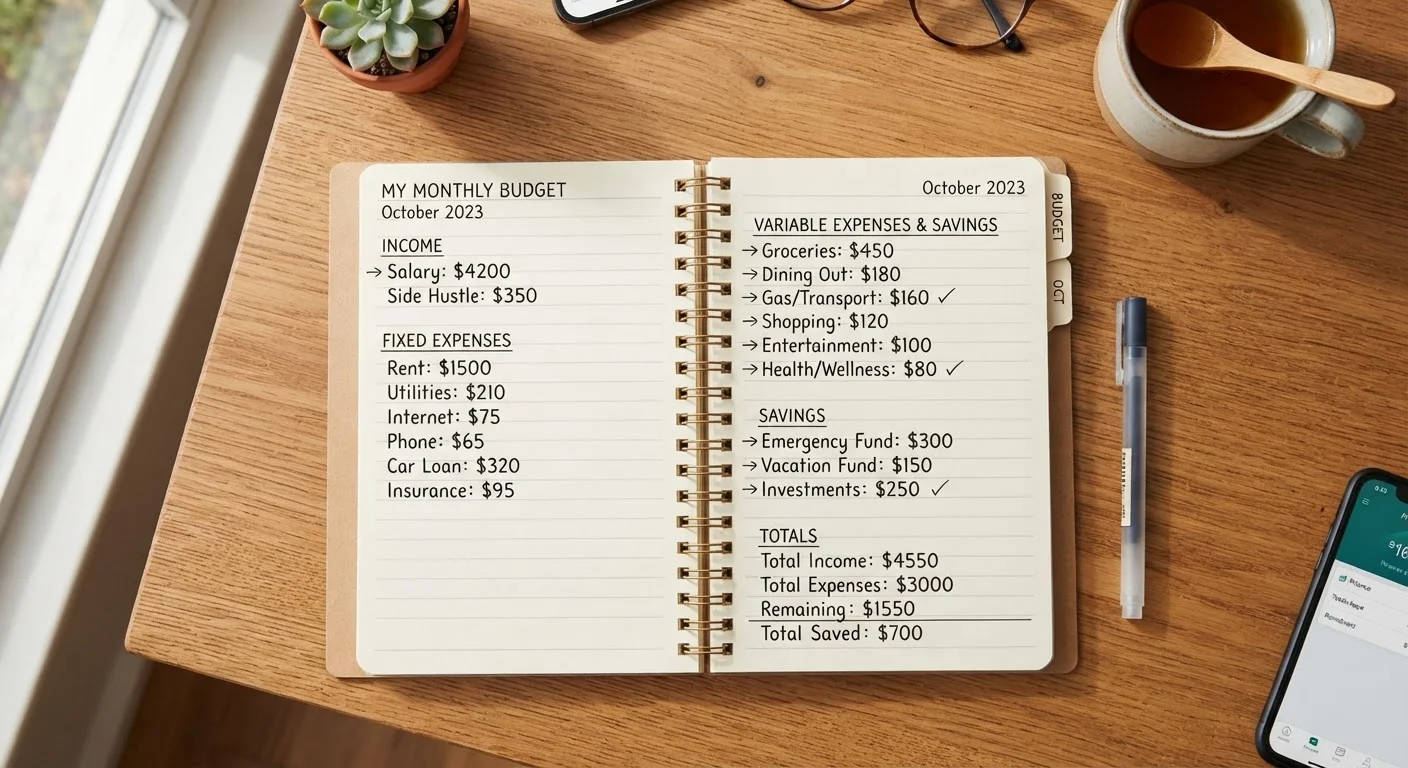
Building a simple budget is one concrete way to anchor decisions to your own numbers rather than others'. If you're not sure where to start, our budgeting basics resources cover the fundamentals without assuming prior knowledge. You might also find it worth examining some of the cognitive biases that distort financial decisions — comparison is just one of several patterns that can quietly pull you off course.
This article is for general informational and educational purposes only and does not constitute personalized financial advice. Please consult a qualified financial professional for guidance specific to your situation.