Why the Type of Salt Actually Matters
Salt is sodium chloride — that much is always true. But the shape, size, and source of salt crystals change how it behaves in your food in ways that genuinely matter. A teaspoon of table salt contains far more sodium than a teaspoon of kosher salt, because smaller crystals pack together more tightly. Swap them without adjusting the amount, and you can easily over- or under-season a dish. Understanding the differences helps you season more accurately and choose the right salt for the right job.
Salt does far more than add flavour — it draws out moisture, tenderises proteins, and transforms texture. Getting the variety right is the first step.
| Table salt sodium per teaspoon | ~2,300 mg (USDA FoodData Central) |
| Kosher salt sodium per teaspoon | ~1,120–1,960 mg (varies by brand) (USDA FoodData Central) |
| Main ingredient in all salt types | Sodium chloride (NaCl) |
| Flaked salt best used as | Finishing salt only |
| Table salt additives | Iodine, anti-caking agents |
| Sea salt vs. table salt (by weight) | Nearly identical sodium content (Harvard T.H. Chan School of Public Health) |
The Four Main Varieties, Decoded
Table Salt
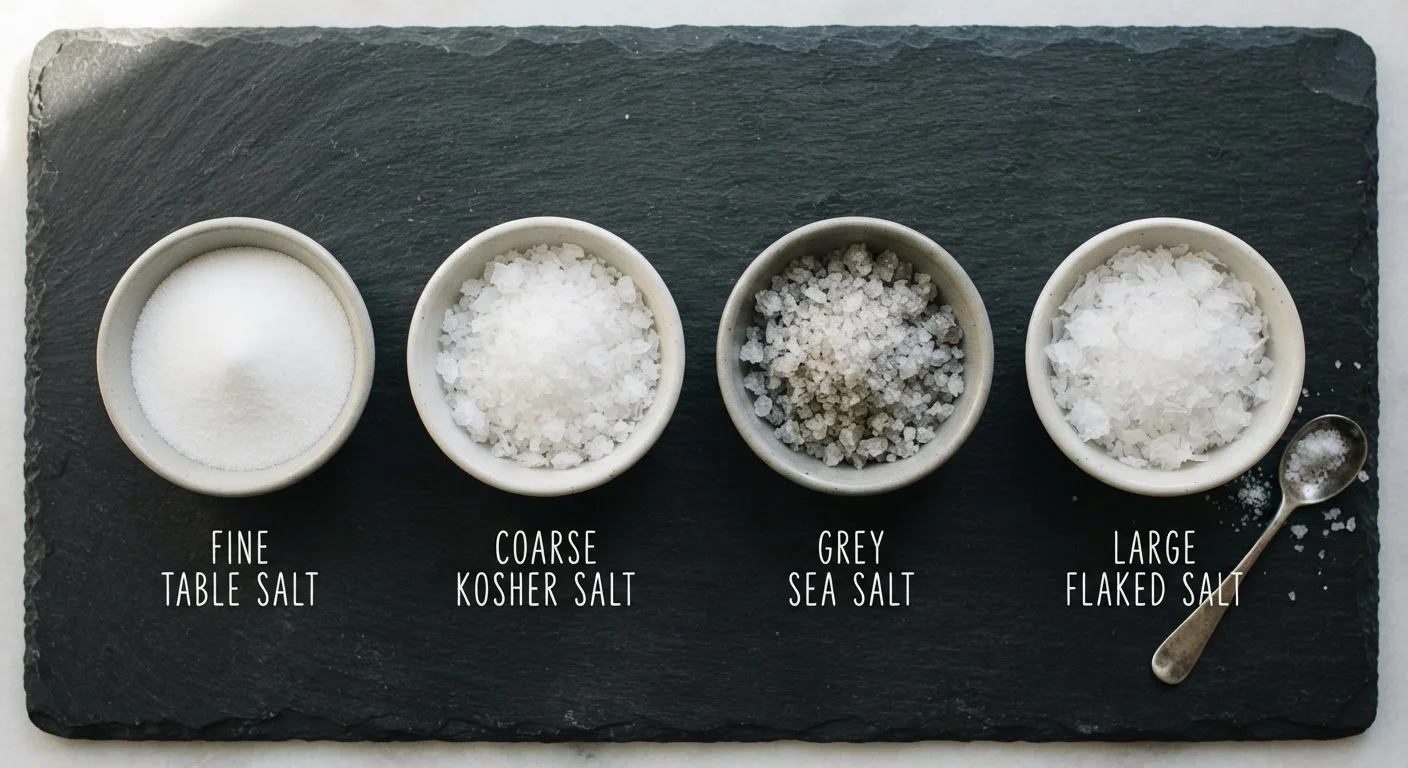
Table salt is finely ground and almost always contains added iodine (an essential mineral once scarce in many diets) plus anti-caking agents to keep it flowing freely. Its tiny, uniform crystals dissolve instantly and measure predictably, which is why most recipes — especially baked goods — are calibrated to it. The trade-off is a slight metallic edge that some tasters notice, often attributed to those additives. It is the default choice when a recipe gives no other instruction.
Kosher Salt
Kosher salt has coarser, irregularly shaped flakes that were historically used to draw blood from meat in accordance with Jewish dietary law — the flake structure pulls moisture efficiently. It contains no iodine and typically no additives, which gives it a cleaner taste. Because the crystals are larger and less dense, one teaspoon of kosher salt delivers significantly less sodium than one teaspoon of table salt. Two popular brands of kosher salt differ meaningfully in grain size from each other, so always taste rather than measure blindly when switching. Kosher salt is a favourite for seasoning meat, pasta water, and general cooking.
Sea Salt
Sea salt is produced by evaporating seawater, and its mineral content — small amounts of magnesium, calcium, and potassium — varies by source and can subtly influence flavour. It comes in both fine and coarse grinds. Fine sea salt works as a table salt substitute in most cooking. Coarse sea salt is better used as a finishing touch. Nutritionally, sea salt and table salt are nearly identical in sodium content by weight; the perceived difference in taste comes from crystal texture and trace minerals, not health benefits.
Flaked Salt
Flaked salt — such as thin pyramid-shaped crystals produced by controlled evaporation — has a delicate crunch and dissolves almost the moment it touches your tongue. Its large surface area carries flavour efficiently, making small amounts feel impactful. It is almost exclusively a finishing salt: sprinkled over roasted vegetables, chocolate desserts, eggs, or fresh bread just before serving. Using it in cooking would waste both its texture and its cost.
Anti-caking agent
An additive mixed into table salt to prevent crystals from clumping together in humid conditions. Common examples include silicon dioxide and sodium aluminosilicate.
Finishing salt
A salt applied to food at the very end of cooking or at the table, valued for its texture, crunch, and concentrated burst of flavour rather than for cooking performance.
Iodised salt
Table salt to which potassium iodide has been added as a public health measure to prevent iodine deficiency. Most kosher and specialty salts are not iodised.
Crystal density
How tightly salt crystals pack into a given volume. Fine table salt is denser than coarse kosher salt, meaning equal volumes contain different amounts of sodium.
Practical Swapping and Storage Tips
If a recipe calls for table salt and you only have kosher salt, use roughly 1.5 to 2 times the volume (but taste as you go, since grain sizes vary by brand). Going the other direction — table salt for kosher — use about half to two-thirds the called-for amount. Flaked and coarse sea salts are best left as finishers and are not reliable substitutes in baking, where precision matters.
Store all salt in a sealed container away from steam and humidity. Despite what the packaging sometimes implies, salt itself does not expire — but anti-caking agents in table salt can eventually lose effectiveness, causing clumping. For baking, consistent, measured salt matters more than it does for seasoning a pan of vegetables. This connects to a broader truth about ingredient precision: just as using unsalted vs. salted butter changes a recipe's sodium balance, so does the salt variety you choose.
Sodium Is Sodium, Regardless of the Salt
Some specialty salts are marketed with implied health benefits, but nutritionally all salt varieties deliver sodium chloride. By weight, sea salt and table salt contain approximately the same amount of sodium. The real differences are textural and culinary, not nutritional. If you are managing sodium intake for health reasons, speak with a qualified healthcare professional rather than switching salt varieties as a strategy.