Why Tea Became More Than a Drink
Tea is the second most consumed beverage on Earth after water — but in many cultures, it is far more than a thirst-quencher. Across thousands of years and dozens of traditions, people have woven tea into ceremonies that mark hospitality, express spiritual values, seal friendships, and communicate social hierarchies. The cup itself becomes a kind of language.
What makes tea so uniquely suited to ritual? Part of the answer is practical: preparing tea well requires time, attention, and specific tools. Those requirements create a natural pause in the day — a moment when guests and hosts are brought together around a shared, deliberate act. That pause becomes meaningful, and meaning, over generations, becomes ceremony.
Tea's global reach also traces the movement of trade routes, colonial history, and agricultural geography. To understand how drinks have shaped history and culture, tea is an unavoidable chapter. Below are six traditions that show just how different — and how deeply human — that chapter can be.
Japanese Chado: The Way of Tea
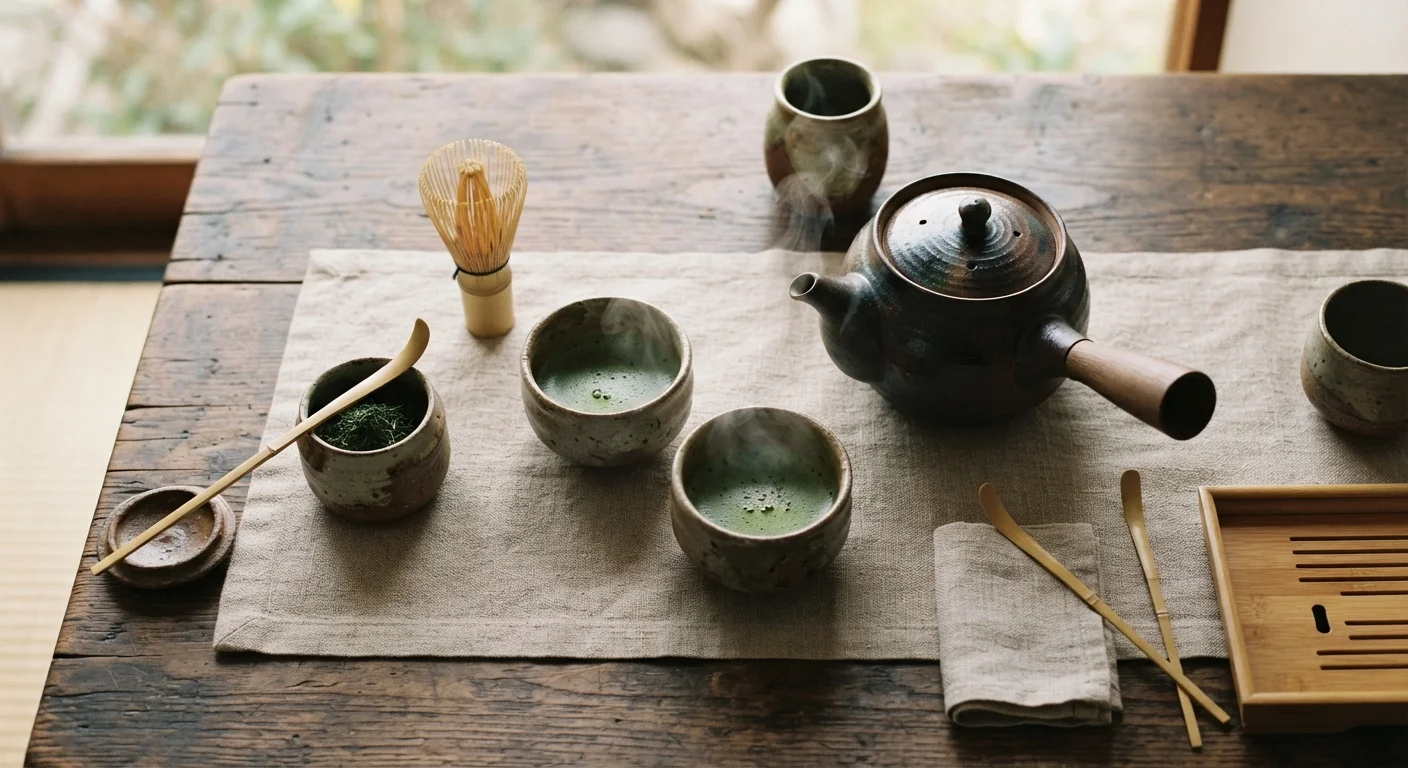
In Japan, the tea ceremony is known as chado (also written chanoyu), meaning "the way of tea." It is not simply about drinking matcha — a finely powdered green tea — but about practising four core principles: harmony (wa), respect (kei), purity (sei), and tranquillity (jaku).
A formal ceremony can last several hours and follows a precise sequence of movements, from the arrangement of the tatami room to the way the host folds the cloth used to wipe the tea bowl. Guests bow upon entering, turn the bowl before drinking to avoid sipping from the front, and offer quiet appreciation afterward. Every gesture is intentional — nothing is decorative for decoration's sake alone.
Chado developed significantly during the 15th and 16th centuries, influenced by Zen Buddhist practice. Today it is still taught in schools and community centres across Japan as a form of living cultural heritage.
In chado, every gesture — from folding a cloth to turning the bowl — carries deliberate meaning.
Moroccan Atay: Tea as an Act of Welcome
In Morocco, serving tea is one of the most significant expressions of hospitality a host can offer. The drink — called atay — is a blend of gunpowder green tea, fresh spearmint, and generous amounts of sugar. Refusing a cup is generally considered impolite; accepting it signals respect and trust.
What makes the preparation visually striking is the pour. The host lifts the teapot high above small, decorated glass cups and streams the tea from a height, aerating it to create a light froth on top. The same tea is poured back into the pot and re-served multiple times, with each round said to carry a different meaning: the first is as bitter as life, the second as strong as love, and the third as gentle as death.
Tea in Morocco is typically served three times per sitting. It functions as a social anchor — a reason to sit, slow down, and talk, whether among family, in a souk, or when welcoming a stranger.
Each of the three poured rounds carries its own traditional meaning: life, love, and death.
Chinese Gongfu Cha: Precision and Patience
Gongfu cha translates roughly as "making tea with skill" — and skill is exactly what it demands. Originating in the Fujian and Guangdong provinces of China, this method uses a small clay teapot (often Yixing clay, prized for its heat retention and porous texture that absorbs tea flavour over decades), tiny cups, and a wooden or bamboo tea tray to catch overflow.
The key distinction of gongfu cha is the brewing approach: very small amounts of high-quality tea — often oolong or pu-erh — are steeped in very little water for very short intervals, sometimes only 15 to 30 seconds. The tea is then poured completely out of the pot to stop the steep, and this process is repeated multiple times. Each infusion reveals a slightly different character in the leaf.
The ritual rewards attention. Participants observe the colour of the liquor change across infusions, inhale the aroma from dedicated scent cups, and discuss what they taste. It is as much a sensory education as a social ritual. If you're curious about what separates oolong from other varieties, see our guide to the major tea types.
In gongfu cha, the same leaves may be steeped six or more times, each infusion revealing something new.
British Afternoon Tea: Social Ritual in a Teacup
Britain's relationship with tea is one of the most documented in modern history — and while it lacks the spiritual dimensions of chado or the ancestral depth of Chinese ceremonies, it carries a firmly codified social structure of its own.
Afternoon tea as a formal practice is generally traced to the mid-19th century, when the custom of taking tea, finger sandwiches, and small cakes between lunch and dinner became popular among the upper classes. It spread through social strata over time, becoming a widespread cultural institution.
Even in everyday British households, tea etiquette carries weight: whether to add milk before or after the tea (a genuine ongoing debate), how strong to brew it, and the correct way to hold a cup in formal settings. The drink most commonly used is a robust black tea blend — often Assam or a similar full-bodied variety — served from a ceramic or porcelain teapot. Tea in Britain functions as a social lubricant, a comfort ritual, and a marker of hospitality all at once.
British afternoon tea evolved from an aristocratic gap-filler into one of the nation's most enduring social customs.
Indian Chai: Spice, Street Culture, and Community
In India, chai simply means "tea" — but what is sold at roadside stalls and brewed in homes is a very specific preparation: strong black tea simmered with milk, water, sugar, and a blend of warming spices that typically includes ginger, cardamom, cinnamon, cloves, and black pepper. This spiced version is formally called masala chai (spiced tea), though the terms are often used interchangeably.
Chai is deeply democratic. It is sold for a few rupees from chaiwalas (tea vendors) at railway stations, markets, and street corners across the country, consumed from small clay cups (kulhads) that are often discarded after a single use. The act of buying chai from a chaiwala and drinking it while watching the world go by is an everyday social ritual shared across age, class, and region.
No two chai recipes are identical — family recipes vary by region, and what is brewed in Kashmir (often with saffron and almonds) differs markedly from what you'd find in Mumbai or Chennai. That regional variation is part of what makes Indian tea culture so rich.
Chai's magic lies in its regional variation — no two family recipes, or two chaiwalas, brew it the same way.
Tibetan Butter Tea: Nourishment and Identity
Po cha — Tibetan butter tea — may be the most surprising entry on this list for those encountering it for the first time. It is made by churning strong black tea (often brick tea, a compressed form) with yak butter and salt in a long wooden cylinder called a chandong, producing a thick, savory, soup-like drink rather than anything resembling a sweet or floral brew.
In the high-altitude environment of the Tibetan Plateau, where temperatures are extreme and calorie demands are high, butter tea serves a practical purpose: it provides fat, warmth, and hydration in a single cup. But it is also central to Tibetan hospitality and religious life. Guests are offered po cha upon arrival, and refusals can be taken as an insult. The cup is continuously topped up — a nearly empty cup is considered impolite on the host's part.
Understanding this tea means understanding its context. What reads as unusual to an outside palate is, within Tibetan culture, an expression of generosity, sustenance, and deep-rooted identity.
Po cha's savory, buttery flavour reflects the Tibetan Plateau's harsh climate and its people's need for high-calorie warmth.
What Every Cup Teaches Us
Across these six traditions, a few themes recur: generosity, patience, and the value of slowing down together. Whether it's the precise choreography of a Japanese tea room, the theatrical pour of Moroccan atay, or the everyday democracy of a Mumbai chai stall, tea ceremonies create a space where social bonds are formed and maintained.
Participating Respectfully in Tea Ceremonies
If you're ever invited to participate in a formal tea ceremony — whether chado in Japan or gongfu cha in China — a little research beforehand goes a long way. Key starting points: remove shoes where indicated, accept the first cup with both hands as a sign of respect, and avoid loud conversation during meditative rituals. When in doubt, observe your host and follow their lead. For broader cultural etiquette guidance, see our guide to greetings around the world.
These traditions are also living practices — they evolve, adapt, and travel. Moroccan mint tea is now found in French cities. Masala chai has become a global café staple. Japanese matcha appears in everything from ice cream to skincare. This diffusion is worth appreciating, though it's equally worth understanding these drinks in their original contexts before the next sip.
Try Gongfu Cha at Home
You don't need specialist equipment to explore gongfu-style brewing. A small teapot (even a basic ceramic one), a high-quality oolong, and a timer are enough to start. Use about twice the amount of loose-leaf tea you'd normally use, steep for 20–30 seconds, pour fully, then re-steep four to six times. Our loose-leaf brewing walkthrough covers the fundamentals in plain language.
If tea culture has sparked broader curiosity, non-alcoholic drinks from around the world offers an even wider lens on how beverages define communities globally.