Why Credit Score Myths Spread So Easily
Credit scores sit at the center of major financial decisions — mortgages, car loans, apartment applications — yet most people are never formally taught how they work. That gap gets filled by word of mouth, half-remembered advice, and confidently stated misinformation. The result is a set of widely held beliefs that can quietly lead people to make choices that hurt rather than help their scores.
Understanding what a credit score actually measures is the first step toward separating myth from fact. The myths below are some of the most common ones we see trip people up.
Myth
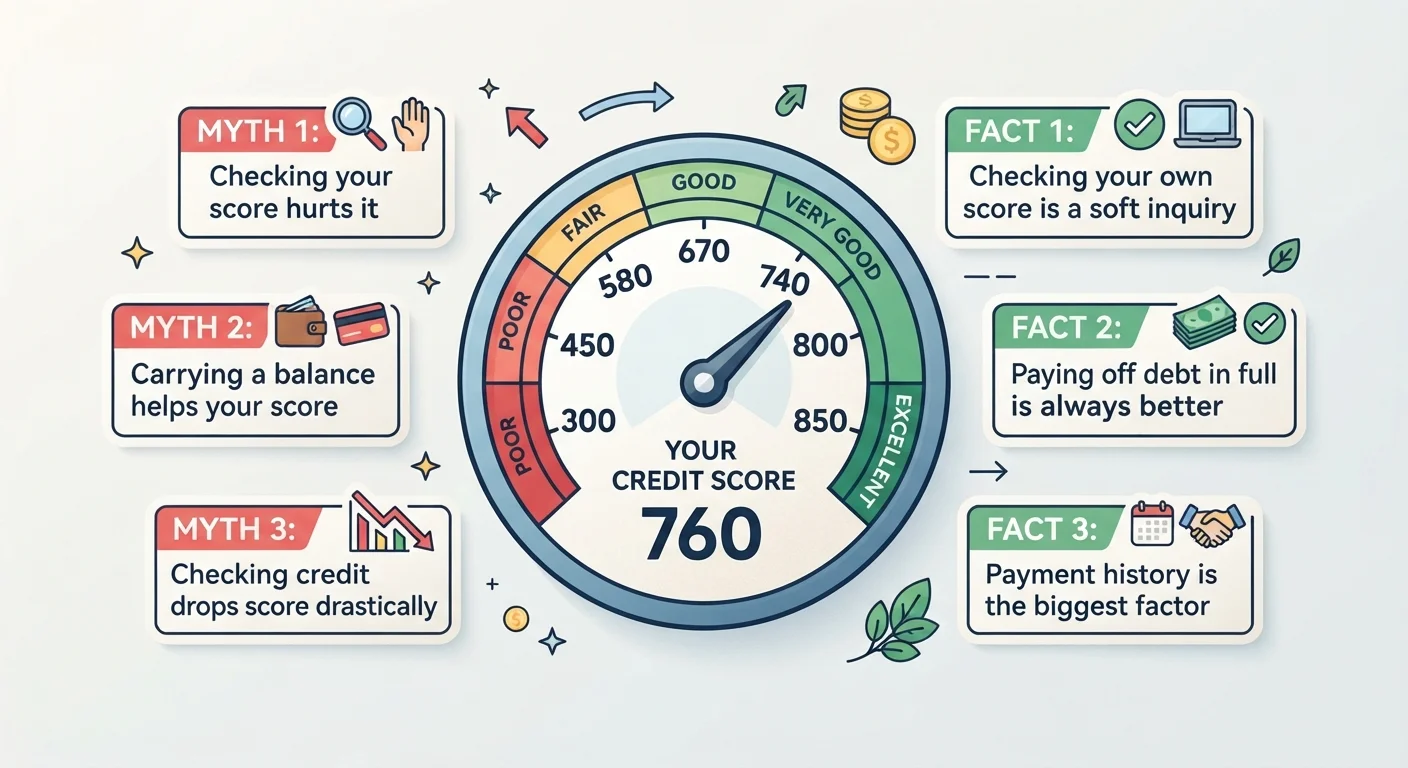
Checking your own credit score will lower it.
Fact
Checking your own score is a "soft inquiry" and has no effect on your credit score whatsoever.
There are two types of credit inquiries. A hard inquiry happens when a lender pulls your credit to evaluate you for a loan or card — this can temporarily lower your score by a few points. A soft inquiry happens when you check your own score, or when a company pre-screens you for an offer. Soft inquiries are invisible to lenders and do not affect your score. Checking your credit regularly is actually encouraged — it helps you catch errors early.
Myth
Closing old credit cards you no longer use is always the responsible thing to do.
Fact
Closing old cards can hurt your score by reducing your available credit and shortening your average account age.
Two important scoring factors are at play here. First, credit utilization — the percentage of your total available credit that you're using. Close a card, and your available credit drops, which can push that percentage up even if your spending stays the same. Second, older accounts help establish a longer credit history, which scoring models generally reward. Before closing a card, weigh those effects against any annual fee you're trying to avoid.
Myth
You need to carry a balance on your credit card to build credit.
Fact
Paying your balance in full each month is just as good for your score — and saves you interest charges.
This myth may have started as a misunderstanding of how credit activity gets reported. Lenders do report your account activity to credit bureaus, but they care whether you pay on time and how much of your limit you're using — not whether you leave a balance unpaid. Carrying a balance doesn't signal responsibility; it just costs you money in interest. Paying in full, on time, every month is the most effective and least expensive way to build a solid payment history.
Myth
You need a perfect 850 credit score to get the best rates.
Fact
Most lenders treat scores above roughly 760 the same — you don't need a perfect score to qualify for top-tier terms.
Credit score ranges vary slightly by scoring model, but lenders typically group applicants into tiers rather than evaluating each point individually. Once you're in the top tier — generally somewhere above 750–760 — improving further usually doesn't change the rate or terms you're offered. Chasing perfection can also lead to overcorrection, like keeping too many accounts open for no real purpose. A consistently good score matters far more than a flawless one.
Myth
Paying off a debt removes it from your credit report immediately.
Fact
Paid debts, including negative items like late payments, can remain on your credit report for up to seven years.
Paying off a debt is unquestionably the right move, and it does update the account status to show it's paid. But the record of the account — including any late payment history attached to it — stays on your report. Negative items such as missed payments or collections generally remain for seven years from the date of the original delinquency, regardless of whether the balance is settled. The impact of those items does diminish over time, but they don't disappear the moment you pay.
What These Myths Cost You in Practice
Getting these things wrong has real consequences. Closing cards to look more responsible, avoiding credit entirely to stay safe, or dutifully carrying a balance every month — these habits can quietly drag a score down over months or even years. For a deeper look at patterns that erode credit without obvious warning signs, see things that quietly damage your credit without you noticing.
35%
Portion of FICO score tied to payment history
According to FICO, payment history is the single largest factor in a standard FICO credit score calculation.
30%
Portion of FICO score tied to credit utilization
FICO identifies amounts owed — including utilization ratio — as the second-largest scoring factor, making card balance management especially impactful.
The good news is that once you understand the factors that actually shape your score, it becomes much easier to make decisions that move in the right direction. Most score improvements come from consistent, undramatic habits: paying on time, keeping balances low relative to your limits, and leaving older accounts open unless there is a concrete reason to close them.
One Myth Can Undo Months of Progress
Acting on a single credit myth — like closing your oldest card or intentionally carrying a balance — can undo months of careful score-building. Credit scoring models don't reward effort or intention; they reflect your actual account behavior. Before making any significant change to how you manage credit, it's worth understanding how that specific action is likely to be scored. When in doubt, consult a nonprofit credit counselor or a licensed financial professional.
This article is for general informational and educational purposes only and does not constitute financial or legal advice. For guidance specific to your situation, consult a qualified financial professional.