What Each Conditioner Actually Does
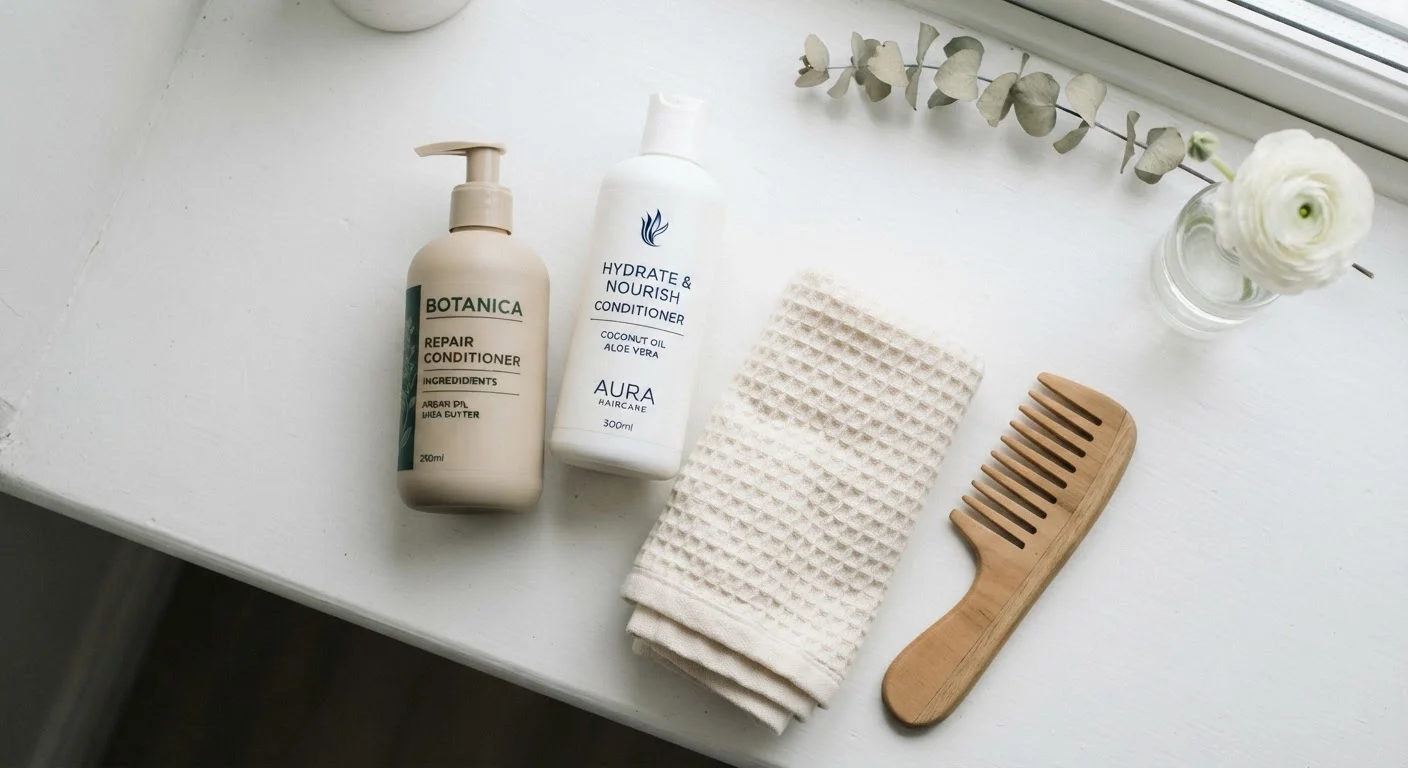
Conditioner is a broad term, and not all formulas work the same way. Understanding what each type is designed to do — and why — is the clearest first step for any beginner.
Leave-in conditioner is a lighter formula applied to freshly washed, damp hair and left on without rinsing. Its job is to deliver a sustained layer of moisture and slip (the quality that makes hair easier to comb through) throughout the day. Because it stays on the hair, it also forms a light protective barrier against environmental stressors like wind, humidity, and heat. If you struggle with detangling, a leave-in is often the solution — see our guide on detangling without breakage for more technique tips.
Deep conditioner, sometimes called a hair mask, is a concentrated treatment packed with proteins, emollients, or humectants (ingredients that attract water). It is applied to clean, damp hair and left on for a set period — typically 15 to 30 minutes — before being fully rinsed out. During that window, the formula is designed to penetrate the hair shaft more deeply than a standard rinse-out conditioner, replenishing lost moisture and reinforcing weakened strands.
Think of it this way: a leave-in maintains, while a deep conditioner restores.
| Criterion | Leave-In Conditioner | Deep Conditioner |
|---|---|---|
| Rinsed out? | No — stays in hair | Yes — fully rinsed after use |
| Frequency of use | Every wash day (or daily) | Weekly or bi-weekly |
| Primary purpose | Daily moisture and detangling | Intensive repair and replenishment |
| Formula weight | Lightweight, often liquid or mist | Thick and creamy or mask-like |
| Application timing | Applied, then style immediately | Left on 15–30 minutes, then rinsed |
| Best for | Frizz control, softness, protection | Damage repair, elasticity, dryness |
| Works on scalp? | Typically applied mid-length to ends | Root to ends, then fully rinsed |
How to Know Which One Your Hair Needs Right Now
Most people benefit from both products — they complement each other rather than compete. However, knowing when to prioritise each one depends on your hair's current condition.
Hair porosity is one useful guide. Porosity describes how readily your hair absorbs and retains moisture. High-porosity hair (often the result of heat damage or chemical processing) tends to absorb products quickly but loses moisture just as fast — making regular deep conditioning especially valuable. Low-porosity hair resists product absorption, so a lightweight leave-in is often more practical for daily use. You can read more about understanding your hair's baseline condition in our pre-routine hair health check.
Signs your hair is calling for a deep conditioner:
- Strands feel brittle, rough, or straw-like after washing
- You notice increased breakage when brushing or styling
- Hair has been recently bleached, coloured, relaxed, or permed
- Heat tools are used frequently without heat protection
Signs a leave-in conditioner is what you need daily:
- Hair becomes frizzy or dry within hours of washing
- Combing through damp hair causes tangles and resistance
- You want a simple daily product that requires no timing or rinsing
95%
Of hair damage linked to mechanical stress
Research consistently identifies combing and brushing dry, unprotected hair as the leading source of preventable strand breakage.
15–30 min
Ideal deep conditioning contact time
Most hair care professionals recommend this window as sufficient for conditioner ingredients to penetrate the cortex without over-softening the strand.
3 types
Core hair porosity categories
Hair is broadly classified as low, medium, or high porosity — a key factor in deciding how often and which conditioning treatments are needed.
It is worth noting that the distinction between leave-in conditioners and deep conditioners parallels a broader concept in hair and skin care — the difference between maintaining current moisture and actively replenishing what has been lost. For a related breakdown, our article on hydration vs. moisturisation explores why these terms matter.
How to Use Each One Correctly
Application method matters as much as the product itself. Using either conditioner incorrectly can reduce its effectiveness or weigh hair down unnecessarily.
Leave-In Conditioner: Step by Step
- After shampooing, gently squeeze excess water from hair — do not rub with a towel.
- Apply the leave-in to damp (not dripping wet) hair, working from mid-lengths to ends. Avoid the scalp unless the formula specifically instructs otherwise.
- Use a wide-tooth comb or fingers to distribute evenly, then style as usual.
- No rinsing needed — the product stays in.
Deep Conditioner: Step by Step
- Shampoo hair first to remove build-up so the treatment can penetrate effectively.
- Apply a generous amount from roots to ends on damp hair.
- Cover with a shower cap or warm towel for 15–30 minutes. Gentle heat (from a hooded dryer or simply a warm room) can help the formula absorb more readily.
- Rinse thoroughly with cool water, which helps close the hair cuticle and lock in the treatment's effects.
- Follow with your leave-in conditioner once hair is towel-dried to damp.
For a full picture of how these steps fit into your overall wash routine, see our beginner hair care routine guide.
This article is for general informational purposes only. Individual hair care needs vary — if you have a scalp condition or significant hair loss concern, consult a qualified dermatologist or trichologist for personalised guidance.