Why Your Gateway City Shapes Your Entire South America Experience
Most first-time visitors to South America default to Buenos Aires or Rio de Janeiro — and honestly, who could blame them? Those cities have earned their reputations. But the continent stretches across an extraordinary range of climates, cultures, and landscapes, and your entry point sets the tone for everything that follows.
Choosing a less-obvious gateway doesn't mean sacrificing convenience. Several South American cities now receive direct flights from major US hubs, offer solid tourism infrastructure, and serve as springboards to remarkable regions that the Buenos Aires crowd often never reaches. Whether you're drawn to Andean landscapes, Pacific coastlines, Caribbean history, or cutting-edge urban food scenes, there's an entry city perfectly tuned to your interests.
The cities below have each earned standout reputations on their own terms — not just as stopovers, but as genuine destinations worth savoring before you venture further.
Medellín, Colombia — The City That Reinvented Itself
Once a cautionary tale, Medellín has completed one of the most remarkable urban transformations in the Western Hemisphere. Today, it's a city of cable cars, botanical gardens, world-class street art, and a food scene that locals are quietly very proud of. The El Poblado and Laureles neighborhoods are both beginner-friendly, walkable, and packed with cafés and hostels geared toward first-time visitors.
Medellín sits in a valley in the Andes at roughly 5,000 feet above sea level, giving it an eternally springlike climate that locals call la ciudad de la eterna primavera — the city of eternal spring. Direct flights connect several US cities to Medellín's José María Córdova International Airport, making it an increasingly practical entry point. From here, the Coffee Region (Eje Cafetero) and the Caribbean coast are both within easy reach.
Medellín's spring-like climate and reinvented urban culture make it one of South America's most compelling first stops.
Lima, Peru — A World-Class Food City at the Edge of the Pacific
Lima doesn't always get the attention it deserves, but food travelers have known the secret for years: this city is widely considered one of the great culinary capitals of the world. Ceviche, lomo saltado, and causa are just the beginning of what the local restaurant scene has to offer at every price point imaginable.
Beyond the food, Lima's Miraflores district sits dramatically on clifftops overlooking the Pacific, and the historic Centro Histórico — a UNESCO World Heritage Site — offers centuries of colonial architecture to explore. Jorge Chávez International Airport receives direct flights from several US cities and serves as the natural jumping-off point for Machu Picchu, the Amazon basin, and the Nazca Lines. Lima also tends to be more affordable than you might expect for a city of its caliber.
Lima's UNESCO-listed historic center and legendary food scene reward travelers long before they ever board a connecting flight.
Cartagena, Colombia — Caribbean Color on the South American Coast
Cartagena sits on Colombia's Caribbean coast and operates at a completely different tempo than the Andean cities. Its Walled City (Ciudad Amurallada) — another UNESCO World Heritage Site — is a maze of bougainvillea-draped colonial buildings, cobblestone streets, and open plazas that reward slow, unhurried wandering. Evenings here involve salsa drifting out of doorways and sunset views from the fortified walls.
This is a strong choice for travelers who want a warm-weather, beach-adjacent introduction to South America without sacrificing history or cultural richness. Rafael Núñez International Airport connects to several US cities via direct or one-stop flights. From Cartagena, the nearby Rosario Islands and the lesser-visited Sinú River region are both accessible day trips or short extensions.
Cartagena's UNESCO Walled City offers one of the most visually stunning introductions to South American colonial history.
Santiago, Chile — A Modern Gateway to Extraordinary Landscapes
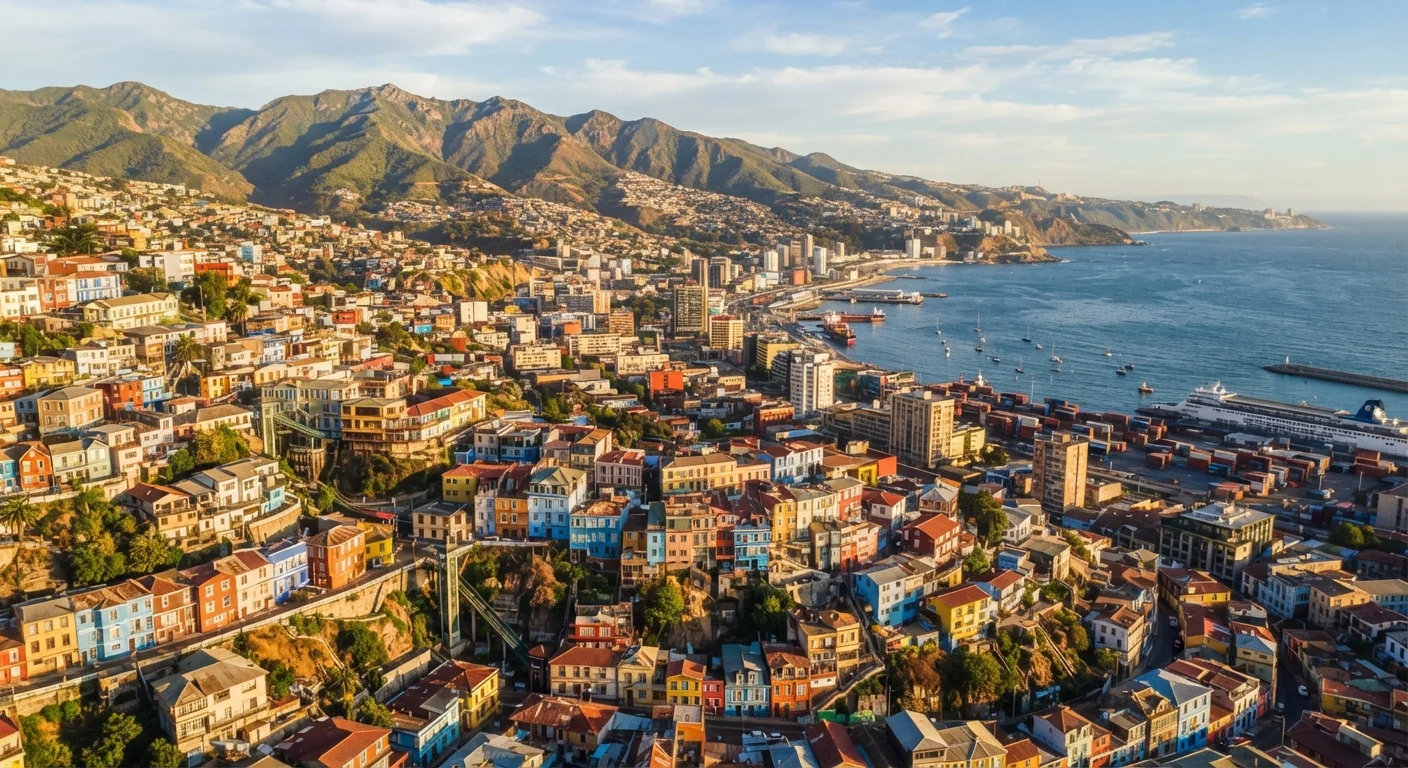
Santiago is South America's most underappreciated major city — polished, safe for first-timers by most accounts, and surrounded by landscapes that are almost surreally diverse. On a clear day, the snow-capped Andes are visible from the city center. Within a few hours, you can be skiing in Valle Nevado, wine-tasting in the Maipo Valley, or standing on the Pacific coast at Valparaíso — a riot of colorful hillside homes and street murals.
Arturo Merino Benítez International Airport is one of the best-connected airports on the continent, with numerous US departure cities offering direct routes. Santiago itself has a sophisticated dining and arts scene centered around neighborhoods like Lastarria and Barrio Italia. For travelers planning to explore Patagonia, Easter Island, or the Atacama Desert, Santiago is the essential hub.
Santiago puts Andean peaks, Pacific beaches, and world-class wineries all within a few hours of each other.
Bogotá, Colombia — Altitude, Art, and Andean Energy
At nearly 8,700 feet above sea level, Bogotá asks something of visitors right away: slow down and let your lungs adjust. Give it a day, and the altitude payoff becomes clear — this high-altitude capital is one of the most culturally dense cities on the continent. The Gold Museum (Museo del Oro) alone contains thousands of pre-Columbian gold artifacts and is considered one of the finest museums in Latin America.
The La Candelaria neighborhood is a living museum of colonial architecture, street art, and independent bookshops. Bogotá's El Dorado International Airport is one of the busiest on the continent and receives direct flights from numerous North American cities, often at competitive fares. It's also a practical hub for travelers heading to Colombia's Pacific coast or deeper into the Amazon.
Bogotá's Gold Museum and La Candelaria neighborhood offer a crash course in thousands of years of South American history.
Planning Your Arrival: A Few Things Worth Knowing First
No matter which city you choose as your entry point, a little preparation goes a long way. South America spans multiple time zones, and each country has its own entry requirements — some nationalities need visas, others don't. Always check the official embassy or consulate website for your destination country before you book, and verify requirements again close to your departure date, since policies can change.
Give Yourself a Full Day in Your Gateway City
Even if your ultimate destination is elsewhere — Machu Picchu, Patagonia, the Amazon — resist the urge to treat your entry city as just a transfer point. Arriving a day early lets you acclimate, explore, and shake off jet lag before moving on. It also provides a buffer if flights are delayed or luggage is slow. Many first-time South America travelers say their gateway city ended up being a highlight of the entire trip.
Currency is another consideration: most of these cities have reliable ATM networks in tourist areas, but carrying a small amount of local currency upon arrival reduces stress during those first few hours. Airport exchange counters typically offer less favorable rates, so use them only as a last resort.
Whichever gateway you choose, you're in for a genuinely thrilling start. South America has a way of exceeding expectations — and arriving somewhere a little unexpected only adds to the magic.