
What Mood Tracking Actually Is
Mood tracking is the practice of regularly recording how you feel — usually once or a few times a day — so you can observe patterns over time. It is not therapy, diagnosis, or treatment. It is simply data collection about your own emotional experience.
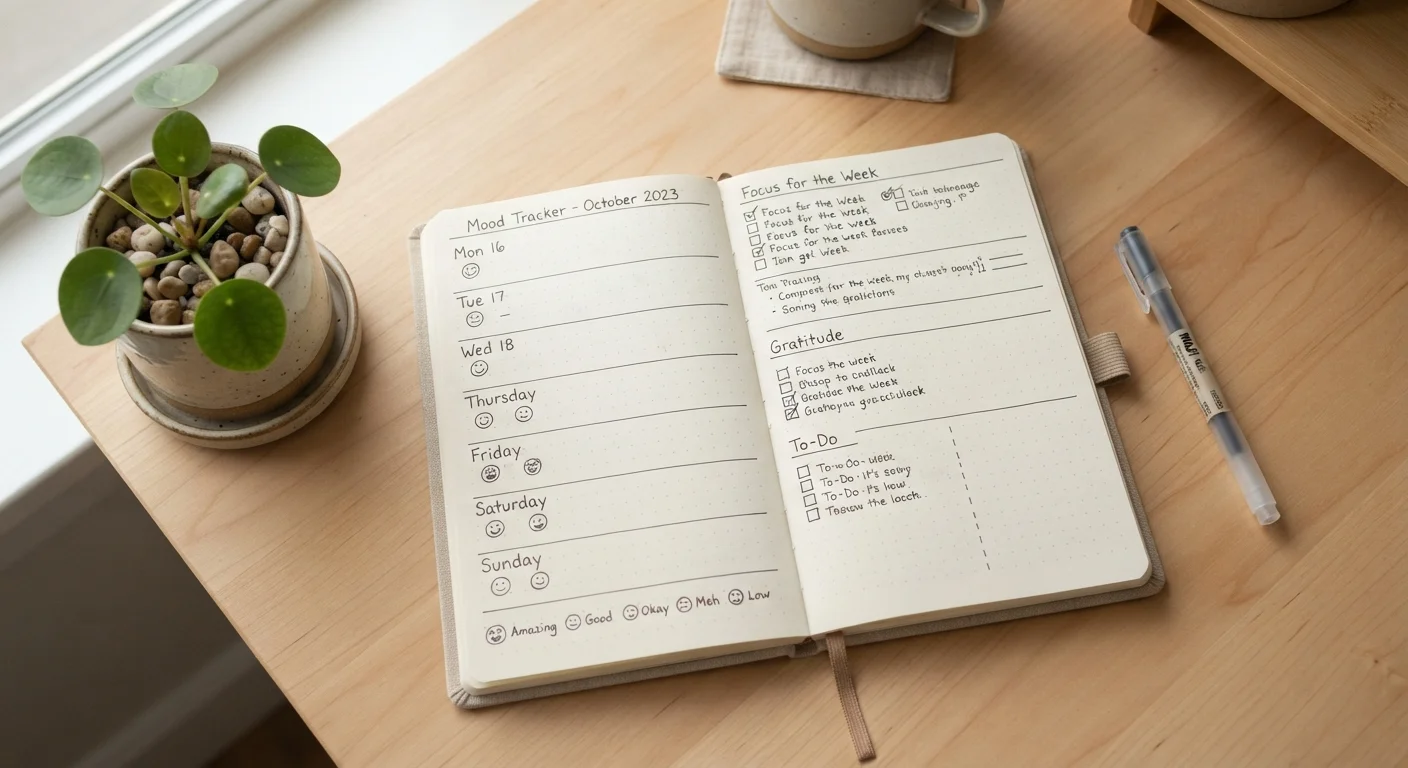
People track mood in many forms: a number on a scale of 1–10, a single word ("anxious," "calm," "energized"), an emoji, or a short written note. Some use dedicated apps; others prefer a plain notebook or a simple spreadsheet. The format matters less than the consistency.
The core idea is that any single moment of feeling gives you limited information, but a series of recorded moments across days or weeks starts to reveal something more useful — context, repetition, and change. Much like tracking what works in a daily routine, mood logs make it easier to spot what's helping and what isn't.
Why People Choose to Track Their Mood
There are several distinct reasons someone might start mood tracking, and they don't all look the same in practice.
Self-awareness and pattern recognition
The most common motivation is simply curiosity. Many people are surprised to notice, once they look at two or three weeks of entries, that their mood dips reliably on Sunday evenings, or lifts after physical activity, or drops during low-sleep stretches. These patterns are nearly invisible without some kind of record.
Supporting conversations with healthcare providers
For people managing depression, anxiety, bipolar disorder, or other conditions, a mood log can provide their clinician with concrete, timestamped information instead of a subjective recall of "how things have been." Many mental health professionals actively encourage it for this reason. Mood tracking is not a substitute for professional care — it is a tool that can support it.
Identifying triggers and lifestyle factors
Tracking mood alongside notes about sleep, diet, exercise, or social activity can surface connections that would otherwise stay hidden. This overlaps with the broader value of self-monitoring described in research on journalling for mental clarity. Tracking gives that reflective practice a structured, comparable format.
~20%
Adults in the US experiencing a mental illness in a given year
According to the National Institute of Mental Health (NIMH), mental illness is common — making self-monitoring tools like mood tracking broadly relevant.
Weeks to months
Time typically needed to surface meaningful mood patterns
Mental health researchers generally note that short-term logs (a few days) rarely reveal reliable trends; consistency over longer periods is what yields useful insight.
Limitations and What to Watch For
Mood tracking is a useful habit for many people, but it has real limitations worth knowing before you start.
Mood tracking
The habit of recording your emotional state at regular intervals to observe patterns over time. It is a self-monitoring tool, not a clinical procedure.
Affect
A broad psychological term for the experience of feeling or emotion. Mood is a sustained form of affect, distinct from short-lived emotional reactions.
Ecological momentary assessment (EMA)
A research method in which participants record their thoughts, feelings, or behaviors multiple times a day in real time. Many mood-tracking apps are inspired by this approach.
Rumination
Repetitively focusing on distressing thoughts or feelings without moving toward resolution. Excessive self-monitoring can sometimes feed rumination rather than reduce it.
- Recall bias: If you log at the end of the day, you may unconsciously weight the last few hours over the full day.
- Over-monitoring: Some research suggests that for people prone to health anxiety or rumination, very frequent checking can amplify distress rather than reduce it. If tracking starts to feel like a burden or increases worry, it is worth stepping back.
- False precision: A number like "6 out of 10" feels objective, but it reflects a judgment call. Scores aren't comparable across different people and may not even be stable within the same person over months.
- Not a diagnostic tool: A pattern in your mood log doesn't constitute a diagnosis. If your entries consistently reflect low mood, hopelessness, or other concerning patterns, that's a reason to speak with a qualified mental health professional — not to self-diagnose.
Mood tracking works best when treated as one input among many, not as a definitive account of your mental health. The same principle applies to everyday habits that support emotional wellbeing — no single tool or habit does everything on its own.
This article is for general informational purposes only and is not a substitute for professional medical or mental health advice. If you have concerns about your mood or mental health, please speak with a qualified healthcare provider.