The Five Signs of Hair Damage (and What Each Means)
Hair damage isn't one single thing — it's a range of structural changes that show up differently depending on the cause. Here's what to look and feel for.
| Most visible damage sign | Split ends (trichoptilosis) |
| Common heat damage threshold | Above 230°C (450°F) accelerates protein breakdown (Journal of Cosmetic Science research) |
| Normal daily hair shedding | 50–100 strands per day (American Academy of Dermatology) |
| Primary structural protein in hair | Keratin |
| Key damage amplifier | Combining chemical treatments with high heat |
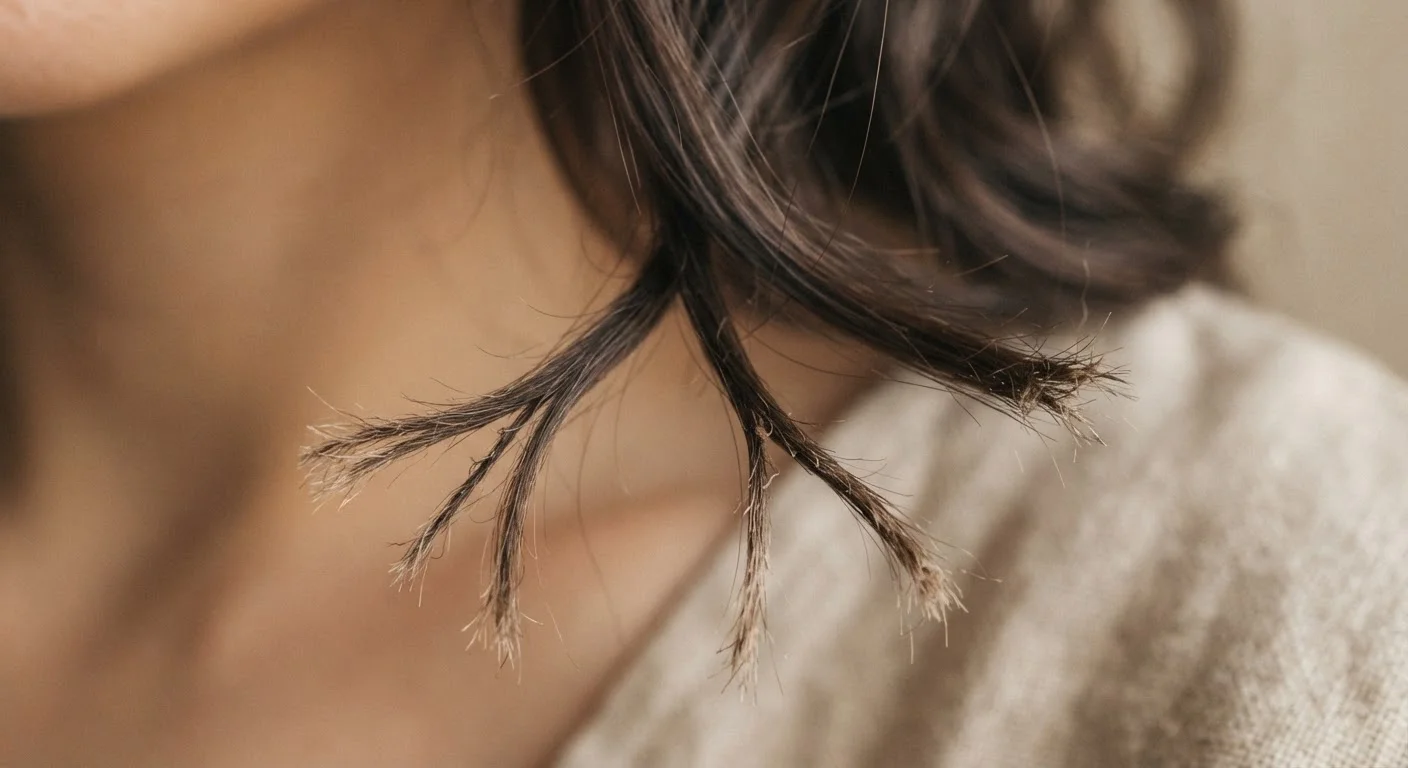
- Split ends
- The cuticle at the tip has completely worn away, allowing the inner cortex to fray. They feel rough and look frayed or Y-shaped at the end of the strand.
- Dullness and lack of shine
- Healthy hair reflects light off a smooth, flat cuticle. Raised or chipped cuticle scales scatter light instead, making hair look lifeless.
- Mid-shaft breakage
- Short, snapped pieces in your brush — not full-length strands — signal the inner cortex is compromised. This is common after chemical or repeated heat damage.
- Excessive tangling
- Rough, lifted cuticles snag on each other, creating knots. If hair tangles far more than it used to, cuticle integrity has declined.
- Low elasticity
- Wet a single strand and gently stretch it. Healthy hair stretches up to 30% and springs back. If it snaps immediately or stays elongated, the moisture-protein balance inside the cortex is off.
Damage vs. Shedding: Know the Difference
Finding hair in your brush doesn't always mean damage. Shed hairs typically have a small white or translucent bulb at the root end, indicating the follicle completed its growth cycle naturally. Broken hairs are shorter, tapered at both ends, and have no bulb. Checking for the bulb is the quickest way to tell the two apart.
What Actually Causes Hair Damage
Most damage falls into three categories: mechanical (physical force), thermal (heat), and chemical (products or treatments that alter structure). Many people deal with more than one simultaneously, which is when damage accelerates.
Cuticle
The outermost protective layer of a hair strand, made up of overlapping scales. When the cuticle is smooth and flat, hair looks shiny; when it's raised or broken, hair appears dull and rough.
Porosity
Hair's ability to absorb and retain moisture, determined by how open or closed the cuticle layer is. High-porosity hair absorbs moisture quickly but loses it just as fast.
Hygral fatigue
Weakening of the hair fiber caused by repeated swelling (when wet) and contracting (when dry). Over time, this cycle makes strands more prone to breakage.
Elasticity
A healthy hair strand's ability to stretch and return to its original shape without snapping. Low elasticity is a sign of protein or moisture imbalance inside the hair shaft.
Split end (trichoptilosis)
The splitting of a hair fiber at or near the tip due to worn-away cuticle. Once split, the damage can travel up the strand if left untrimmed.
Breakage
Snapping of a hair strand mid-shaft rather than at the root. Breakage is distinct from normal shedding, which releases the whole strand including a small white bulb at the root end.
Mechanical Damage
Brushing or combing aggressively — especially when hair is wet and most elastic — causes breakage. Tight hairstyles that put constant tension on the shaft and follicle weaken the fiber over time. See our guide to detangling without breakage for techniques that reduce this risk significantly.
Thermal Damage
Heat tools (flat irons, curling wands, blow dryers) temporarily soften keratin bonds to reshape the strand. Repeated high-heat exposure degrades those bonds permanently. Water trapped inside the shaft during heat styling can also cause internal bubbling — a condition visible under a microscope called bubble hair.
50–100
Strands shed daily (normal range)
According to the American Academy of Dermatology, losing this many strands per day is considered part of a healthy hair growth cycle.
230°C+
Temperature where protein breakdown accelerates
Research published in the Journal of Cosmetic Science indicates that sustained heat above this threshold significantly degrades keratin bonds.
Chemical Damage
Bleaching, permanent color, relaxers, and perms all work by breaking and reforming chemical bonds in the hair's cortex. Each process raises porosity, and combining multiple chemical treatments without recovery time compounds the stress significantly. Environmental factors — UV radiation, hard water mineral deposits, and chlorine — are slower-acting but cause measurable cuticle erosion over time.
Understanding which type of damage you're seeing helps you address the right cause. Before building any styling routine, it's worth doing a full pre-routine hair health check to baseline where your hair currently stands. If you're unsure of your hair type, learning the 1A–4C typing system can also guide more appropriate tool and product choices.
This article is for general informational purposes only and is not a substitute for professional advice from a licensed cosmetologist or dermatologist. If you are experiencing significant hair loss or scalp concerns, consult a qualified healthcare professional.