
The Alarm System: How Your Brain Detects a Threat
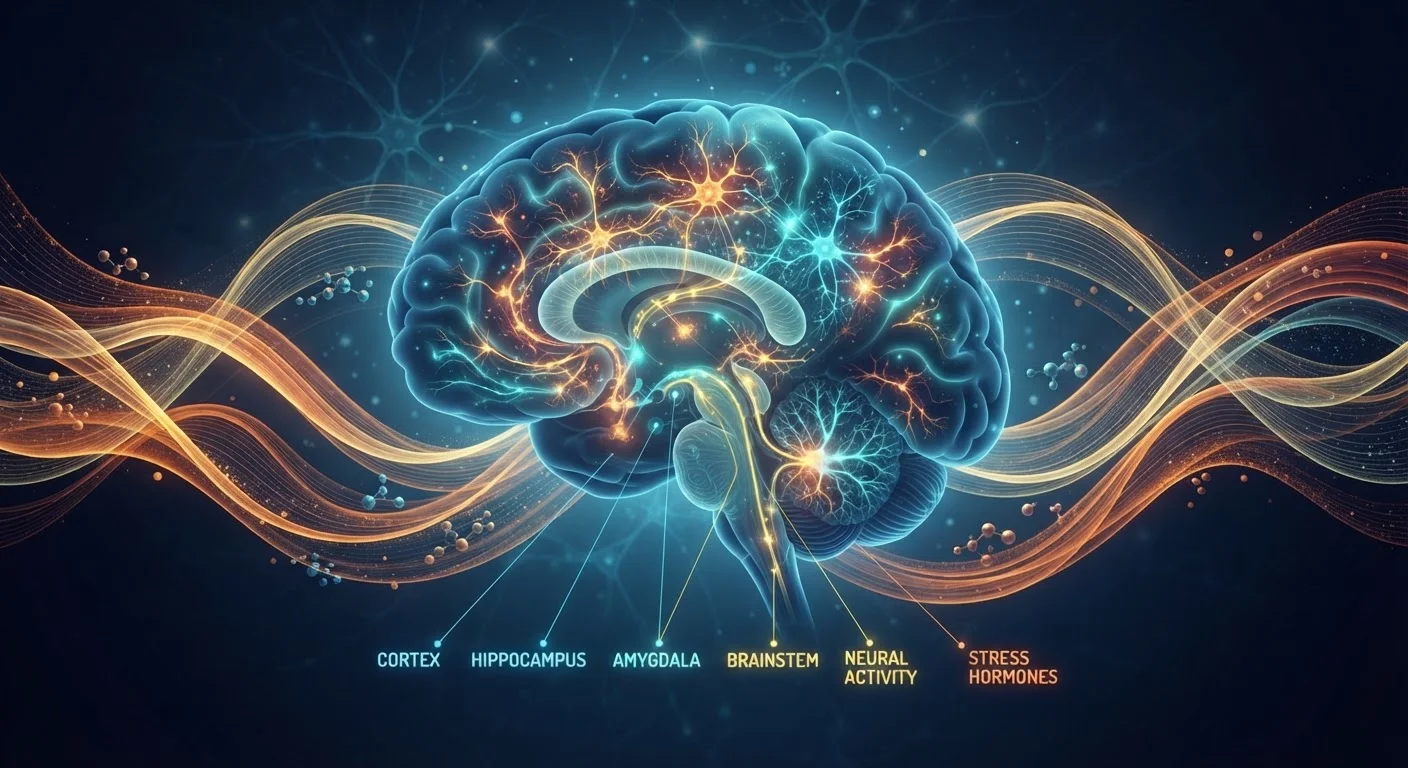
Stress begins with perception. Before you've consciously registered what's wrong, a small, almond-shaped structure deep in your brain called the amygdala has already flagged the situation as a potential threat. Think of it as your brain's smoke detector — fast, automatic, and designed to err on the side of caution.
The amygdala sends an emergency signal to the hypothalamus, which acts like a command center, wiring together your brain and body. The hypothalamus then activates the sympathetic nervous system — the branch responsible for mobilizing your body for action. This happens in milliseconds, before your thinking brain has had time to weigh in.
What follows is the well-known fight-or-flight response: a cascade of physical changes designed, evolutionarily speaking, to help you escape a predator or confront a danger. The same mechanism fires whether the trigger is a wild animal or a stressful email.
Not All Stress Is Harmful
Researchers distinguish between acute stress — short-lived and often motivating — and chronic stress, which persists over time. A moderate stress response before a job interview or athletic event can actually sharpen focus and performance. It's the prolonged, unrelenting activation of the stress system that poses risks to health. This distinction matters: feeling stressed occasionally is a normal part of being human, not a problem to eliminate.
The Chemical Flood: Adrenaline and Cortisol
Two hormones do most of the heavy lifting in a stress response.
Adrenaline (epinephrine) is released almost immediately from the adrenal glands, which sit atop your kidneys. It raises your heart rate, increases blood pressure, and diverts blood toward your muscles. Your pupils dilate, your breathing quickens, and your senses sharpen. Your body is now primed for rapid physical action.
Seconds to minutes later, the hypothalamic-pituitary-adrenal (HPA) axis kicks in. The hypothalamus signals the pituitary gland, which in turn signals the adrenal glands to release cortisol. Cortisol sustains the stress response over a longer period — keeping blood sugar elevated for energy and temporarily suppressing systems the body considers non-essential in a crisis, such as digestion and immune activity.
~30 seconds
Time for adrenaline to reach peak effect
The initial adrenaline surge following a perceived threat can reach its physical peak within roughly 30 seconds, according to general endocrinology literature.
20–30 minutes
Time for cortisol to return toward baseline
After an acute stressor ends, cortisol levels typically begin declining within 20 to 30 minutes, though individual variation is significant.
77%
Adults who experience physical stress symptoms
According to the American Psychological Association's Stress in America surveys, a large majority of U.S. adults report experiencing physical symptoms related to stress.
Once the threat has passed, cortisol levels should gradually return to baseline. The body's built-in off-switch, the parasympathetic nervous system, takes over — slowing the heart, resuming digestion, and restoring calm.
What Chronic Stress Does to Brain Structures
A single stressful event is something your brain and body are well-equipped to handle. The problem arises when stress is persistent and the HPA axis stays activated for weeks or months at a time.
The hippocampus — involved in memory formation and emotional regulation — is especially sensitive to prolonged cortisol exposure. Research suggests chronic stress can affect the hippocampus's structure and function, which may help explain why people under long-term stress often report difficulty concentrating or remembering things clearly. For more on how sleep interacts with memory and stress recovery, see our explanation of what happens during sleep.
The prefrontal cortex — the brain's decision-making and reasoning center — can also be affected, making it harder to think clearly or regulate emotions under sustained pressure. Meanwhile, the amygdala may become more reactive, lowering the threshold for triggering future stress responses. Social isolation can compound these effects; research on loneliness and the mind shows that disconnection has measurable effects on stress-related brain systems.
Slow Breathing Engages Your Off-Switch
Deliberate slow exhalations activate the parasympathetic nervous system, which counteracts the fight-or-flight response. Breathing out for longer than you breathe in — for example, inhaling for four counts and exhaling for six — signals to your brain that the threat has passed. This is one of the fastest evidence-informed ways to begin calming a stress response in the moment.
Why This Knowledge Matters
Understanding the biology of stress does something important: it normalizes the experience. The racing heart, the inability to focus, the tight chest — these are not character flaws or signs of weakness. They are the output of a finely tuned survival system doing exactly what it was built to do.
Knowing that stress is a brain-driven physiological process also opens the door to working with it more skillfully. Practices like slow breathing directly engage the parasympathetic nervous system, signaling to your brain that the threat has passed. Regular movement helps regulate baseline cortisol levels over time. Good sleep allows the brain to process and recover from daily stress loads.
If your stress feels persistent, disproportionate, or is getting in the way of daily life, that is worth a conversation with a healthcare professional. See signs your stress may be worth discussing with a doctor to understand when it's time to seek support.
This article is for general informational and educational purposes only and is not a substitute for professional medical advice, diagnosis, or treatment. Always consult a qualified healthcare provider with questions about your health.